Unit 13 Planets
This article explores the definition of a planet as per the International Astronomical Union, highlighting the distinction between the old and new definitions. It discusses the formation of planets through the nebular hypothesis, explaining the early solar system's evolution from a dust cloud. The planets are categorized into two groups: Rocky (Terrestrial) and Gas Giants (Jovian), detailing their characteristics. Each planet, from Mercury to Jupiter, is briefly described, focusing on surface conditions, atmospheres, and notable features.

Unit 13 Planets
E N D
Presentation Transcript
Old Definition • A planet is a body that orbits a star, shines by reflecting the star's light and is larger than an asteroid.
New Definition The International Astronomical Union (IAU), defines a planet as an object that orbits a star, is large enough to have settled into a round shape and, crucially, "has cleared the neighborhood around its orbit."
How did they form? • Remember the nebular hypothesis? • Our solar system started 4.6 billion years ago as a cloud of dust rotating in space. • 10% of the cloud made up the platelike disk around the sun. • As the cloud spun large pieces of debris would collide to form planetesimals.
What are the 2 groups? • Rocky
Terrestrial (Inner-Rocky) • Rocky crust • Dense mantle layers • Very dense cores
Jovian (Outer-Gas Giants) • Much larger • No solid surfaces • Mainly hydrogen and helium • They all have rings
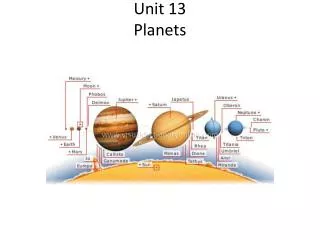
Mercury • Closest to the Sun • No atmosphere • Surface temp between -280oF and +800oF • Hot enough to melt lead and zinc • Almost cold enough for liquid oxygen to form • Day is nearly 59 days long • Year is 88 days
Venus • Hotter than Mercury, even though almost twice as far from the Sun • Its day (243 days) is longer than its year (224 days • Atmosphere is about 96% CO2 • Air pressure 90 times that of Earth • Sulfuric acid clouds
Earth • Only planet with chocolate • Only planet with liquid water • Only known life, so far, in the solar system
Mars • A bit more than half the diameter of Earth • Surface area a bit less than land mass of Earth • Day is about 24.5 hours, Year about 22.5 months • Atmosphere less than 1% of Earth’s • 2 moons • Phobos, average diameter, 13.8 miles • Deimos, average diameter, 7.8 miles
Jupiter • King of the planets • Weighs more than all the other planets combined • Over 1300 Earths could fit inside • Magnetic field is 20,000 times Earth’s • Nearly 90% hydrogen • At least 63 moons
Moons of Jupiter • Biggest moon, Ganymede, larger than Mercury • Europa, bigger than Pluto, nearly as large as the Moon • Io, most volcanically active body in the solar system. Larger than the Moon • Callisto, almost as large as Mercury • These 4 moons were discovered by Galileo