
SlideServe
Menu
Préférences
© SlideServe · v2026

Understanding ROI, Break-Even Point, Markup, and Discounts in Business

egan avatar
10 diapositives · 255 Views · Jul 20, 2014

This guide explores key financial concepts crucial for businesses, including Return on Investment (ROI), Break-Even Point, and Markup calculations. Learn how to calculate profitability with ROI, identify the break-even sales volume where costs equal revenue, and differentiate between markup and profit. It also discusses markdowns and discounts to optimize pricing strategies. Understand not just how to calculate these figures, but why they're essential for informed business decision-making. Master these concepts for better financial management and enhanced profitability.
Understanding ROI, Break-Even Point, Markup, and Discounts in Business - slide 1
01 / 10Understanding ROI, Break-Even Point, Markup, and Discounts in Business
1 / 17

Télécharger la présentation

Understanding ROI, Break-Even Point, Markup, and Discounts in Business
Une image / un lien ci-dessous est fourni (tel quel) pour télécharger la présentation

Politique de téléchargement : le contenu du site vous est fourni TEL QUEL pour votre information et votre usage personnel ; il ne peut être vendu, concédé sous licence ni partagé sur d’autres sites sans l’accord de son auteur.Le contenu vous est fourni TEL QUEL, pour votre information et votre usage personnel uniquement. Téléchargez la présentation en cliquant sur ce lien. Lors du téléchargement, si vous ne parvenez pas à télécharger une présentation, l’éditeur a peut-être supprimé le fichier de son serveur.Pendant le téléchargement, si vous ne parvenez pas à obtenir une présentation, le fichier a peut-être été supprimé par l’éditeur.

F I N

Plus de contenu associé

Transcription de la présentation
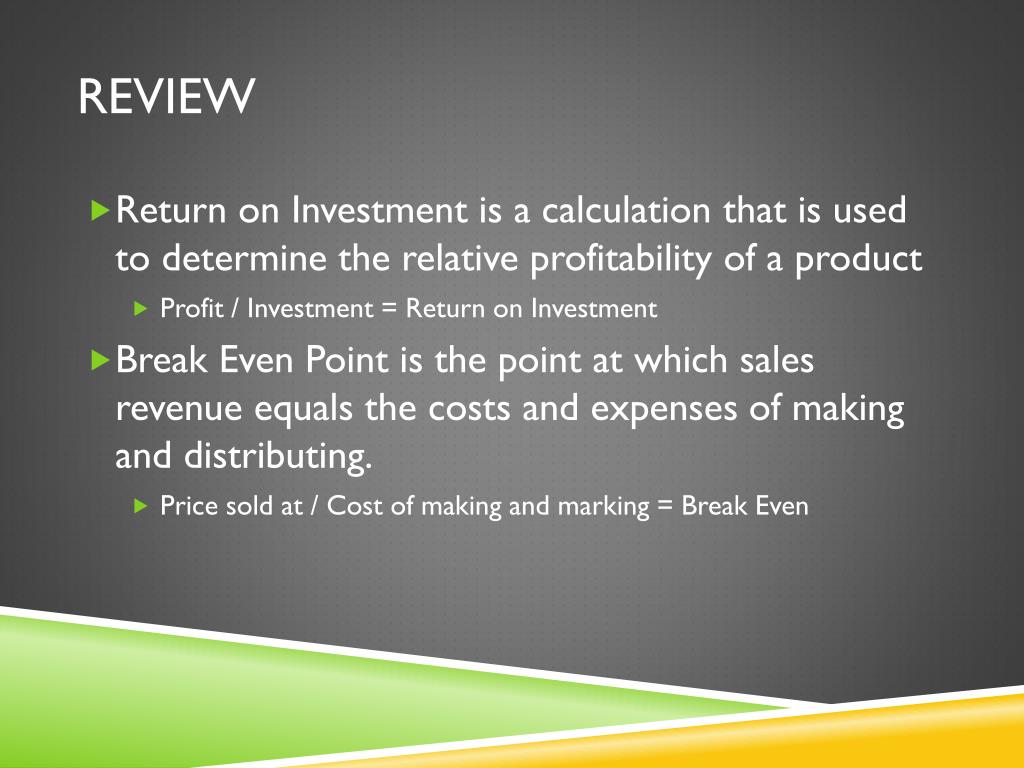
  1. Review • Return on Investment is a calculation that is used to determine the relative profitability of a product • Profit / Investment = Return on Investment • Break Even Point is the point at which sales revenue equals the costs and expenses of making and distributing. • Price sold at / Cost of making and marking = Break Even

  2. Pricing math

  3. Because Everyone takes to long to take notes. • (P) – Price • (D)% - Discount Percent • (D)$ - Discount Dollars • (NP) – Net Price • (SP) – Sales Price • (C) - Cost • (MM)$ - Maintained Markup Dollar • (MM)% - Maintained Markup Percentage • (MD)$ - Markdown Dollar • (MD)% - Markdown Percentage • (MU)$ - Markup Dollar • (MU)% - Markup Percentage

  4. Profit vs.Markup • Basic Markup Calculations • Cost (C) + Markup (MU) = Retail (RP) • Retail Price (RP) – Markup (MU) = Cost (C) • Retail price (RP) – Cost (C) = Markup (MU)

  5. Percentage Markup • Determine the dollar markup • RP – C = MU$ • Change the dollar markup to the percentage markup, divide it by the retail price. Result will be a decimal • MU$/RP = MU% • Change the decimal to a percentage • .40 = 40%

  6. Markup Equivalent table • On page 487

  7. Calculations for lowing prices • Markdowns – Reduce the quantity of goods in stock, a business will sometimes mark down merchandise by a certain percentage. • Retail Price (RP) x Markdown % = (MD)$ • Retail Price (RP) – Markdown$ = Sales Price (SP)

  8. Calculations for lowing prices • Maintained Markup – Different between an item’s final sale price and its cost. • Retail Price (RP) – Markdown$ = Sales Price (SP) • Maintained Markup • SP – C = Maintained Markup (MM)$ • Determine the maintained markup percentage • (MM) $ Divided by SP = (MM)%

  9. discounts • Discount is a reduction in the price of good and services sold to customers. • Multiply the price by the discount percentage to get the dollar amount of the discount • (P) x (D)% = (D)$ • Subtract the discount from the price to get the net price • (P) – (D)$ = NP

  10. Discounts • Cash Discounts is a discount offered to buyers to encourage them to pay their bills quickly • Determine the dollar discount • (P) x (D)% = (D)$ • Determine the net price • (P) – (D)$ = (NP)