Functional Categories of the 600A Corrector for Beam Squeeze and Quadrupole Gradients
The 600A corrector can be categorized into three distinct functions, each relevant to LHC operations. Quadrupole gradients (expressed in [T/m]) are examined across Q1 to Q6 for both beams under different 'b*' conditions, noting smoother responses for main squeezes compared to erratic behaviors in trim quadrupoles QTL11, QT12, and QT13, which fluctuate significantly, especially at key b* values. Essential considerations for acceleration profiles are discussed, including the interplay between current changes and beam dynamics, alongside the implications for operational efficiency and collision avoidance.

Functional Categories of the 600A Corrector for Beam Squeeze and Quadrupole Gradients
E N D
Presentation Transcript
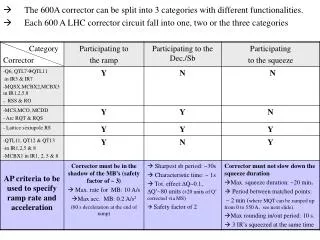
The 600A corrector can be split into 3 categories with different functionalities. Each 600 A LHC corrector circuit fall into one, two or the three categories
Squeeze for the mains in IR1 & IR5 Quadrupole gradient [T/m] from Q1 to Q6 as a function of b*: beam1 (left) and beam2 (right) Rather smooth and/or monotonous (note Q6 going to very low gradient which will be the limiting circuits below b* ~2m ).
Squeeze for the trims QTL11, QT12 and QT13 Quadrupole gradient [T/m] in the trim quadrupoles (QTL11,-QT12,QT13) as a function of b*: beam1 (left) beam2 (right) • More “erratic’’ with big jump at b* ~2m and 5 m, with unavoidable zero-crossing for both beams
Target obtained on dI/dt and d2I/dt2 (guess-estimate in some cases) • 0) : The acceleration means what it means!.. i.e. I(t)=I(0)+(dI/dt) × t + 1/2 × (d2I/dt2 )× t2 • 1) : d2I/dt2 further pushed by a factor of 3 for MO’s (starting of the ramp above 2 TeV not yet defined) and for MQSX,MCBX2 & 3 (requirement during squeeze not yet known if large dynamic b-beating). • 2) : d2I/dt2 could be compromised (reduced) for MCBX1 … but the parallel separation has to be switched off as quickly as possible to bring the beams into collision (to avoid parasitic collision at very small separations during a too long period). Is dI/dt sufficient to warrant a degaussing cycle of the corrector after each fill??