The Legacy of J. Edgar Hoover: Transforming the FBI into a Forensic Powerhouse
J. Edgar Hoover, born on January 1, 1895, in Washington, D.C., was a transformative figure in American law enforcement. After obtaining his law degrees, he joined the Department of Justice, eventually becoming the Director of the Bureau of Investigation at just 29. Under his leadership, the FBI underwent significant reforms, including improved hiring practices and the establishment of the national fingerprint depository and crime laboratory. Hoover’s initiatives solidified the FBI’s role in forensics, earning him accolades like the John A. Dondero Award in 1959. He passed away on May 2, 1972, after leading the FBI for 48 years.

The Legacy of J. Edgar Hoover: Transforming the FBI into a Forensic Powerhouse
E N D
Presentation Transcript
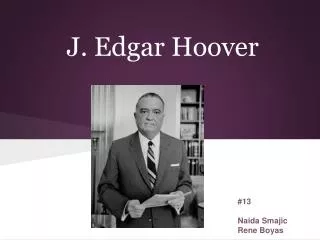
J. Edgar Hoover #13 Naida SmajicRene Boyas
About Hoover He was born on January 1, 1895 in Washington DC.After finishing high school, he started working at the Library of Congress while attending night classes at George Washington University Law School.In 1916, he was awarded his L.L.B and the next year, his L.L.M.He started working with the Department of Justice on July 26, 1917. He led the Department's General Intelligence Division and was named assistant to the attorney general. In 1921, he was named assistant direction of the Bureau of Investigation. He became the Director of the Bureau at 29 years old.As Director, he fired many unqualified agents and ordered background checks, interviews, and physical tests for new applicants. He also revived the policy of requiring legal or accounting training. Under Hoover, the Bureau grew in importance and became a big part of the government. Hoover died on May 2, 1972 in his sleep. He had led the FBI for 48 years.
His contributions to Forensics He changed the FBI for the better, so that it gained responsibility and importance. He rid it of unqualified agents and made a new hiring process with only picked high-quality candidates. Hoover established the FBI's national fingerprint depository and crime laboratory. The crime laboratory would provide forensic analysis on investigations across the country. He made the new fingerprint collection a national resource. Hoover was honored for his contributions to forensic science in 1959 with the John A. Dondero Award from the International Association for Identification.
Bibliography • Edgar J. Hoover . (1961, September 28). Library of Congress Home. Retrieved September 5, 2012, from http://www.loc.gov/pictures/resource/ppmsc.03262/ • FBI — John Edgar Hoover. (n.d.). FBI — Homepage. Retrieved September 5, 2012, from http://www.fbi.gov/about-us/history/directors/hoover • Lerner, E. K., & Lerner, B. W. (n.d.). Hoover, J. Edgar . eNotes. Retrieved September 5, 2012, from http://www.enotes.com/hoover-john-edgar-reference/hoover-j-edgar