From the literature survey, no published data was found regarding the topic of repeatedly heated cooking oil from Raub, Pahang. Thus this study was designed to evaluate the level of knowledge, attitude and practice of food outlet operators in Raub, Pahang morning market regarding the usage of repeatedly heated cooking oil. Food prepared from repeatedly heated cooking oil becoming a common issue in Malaysian setting. Few related articles to this topic (not focusing Raub) has been published previously also mentioning the seriousness of this practice to the health of human being.
94 Contenus publiés
Page 1 sur 4The valorization of the medicinal plants of our country and determination of their impact on health due to their abundance of substances with various pharmacological effects are our principal objective. This study was evaluated the phytochemical screening and radical 2, 2-Diphenyl-1-picrylhydrazyl (DPPH) scavenging activity of different extracts of Sakersia africana Hook. f.. The results revealed that Sakersia africana Hook. f. is rich in phenols compounds, sterols, triterpenes, alkaloids and reducing compound.
Andrographis paniculata, Allium sativum and Adhatoda vasica are the three important medicinal plants in which it is used for daily consumption by the user especially in the rural areas. Not only rural people are seeking for the medical benefits from the medicinal plants but also urban people because trying to eliminate the side effects of synthetic medicine on health. Research using these three plants should not stop here and must be extensively employed by the researchers and try to get more medical properties which is useful for the public.
A lot of literature reviews about Andrographis paniculata has been published previously. Researchers are critically involved in the research to extract out the potential medicinal value that possess by the u201cKing of Bitteru201d. It has a broad pharmacological value. Traditionally many disease condition have been treated successfully. The success of the plant is due to the presence of few bioactive compounds such as andrographolide, homo-andrographolide andrographesterol, andrographopne which are identified through the phythochemistry studies of the plant
The study was designed to evaluate the antibacterial potential of three plants which are Andrographis paniculata, Durio zibethinus and Psidium guajava. Andrographis paniculata leaves (30mg/ml) and roots (30 mg/ml), Durio zibethinus wood bark (10mg/ml), and Psidium guajava leaves (15mg/ml) extract was obtained through the process called maceration, filtration, evaporation and the paste form was freshly reconstitute in dimethyl sulfoxide (DMSO) and tested against Staphylococcus aureus for Andrographis paniculata, Psidium guajava.
Type 1 diabetes (T1D) is characterized by autoimmune destruction of insulin-producing u03b2-cells in the pancreas, an organ in the abdomen, produces very little or no insulin caused by a complex interaction of genetic and environmental factors. Insulin is a hormone that helps the body to absorb and use glucose and other nutrients from food, store fat, and build up protein and without insulin, blood glucose (sugar) levels become higher than normal. The genetic factors involved consist of multiple susceptibility genes, at least five of which, HLA, INS, CTLA4, PTPN22 and IL2RA/CD25.
Micro RNAs (miRNAs) are small non-coding RNAs molecules having approximately 18-25 nucleotides, they are present in both plants and animals genomes. MiRNAs have diverse spatial expression patterns and regulate various developmental metabolisms, stress responses and other physiological processes. The dynamic gene expression playing major roles in phenotypic differences in organisms are believed to be controlled by miRNAs. Mutations in regions of regulatory factors, such as miRNA genes or transcription factors (TF) necessitated by dynamic environmental factors or pathogen infections,
Diabetes is a chronic autoimmune disease characterized by the inability of body to produce or respond to insulin a hormone required by body to burn glucose for energy. Type I Diabetes mellitus, also known as Insulin Dependent Diabetes mellitus is a most frequent chronic disease of childhood, afflicts 0.2-0.3% of human individuals due to auto immune destruction of insulin secreting pancreatic u03b2 cells. GAD65 is the major auto antigen in Insulin Dependent Diabetes Mellitus (IIDM). Thus, this project is aimed at expression of GAD65 in E. coli.
Hepatitis B, a common viral infection, affecting millions of people every year, leads to disability and death. It has become one of the alarming diseases in the world. Vaccination is the best possible way to prevent this deadly viral infection and its consequences. Unaffordability of the mass vaccination program due to low health budgets especially in developing countries have demanded the economical, effective and easily available vaccine production against hepatitis B virus. The expression of subunit vaccines and recombinant proteins in plants is a convenient, safe and potentially economical
Capsicum annuum L. is the extensively cultivated species of peppers (chilies) in all over the world. Its fruits are used for spiciness (capsaicin) and color (capsanthin) in our daily foods. Pakistan is the leading chili consuming country. Genetic divergence among 25 accessions (local and exotic) collected from Ayub Agriculture Research Institute (AARI) Faisalabad, Pakistanwas estimated from the data collected during the year 2014 in the Department of Plant Breeding and Genetics, University of Agriculture Faisalabad, Pakistan for different morphological and growth parameters viz fruit width,
Raffiasu2019 species are used in handcrafts, constructions, food processing etc. But in Benin, any quantitative ethnobotanical study was not evaluated for their use and socioeconomic impact of uses on average income. This study investigated the importance of use of raffiasu2019 species and the impact of socioeconomic characteristics of informants on the household income. Ethnobotany quantitative approach was used and data on use, products prices and the quantity sold were collected using a semi-structured questionnaire administered during an interview.
Honey plants are plants that produce a good amount of nectar and pollen that can be collected by bees to make honey. In the north of Cu00f4te du2019Ivoire, beekeeping is an income-generating activity subject to climatic hazards. It is therefore necessary to study honey plants in the north of Cu00f4te du2019Ivoire, which is an area of high honey production. The present study was carried out in the Ferme des Trois Lacs in the Department of Dabakala. The farm is one of the largest beekeeping farms in the North and the largest in the region. The study contributes to the knowledge of the honey plants
Candidiasis is the term for disseminated, visceral, and mucocutaneous infections. The majority of these infections are caused by the species Candida albicans. C. albicans can infect such diverse host niches because it is supported by a variety of virulence factors and fitness attributes. These factors, particularly biofilm production, may explain treatment failures; for example, biofilm-producing strains show increased resistance to antifungal drugs and host immunity. Several genes are thought to promote biofilm formation, including those for hyphal wall protein 1 (hwp1),
Propolis, a natural resinous substance collected by honeybees from buds and exudates of plants, is known for its use in the beehive as a protective barrier against intruders. It is widely used as a popular remedy in folk medicine and as a constituent of bio-cosmetics. Recently, it is extensively used in food and beverages to improve health and prevent diseases. Depending on the season, bee species, vegetation and the area of collection, the chemical composition of propolis are qualitatively and quantitatively variable, resulting in diverse biological properties.
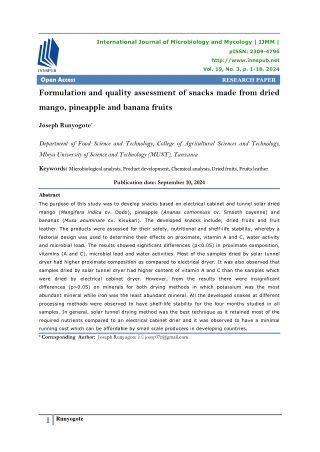
The purpose of this study was to develop snacks based on electrical cabinet and tunnel solar dried mango (Mangifera indica cv. Dodo), pineapple (Ananas comonsuss cv. Smooth cayenne) and bananas (Musa acuminate cv. Kisukari). The developed snacks include; dried fruits and fruit leather. The products were assessed for their safety, nutritional and shelf-life stability, whereby a factorial design was used to determine their effects on proximate, vitamin A and C, water activity and microbial load. The results showed significant differences (p<0.05) in proximate composition, vitamins (A and C),
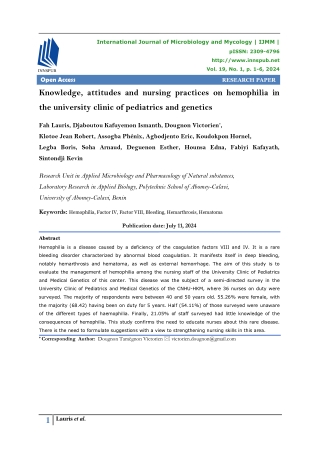
Hemophilia is a disease caused by a deficiency of the coagulation factors VIII and IV. It is a rare bleeding disorder characterized by abnormal blood coagulation. It manifests itself in deep bleeding, notably hemarthrosis and hematoma, as well as external hemorrhage. The aim of this study is to evaluate the management of hemophilia among the nursing staff of the University Clinic of Pediatrics and Medical Genetics of this center. This disease was the subject of a semi-directed survey in the University Clinic of Pediatrics and Medical Genetics of the CNHU-HKM,
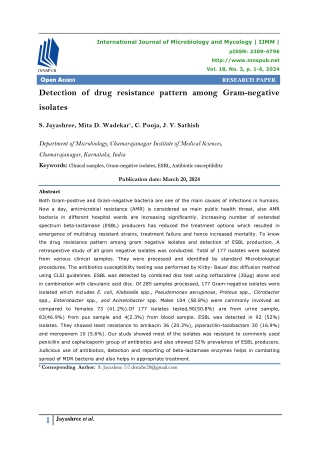
Both Gram-positive and Gram-negative bacteria are one of the main causes of infections in humans. Now a day, antimicrobial resistance (AMR) is considered as main public health threat, also AMR bacteria in different hospital wards are increasing signiufb01cantly. Increasing number of extended spectrum beta-lactamase (ESBL) producers has reduced the treatment options which resulted in emergence of multidrug resistant strains, treatment failure and hence increased mortality. To know the drug resistance pattern among gram negative isolates and detection of ESBL production.
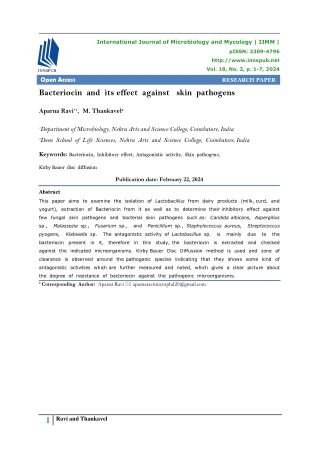
This paper aims to examine the isolation of Lactobacillus from dairy products (milk, curd, and yogurt), extraction of Bacteriocin from it as well as to determine their inhibitory effect against few fungal skin pathogens and bacterial skin pathogens such as: Candida albicans, Aspergillus sp., Malassezia sp., Fusarium sp., and Penicillium sp., Staphylococcus aureus, Streptococcus pyogens, Klebsiella sp. The antagonistic activity of Lactobacillus sp. is mainly due to the bacteriocin present in it, therefore in this study,
Maize is a vital staple crop in Kenya, serving as a primary source of food and feed. Contamination of maize (Zea mays) by Aspergillus flavus and the subsequent production of aflatoxins pose significant threats to food safety and human health. The risk of A. flavus contamination on imported maize at both gazetted and un-gazetted points of entry has not been extensively studied. The primary objective of this study was to examine the genotypic, phenotypic, and aflatoxigenic traits of A. flavus biovars derived from imported maize at Gazetted and Un-gazetted Points of Entries in Kenya.
This study examined the biochemical and histological changes associated with methanolic leaf extract of Gongronema latifolium in acetaminophen-induced hepatic toxicity in wistar albino rats. The serum liver enzymesALT, AST and ALP decreased significantly (p<0.05) in the test animals treated with 600mg/kg of the leaf extract. Protein concentration increased significantly (p<0.05) in the test animals treated with 600mg/kg of the leaf extract.The effect of the G. latifolium leaf extract seems to be dose dependent on the liver enzymes and protein concentration measured.
Interaction of cholesterol which is an essential structural component of animal cell membranes that is required to establish proper membrane permeability and fluidity and the bile chenodeoxycholic acid which significantly increased serum total cholesterol, and high-density-lipoprotein (HDL) cholesterol, and dissolves gallstones appears to be one of pivotal problem of biomedical gastroenterology. The methods of spin labels and spin probes have been proved to be power tools for solving structural and dynamical problems of chemistry and biology on molecular level.
Micro RNAs (miRNAs) are small non-coding RNAs molecules having approximately 18-25 nucleotides, they are present in both plants and animals genomes. MiRNAs have diverse spatial expression patterns and regulate various developmental metabolisms, stress responses and other physiological processes. The dynamic gene expression playing major roles in phenotypic differences in organisms are believed to be controlled by miRNAs. Mutations in regions of regulatory factors, such as miRNA genes or transcription factors (TF) necessitated by dynamic environmental factors or pathogen infections,
Diabetes is a chronic autoimmune disease characterized by the inability of body to produce or respond to insulin a hormone required by body to burn glucose for energy. Type I Diabetes mellitus, also known as Insulin Dependent Diabetes mellitus is a most frequent chronic disease of childhood, afflicts 0.2-0.3% of human individuals due to auto immune destruction of insulin secreting pancreatic u03b2 cells. GAD65 is the major auto antigen in Insulin Dependent Diabetes Mellitus (IIDM). Thus, this project is aimed at expression of GAD65 in E. coli. GAD65 gene was cloned into pET-28a
Hepatitis B, a common viral infection, affecting millions of people every year, leads to disability and death. It has become one of the alarming diseases in the world. Vaccination is the best possible way to prevent this deadly viral infection and its consequences. Unaffordability of the mass vaccination program due to low health budgets especially in developing countries have demanded the economical, effective and easily available vaccine production against hepatitis B virus. The expression of subunit vaccines and recombinant proteins in plants is a convenient,