Autonomous Vehicles
This piece explores the intricacies of autonomous vehicles, focusing on what makes a vehicle truly autonomous, differentiating it from remote-controlled variants. The concept is illustrated through the "3 D's": Detection, Delivery, and Data-Gathering. Current technologies, such as Drive-By-Wire and advanced sensors, are examined alongside existing challenges like environmental understanding, navigation, and social issues regarding trust and liability. Insights from the DARPA Challenges illustrate the progress and ongoing hurdles in developing fully autonomous vehicles.

Autonomous Vehicles
E N D
Presentation Transcript
Autonomous Vehicles By: Rotha Aing
What makes a vehicleautonomous? • “Driverless” • Different from remote controlled • 3 D’s • Detection • Delivery • Data-Gathering
3D’s • Detection – Reasoning • The surroundings and current conditions • Data-gathering – Search • From the information search knowledgebase for purposed actions • What to do next? • Delivery – Learning • View and record results of actions
Current Approaches • Fully Autonomous • Taxi-like cars • Autonomous in closed systems • Monorails • Assistance System • Environment Sensing • Distance Sensors • ABS
Solution Template • Sensors: Figure out obstacles around the vehicle • Navigation: How to get to the target location from the present location • Motion planning: Getting to the location, getting by any obstacles, following any rules • Control: Getting the vehicle itself to move
Current Issues • Technical • Sensors • Understanding the environment • Navigation • Know its current position and where it wants to go • Motion Planning • Navigation through traffic • Actuation • Operate the correct and needed features
Issues • Social Issues • Trusting the car • Getting on public roads • Getting people to go in • Liability Issues • Lost Jobs
What’s been solved? • Control • Navigation • Some issues of Sensory
Control • Drive-By-Wire • Sends messages to onboard computers • Physical ties are unlinked • In most current cars
Drive By Wire • When sensor/trigger is pressed, it sends message to the car to perform the tasks
DBW in Autonomous Vehicles • Replace the human driver • Activate the sensors/triggers • SciAutonics • Servomotors for each gear • Large servomotor with belt drive for steering
Navigation • Already available • Combination of: • GPS • Roadside database
Sensory • Major issue: • Lack of computing power • “More processors” • Half completed • RADAR • Laser Detection • Cameras
Sensory Information Issues • Factors of weather • Dust, rain, fog • Correctly Identifying an obstacle • Shadows vs. ditches • Shallow vs. deep • Speed of the vehicle and the speed data can be correctly received
Motion Planning • Most challenging • Collision Detection • Affected by: • Quality of Sensory information • Quality of Controls • Need for algorithm that can determine movements quickly but also the correct ones
“Road Map” • Decision Tree (Graph) • With points A and G • Fill in free spots (Configuration Space) • Try to link A to G • Configuration Space Algorithms • Sampling-based • Faster, less computing power • Combinatorial • More complete
DARPA Challenge • Defense Advanced Research Projects Agency • 2004 Desert Course • 2005 Off-road, mountain terrain • 2007 Urban Challenge • Collision Avoidance • Obey traffic signs
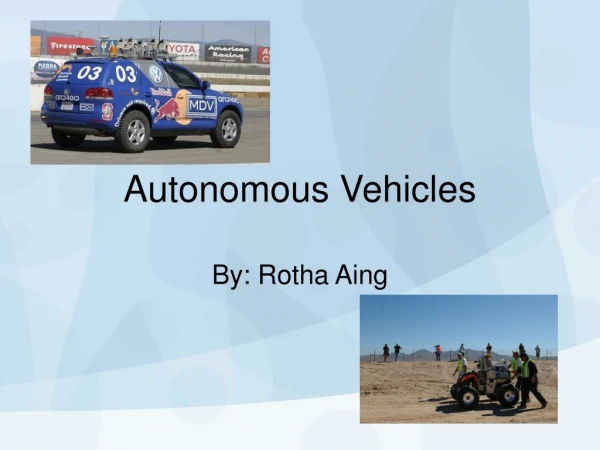
Stanley • 2005 DARPA Challenge winner • Volkswagen Touareg modified with onboard computers
Stanley’s Sensory • 5 LIDAR lasers • 24 GHz RADAR • Stereo camera • Single-lens camera
Path Analysis • Built in RDDF (database of course) • Vehicle predominantly followed the RDDF data
Obstacle Detection • Machine Learning Approach • Accuracy value of data is based on how human’s perform • Slows down when a path can not be found quickly • Grid of either occupied, free, or unknown spots
Issues with mapping scheme • Errors in determining environment • 12.6% of areas determined as obstacle was not
Personal Opinions • Good progress since the first challenge • Not until the 2007 challenge will we really know if a fully autonomous vehicle is possible in the near future • Other approaches more likely to be developed into mainstream before fully autonomous vehicles