
Photosynthesis
E N D
Presentation Transcript
Photosynthesis Mrs. Stewart Advanced Honors Biology
Bell Work • Pick up the note page from the front desk • Take out leaf the color sheet from yesterday
Bell Work • Get your photosynthesis pogil out from yesterday (if you turned it in to the basket, go get it)
Standards • CLE 3210.3.3 Investigate the relationship between the processes of photosynthesis and cellular respiration. • SPI 3210.3.3 Compare and contrast photosynthesis and cellular respiration in terms of energy transformation.
Objectives: • Identify the locations for both phases of photosynthesis • Identify the reactants and products for both phases of photosynthesis • Be able to write the full equation for photosynthesis
ATP • Principal energy compound • Stores energy in the bond between 2 and 3 phosphate groups • Energy is released when last phosphate group is broken off • ATP = 3 phosphates • ADP = 2 phosphates
Whole Point? • To convert the sun’s energy to usable chemical energy (ATP)
The Big Picture Photosynthesis Cellular Respiration
Lilo and Stitch Together • Define autotrophs and heterotrophs, and give an example of each.
Phenomenon • Watch this video • Answer the following questions: • What are the flowers doing? • Why are they doing it?
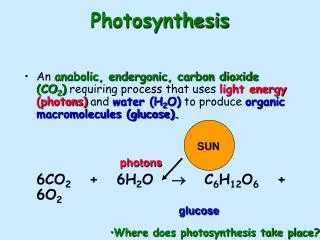
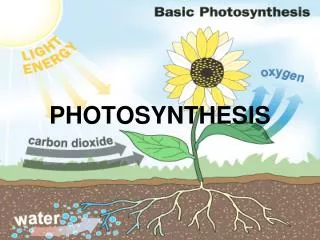
Photosynthesis Reaction 6 CO2 + 6 H2O + Light 6 O2 + C6H12O6 Light Energy O2 CO2 C6H12O6 H2O
Photosynthesis Basics Where does photosynthesis take place? Inside the chloroplasts.
Vocabulary granum Chloroplast
Evidence For Endosymbiotic Theory • Both Chloroplasts and Mitochondria… • Have circular DNA chromosomes • Have their own ribosomes • Reproduce independently within the cell • Reproduce exactly like bacteria • Have double membranes (one original and one that formed from the original endocytosis)
Lilo • Tell Stitch where the all reactions of photosynthesis will occur inside a plant cell
Phenomenon • How did it all get started? • Photosynthesis: • Amazing new mutation that spurred the advancement of species into multicellular organisms? OR • Responsible for the first major extinction event after life appeared on the planet?
Pigments • Absorb different wavelengths of light (colors) • Reflect (transmit) what they do not absorb • We see what is reflected back.
Types of pigments • Chlorophylls – reflect yellow and green light • Carotenoids – reflect yellow, orange and red light • Anthocyanins – reflect red and blue light
Chlorophyll • Most common pigment used in photosynthesis is chlorophyll
Chlorophyll • Chlorophyll absorbs all colors except green and yellow • Reflects green and yellow back
Stitch:Tell Lilo… • Why are leaves (plants) green?
Fill in the blanks: Dark Reaction Calvin Cycle
Calvin Cycle Electron Transport chain Glucose (sugars)
Light & Dark Reactions • Photosynthesis has 2 phases: • Light reactions: Light from the sun/indoor lights used • Dark reactions (Calvin Cycle): No light needed
Photosynthesis Overview: Step 1: Energy from the sun is used to split water into hydrogen and oxygen. The oxygen is released Step 2: Hydrogen is combined with Carbon Dioxide to make sugars H2O O2 H2 + CO2 C6H12O6
Light Reaction Steps: • Photolysis – energy from the sun is used to split water molecules • Oxygen is released • Hydrogen electrons are sent to the Electron Transport Chain and become “energized” (pick up the sun’s energy) • The carrier molecule NADP+ pick up Hydrogen, (creating NADPH), and carries it to the Calvin Cycle • Light reactions occur in the thylakoids
Dark Reaction Steps: • Hydrogen carried on NADPH is added to Carbon Dioxide (CO2) during carbon fixation in the Calvin Cycle. • Glucose (C6H12O6) is produced. • Dark reactions occur in the stroma
Where does it happen? • Two Stages: • Light Cycle: • Calvin Cycle: Takes place in the thylakoid Takes place in the stroma
Lilo • Walk Stitch through the steps for the light dependent reactions of photosynthesis
Stitch • Walk Lilo through the steps of the dark reactions (calvin cycle)
Light-Dependent Reaction • Reactants: • Products: • H2O and Light energy • NADP+ and ADP+ from the Calvin cycle. • O2 gas • ATP and NADPH – to Calvin cycle
Calvin Cycle • Reactants: • Products: • CO2 • ATP & NADPH – from light cycle • Sugars • ADP and NADP+
Lilo • Walk Stitch through ALL of photosynthesis
Stitch • Walk Lilo through ALL of photosynthesis
Lilo and Stitch Working Together • How do the light-dependent and light-independent cycles of photosynthesis depend on each other?
Bell Work • Get your plickers cards • Get out your photosynthesis notes and get ready to start back on your videos
Lilo and Stitch Working Together: Create a stop-motion video to show the steps of photosynthesis • REQUIREMENTS: Must show… • Photolysis occurring – oxygen leaving and hydrogen electrons going to ETC to get energized • NADP+ picking up H (and energized electrons) to take to Calvin Cycle • Calvin Cycle = Carbon fixation – adding H to CO2 to create glucose (be creative – use correct # of ea.) • Show correct locations for each process
Stomata • Stomata (plural) stoma (singular): Specialized cells that create a pore in the leaves that allow air (CO2, O2, water vapor) to come and go.
Lilo and Stitch Together • Determine why plant cells want to close their stoma during the day even though that is when the sun is at its best.
Lilo and Stitch- Think together • If plants close their stomata to prevent evaporation, no carbon dioxide diffuses in. What will this mean in terms of glucose production?
Objectives • Discovery – photosynthesis video • Can you identify the reactants and products of the light-dependent and light-independent (Calvin) cycle in the equation? • Identify the location of each phase of photosynthesis in the video
Objectives • Compare and contrast the light-dependent and light-independent cycles of photosynthesis in terms of reactants and products • Identify the location for the light-independent (Calvin cycle) for photosynthesis