Download
1 / 16
160 likes | 278 Vues
This section covers essential concepts of DNA and cell division. It discusses the necessity of copying an organism's DNA before cell division, the structure of DNA as a double helix and its composition of nucleotides, and the roles played by various scientists in the discovery of DNA. The process of DNA replication is explained, focusing on the mechanisms involved, such as the unzipping of the double helix, the action of DNA polymerase, and the challenges of synthesizing new strands. Understanding these fundamentals is pivotal to grasping genetic inheritance and cellular function.

E N D
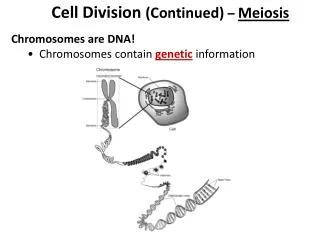
I. INTRODUCTION TO DNA • ________________ – All of an organism’s DNA; must be copied prior to cell division • __________________– Single molecule of DNA wrapped in protein. Proteins maintain chromosome structure & control DNA activity • Somatic cells - ___________ _________________________ • Gametes - ___________ _________________________ • ________________ – Term used to describe fine strands of uncoiled DNA
II. A CLOSER LOOK AT DNA • Discovery of DNA • Early 1900s – Scientists determined genes determined inherited characteristics. Also realized chromosomes were composed of DNA & protein. • Griffith (1928) – Studied 2 strains of bacteria. Determined that pathogenicity could be transferred when living non-pathogens were exposed to remains of dead pathogens. • Avery (1944) – Identified “transforming substance” as DNA • Hershey & Chase (1952) – Used radioactively-viruses that infect bacteria - known as bacteriophages. Virus is made up of DNA & protein – Hershey & Chase proved it was the DNA component that was injected into host cell and used to make new virus particles. • Rosalind Franklin (late 1950s) – Produced x-ray crystallography image of DNA; “borrowed” by Watson & Crick
II. A CLOSER LOOK AT DNA, cont • _______________ & _______________ • Realized DNA was a __________ composed of _____ nucleotide strands • Franklin suggested backbone of DNA was composed of alternating ______________________________ molecules • Watson & Crick determined interior of DNA was made up of paired ___________________ • Eventually deduced bases always paired a specific way • Chargaff • Chemically proved the same base-pairing rules that Watson & Crick proved structurally
II. A CLOSER LOOK AT DNA, cont • Monomers of DNA • Nucleotides • Composed of _____________,_____________, & _________ • _______________ • Single-ring N-base • Ex: Cytosine & Thymine • _______________ • Double-ring structures • Ex: Adenine & Guanine
II. A CLOSER LOOK AT DNA, cont • Structure of DNA • Double helix • Strand of nucleotides held together by ________________ bonds • Nitrogen bases held together with ________________ bonds • Pairs • _____________________ • _____________________ • 2 nucleotide strands are ____________________ • Each strand has a ______ end (terminus) and a _______ end; named for carbon on deoxyribose
III. DNA REPLICATION • DNA Replication • Prior to cell division, DNA must be replicated • Known as _______________________model of replication • Meselson-Stahl Experiment
III. DNA REPLICATION, cont. • ________________- Two identical DNA molecules; copied prior to cell division • ________________ – Site where sister chromatids are most closely attached
III. DNA REPLICATION, cont. • Steps Involved in Replication • ___________________________unwinds the DNA double helix • Replication begins at specific points on the DNA molecule known as ____________________________________________. The Y-shaped region where new strands of DNA are elongating are called ________________________________
III. DNA REPLICATION, cont. • As DNA is “unzipped”, _______________________ binding proteins hold the DNA open • A______________________________untwists the nucleotide strand. • DNA polymerase can only add nucleotides to an already-existing strand so an ___________________ is synthesized to get replication going
III. DNA REPLICATION, cont. • ______________________________ add complementary nucleotides to each side of the DNA molecule. • Can only add nucleotides to the _______ end of the growing strand, so the daughter DNA is synthesized _________________ • So…..only one side of the DNA (3’ – 5’) molecule can be replicated as a continuous strand which is known as the _______________________________.
III. DNA REPLICATION, cont. • Synthesis of ____________________ • To synthesize the other new strand of DNA, DNA polymerase must work away from the replication fork. Leads to synthesis of short pieces of DNA known as ________________ fragments. • ____________________binds fragments together to form a continuous strand of nucleotides. • Proofreading & Repair • DNA Polymerase proofread nucleotides as they are added
III. DNA REPLICATION, cont. An Overview of Replication
III. DNA REPLICATION, cont. • ___________________ • 5’ ends of daughter strands cannot be completed because DNA polymerase can only add nucleotides to the 3’ end • Results in shorter and shorter DNA molecules with jagged ends • To protect genetic integrity, ends of chromosomes do not contain genes – instead there are nucleotide sequences known as telomeres • Contain nucleotide repeat sequences • Telomeres shorten each time cell divides - limits the number of times a cell can divide; thought to protect organism from cancer • Telomerase – Enzyme produced by stem cells, cancer cells that restores telomere length