Download
1 / 17
180 likes | 322 Vues
This article examines the peculiar high eccentricities observed in exoplanetary orbits. Over 130 exoplanets discovered through Doppler spectroscopy reveal a median eccentricity of 0.28, challenging previous expectations of circular orbits. Various theories, such as close encounters, resonant interactions, and interactions with protoplanetary disks, are explored to explain these eccentricities. The study emphasizes the need for further investigations, particularly into smaller planets and longer periods, to uncover the complexities behind planetary migration and orbit formation.

E N D
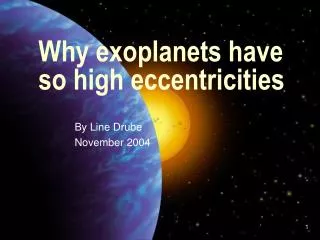
Why exoplanets have so high eccentricities By Line Drube November 2004
Characteristic of exoplanets • Over 130 planets found by- Doppler Spectroscopy - The stars light curve • Mass distribution 0.1 to10 Mj • Brown dwarf desert
Table of all planetsand their semimajor axis • All is under 5.9 AU • Smallest orbit 0.038 AU(Mercury 0.38 AU) • Within the snow line of 4-5 AU • Migration
Eccentricities • High eccentricity small orbits • Median eccentricity: 0.28 • Pluto’s e = 0.25 • Planet expected to have circular orbits.
Theories for the eccentricities • Close encounters between planets • Resonant interactions between planets • Interaction with the protoplanetary disk • Interaction with a distant companion star • Propagation of eccentricity disturbances • Formation from protostellar cloud
Close encounters between planets (1) • During formation 1) Masses increase & differential migration => dynamical instability Or 2) The planets mutual perturbed each other => instability • Ejection or collision • 1 planet far out & 1 close • Explains the migration inwards
Close encounters between planets (2) Problem: • Ecc. distribution: too many in close circular orbit, median ecc. 0.6. Equal masses • Expected: small m => higher ecc.
Resonant interactions between planets (1) • Differential inward migration • Migration caused by a torques from interactions between planet and disk • Locked in orbital resonances • Continued migration => ecc. • Pluto/Neptune (outwards)
Resonant interactions between planets (2) Problems • Needs extremely strong ecc. dampening. • Have to be captured just before migration stops • Have mostly observed single planets • Expected: low-mass planets to have higher ecc.
Interaction with the protoplanetary disk • Interactions at certain resonances can excite or dampen ecc. • The dampening resonances are easier to saturate => ecc. can grow Problem: • Many parameters • Numerical 2D simulation, shows only ecc. growth for >10Mj
Interaction with a distant companion star • Binary stars • A weak tidal force can excited large ecc. • Force needs to be stronger than other effect Problems • Expected: multi-planet system have low ecc. • Expected: high ecc. in binary system. Unseen companions?
Propagation of eccentricity disturbances (1) During formation: • Stars passing within a couple 102 AU • Excite outer planetesimals • Propagate inwards as a wave • In solar neighborhood values => ecc 0.01-0.1 • Dense open clusters => higher ecc.
Propagation of eccentricity disturbances (2) Problems: • Works only with a long-lived extended disk • Works only in dense open clusters • It haven’t been shown if this reproduce the ecc. distribution.
Formation from protostellar cloud (1) • Protoplanetary disk vs. protostellar cloud • Same distribution of periods and eccentricities as binary stars.
Formation from protostellar cloud (2) Problems: • Fragmatation • Brown dwarf desert
Conclusion • None of the theories can explain everything • Likely a combination of several mechanisms Future: • Better statistic with more planets • Finding smaller planets and longer periods. • Giving new clues to the mystery.
References • Tremaine S., Zakamska N.L., “Extrasolar Planet Orbits and Eccentricities” by. arXiv 2003 • Tremaine S., Zakamska N.L., “Excitation and progation of eccentricity disturbances in planetary system”, 2004 ApJ • Zucker S., Mazeh T., “Derivation of the mass distribution of extrasolar planets with MAXLIMA.”, 2001 ApJ • Stepinski T.F. and Black D.C., “On orbital elements of extrasolar planetary candidates and spectroscopic binaries”, 2001 A&A • Marzari F., Weidenschilling S.J., “Eccentric Extrasolar Planets: The Jumping Jupiter Model”, 2002 Icarus • Ivanov P.B., Papaloizou J.C.B., “On the tidal interaction of massive extrasolar planets on highly eccentric orbits”, 2004 Mon.Not.R.Astron.Soc • Marcy G., Butler P., http://exoplanets.org