The Foundations of Mendelian Genetics: Insights from Gregor Mendel's Experiments
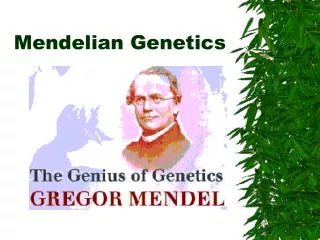
Modern genetics traces its origins to the pioneering work of Gregor Johann Mendel in the 1800s, where he established fundamental laws of inheritance. Through rigorous experiments with pea plants, Mendel uncovered the mechanisms of trait inheritance, contradicting the prevailing belief in blending traits. He identified major characteristics such as flower color and stem length, forming the basis of what we now know as Mendel's laws of segregation and independent assortment. Although his discoveries went unrecognized initially, they became pivotal in understanding genetics.

The Foundations of Mendelian Genetics: Insights from Gregor Mendel's Experiments
E N D
Presentation Transcript
Mendelian Genetics SBI3U0
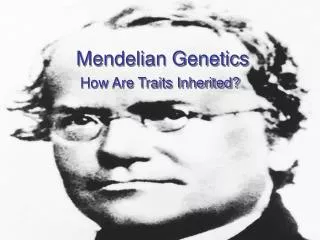
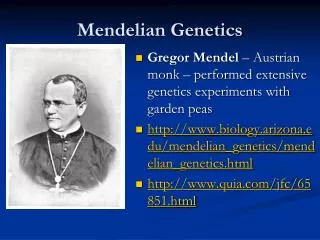
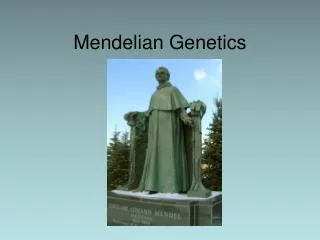
Gregor Johann Mendel • Modern day genetics has its roots in the 1800s • An Augustinian monk named Gregor Johann Mendel independently discovered some of the most important laws governing the inheritance of traits • His work was not accepted at the time, and was dismissed, until it was rediscovered in the early 1900s • His work was independently developed by Hugo de Vries and Carl Correns just before it was rediscovered
Mendel’s Experiments • Mendel ran experiments on pea plants based on the idea that “traits are inherited directly from parents; some are visible in the offspring and some are not” • The prevailing scientific thought at the time was that an offspring’s traits are a blending of the traits of its parents • To illustrate how traits can be inherited Mendel crossbred thousands of pea plants and meticulously recorded all of the results
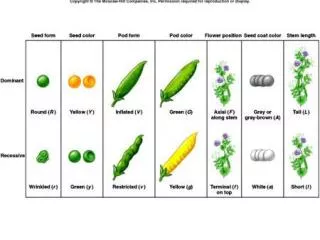
Pea Characteristics • Mendel chose seven specific characteristics of the pea plants to study • Flower colour, flower position, stem length, seed shape, seed colour, pod shape, and pod colour • Mendel created true breeding plants for each trait • Meaning that the plants always produce offspring genetically identical to itself for one or more traits when self-pollinated
Pea Characteristics Note: the traits are different versions of a specific characteristic. Eg: purple is a trait the for flower colour characteristic
Experiments • In his experiments Mendel would cross (breed) two true-breeding plants that had only a one trait difference (eg: purple vs. white flowers) • He did this for all of the characteristics several times • The initial parents are referred to as the parental generation or P generation • The offspring of these crosses are referred to as hybrids • Because they have the genetic material for BOTH traits rather than just one as their parents did
Experiments • These crosses are called monohybrid crosses • Mendel noticed something significant from these monohybrid crosses • All of the offspring (called the first filial generation or F1 generation) showed the same traits • Eg: if a purple flowering and white flowering plant were bred, the F1 generation had all purple flowers • The white flower trait was being masked by the purple flower trait
F2 Generation • When the F1 generation plants were allowed to self pollinate, an interesting thing happened; • Both traits were visible in their offspring, the second filial generation (F2) • Eg: there were both white and purple flowered offspring • Therefore, the genetic material for white flowers had not been lost, it was still present in the F1 generation even though they all appeared purple
Ratios • Even more interesting was that regardless of what trait he investigated, the F2 generation consistently showed the same ratio of traits • The ratio was always 3:1 • Eg: out of every four plants (on average) 3 had purple flowers and 1 had white flowers • From these observations Mendel developed “Mendel’s laws of inheritance” • The Law of segregation • The Law of independent assortment
Law of Segregation • For every characteristic, an organism carries two factors (genes): one from each parent • Parent organisms donate only one of their factors to their children • This is something we now know more about due to microbiology and the study of meiosis • Gamete cells contain only one set of chromosomes • They contain only one copy of each type of gene
Terms • The law of segregation can now be used to predict the characteristics of a filial generation • To do this we must define a few terms • Alleles • Different versions of a particular gene • Homozygous • An individual who carries two copies of the same allele • Heterozygous • An individual who carries two different alleles for the same characteristic
Alleles • We have specific symbols used to describe genes and alleles • We use one letter to describe the characteristic • Eg: flower colour might be represented by the letter C for colour • Specific alleles are shown as superscripts • Eg: the purple flower allele might be Cp • The white flower allele might be Cw
Terms • Genotype • The genetic makeup of an individual • The specific combination of alleles that an individual carries • Eg: CwCw, or CpCp, or CwCp • Phenotype • An individuals outward appearance for a specific characteristic • Eg: purple or white flowers
Dominant and Recessive • Mendel noticed that in the F1 generation, even though each plant was a hybrid (they were heterozygous for a certain characteristic), only one allele was expressed • Meaning that only one phenotype was shown (eg: all purple flowers) • We say that one allele is dominant, while the other is recessive • Meaning that if an individual is heterozygous, only the dominant allele will be expressed
Dominant Vs. Recessive • Dominant alleles are often written as capital letters • Purple flower colour is dominant CP • Axial flower position is dominant PA • Recessive alleles are often written as lower case letters • White flower colour is recessive Cw • Terminal flower position is recessive Ct
Predicting Inheritance • Now we are ready to use the genotypes of two parents to predict the genotypes and phenotypes of the offspring • We use a Punnett square to do this • Punnett squares are diagrams summarizing every possible combination of gametes between two parents
Punnett Squares • Let’s breed two homozygous parents, one homozygous for green seeds (dominant), while the other is homozygous for yellow seeds (recessive) • We say “homozygous green” and “homozygous yellow” to describe the parent’s genotypes • Gametes • Each gamete gets one allele for a given characteristic • Since both parents are homozygous, their gametes are identical • One parent has only the green allele, while the other has only the yellow allele
Punnett Squares • The square below shows a monohybrid cross for seed colour • The gametes of each parent are drawn along the edges and the possible combinations are shown in the squares Homozygous green gametes Homozygous green gametes
Results • Genotypes • All offspring in the F1 generation are heterozygous • Phenotypes • All offspring in the F1 generation have green seeds since the green allele is dominant
F2 Generation • Let’s try a cross of the heterozygous F1 plants with one another • Both parents are heterozygous, therefore there are two possible gamete types: SG, Sy Genotypes: SGSG, SGSY, SYSY Phenotypes: Green seeds, Yellow seeds
Probability • Notice that there are a different amount of possible ways to make each genotype • ¼ ways to make homozygous dominant SGSG • ¼ ways to make homozygous recessive SySy • ½ (or 2/4) ways to make heterozygous SGSy • These fractions can be used as the probability that a certain offspring will have a specific genotype • Remember that it is entirely random which gametes combine with one another
Probability • If the probability of forming a homozygous dominant genotype is ¼ or 25%, does this mean if the plant has 4 offspring 1 will for sure be heterozygous dominant? • No, it doesn’t! These are only probabilities • Due to the randomness of fertilization, it is possible that more or less than 1 offspring will be homozygous dominant • Test it!
Phenotypes • We can calculate phenotype probabilities as well • ¾ of the offspring have green seeds, therefore the probability of making an offspring with green seeds is 75% • ¼ of the offspring have yellow seeds, therefore the probability of making an offspring with yellow seeds is 25%
Test Crosses • A test cross is used to determine the genotype of an unknown individual • A test cross is performed by mating the unknown individual with a homozygous recessive individual • This way the dominant and recessive alleles of the unknown individual will be expressed • If all the offspring show the dominant phenotype, the unknown individual is homozygous dominant • If the offspring show both phenotypes, the unknown individual is heterozygous
Test Cross • If we look at seed shape in pea plants, round is dominant and wrinkled is recessive. • Therefore the possible genotypes of a plant with round seeds is SRSR or SRSw • The possible crosses are;
Test Cross Results • If the unknown is homozygous dominant • All of the offspring have the heterozygous genotype • Thus all of the offspring have the dominant phenotype • If the unknown is heterozygous • ½ of the offspring are heterozygous • ½ of the offspring are homozygous recessive • Thus both the dominant and recessive phenotype may be shown in the offspring