Enhancing VisiGene: Effort to Optimize Image Processing and Data Organization
Explore VisiGene's innovative features like parallel programming constructs, the Virtual Microscope, and the use of JPEG 2000 image compression. Learn about the loading process, near-term updates, and possible long-term projects. Stay informed about the evolving landscape of biological imaging technologies.

Enhancing VisiGene: Effort to Optimize Image Processing and Data Organization
E N D
Presentation Transcript
Parallel programming constructs: • Para: executes in parallel on all items in a collection. • Flow: marks a function as having no side effects.
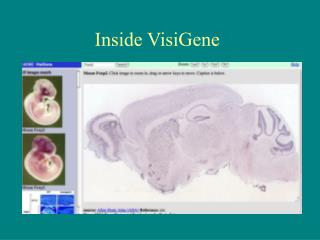
Virtual Microscope • Galt’s bigImage.html file • Image is saved at full size, 1/2 size, 1/4 size, and so on down to 1/64 size. • Broken into 500x500 pixel tiles. • Uses JavaScript to fetch just the tiles needed for the part being displayed.
A whole lot of tiles… • Allen Brain images are ~15000x15000 • Generate 500 tiles each • Overall have ~3 million tiles covering 89000 images • Have at least one image for 14679 genes.
The JPEG 2000 Challenge • Allen uses JPEG 2000, which is based on wavelet compression rather than discrete cosine transform of regular JPEG. • JPEG 2000 not widely supported yet. • After much experimentation with what was available on net, Galt found ECW toolkit, which is very nice, fast and free. • The program based on the ECW toolkit converts an Allen JPEG 2000 images to tiled JPEG at rate of ~1/minute on a single CPU.
VisiGene Loading in General • Get images and data from contributors. • Write a program to convert data into a standard .ra/.tab file format. • Create image tiles with vgPrepImage • Load .ra/.tab file into relational database with visiGeneLoad • Associate known genes with knownToVisiGene • View with hgVisiGene
Near Term Additions • Updating Jackson Labs images. (Over 6 months old) • Load frog images from Harland lab • Bring in zebrafish images from zfin
Possible Long Term Projects • Making it so that users can submit images over the web. • Allowing contributors to normalize and crop images in their own sand box before making images public.