### Understanding Local Government Finance: Revenue and Capital Expenditure Explained ###
This lesson outlines the fundamentals of local government finance, focusing on community leadership, strategic planning, and the concept of best value. Participants will learn how local authorities (LAs) generate and utilize their funds, primarily through revenue support grants from the Scottish Government, local taxes, and service charges. The distinction between revenue and capital expenditure will also be clarified, alongside insights into how councils finance their projects. Expect to understand key sources of income, such as non-domestic rates and council tax, as well as the impact of public-private partnerships. ###

### Understanding Local Government Finance: Revenue and Capital Expenditure Explained ###
E N D
Presentation Transcript
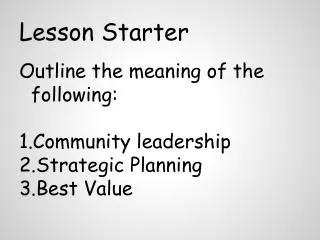
Lesson Starter • Outline the meaning of the following: • Community leadership • Strategic Planning • Best Value
What will I learn • About local government finance
Success Criteria • Identify where LA get their money. • Outline the difference between revenue and capital expenditure.
Financing Local Government • Local government receives most of its income directly from the Scottish Government in the form of grants. Revenue support grant (80%) • 20% is raised locally through council tax payments, fees and charges for the services they provide. • Non-domestic rates- taxes on business in their area. • At the moment there is a council tax freeze.
Financing Local Government Income from charging for their services, for example swimming pools. Introduction of PFI and PPP has allowed councils to finance their own projects.
Expenditure • Given the wide range of services provided by LG, it is not surprising that their annual expenditure is huge. • APPROX. £7 BILLION A YEAR • More than 1/3 of this total goes on Education alone.
Expenditure • There are 2 types of expenditure which councils undertake and which have different sources of income. • Capital Expenditure • Revenue Expenditure
Capital Expenditure • Is when a council uses money to finance the building of a new major asset e.g. school, leisure centre or council housing.
Capital Expenditure • The Finance Minister grants borrowing permission for a certain amount of money to each council, which is then entitled to borrow from a bank/ other financial institution. • Councils raise money themselves by selling off assets – including council owned land e.g. school playing fields.
Capital Expenditure • They get one off grants from the EU or bodies such as National Lottery. • A recent option for councils is to look to the private sector.This allowed for Capital projects to be financed in full by the private sector. Under this model a council may borrow money from financial institutions in the form of a long term loan or lease back of a new building. Labour Govt endorsed and expanded this idea calling it the Public Private Partnership (PPP).
Revenue Expenditure • It consists of the annual running costs of the council. These can range from the wages of employees to telephone and heating bills, to the cost of photocopying books in schools, to repaying loans on Capital Expenditure.
Revenue Expenditure • There are 4 main SOURCES of income for Revenue Expenditure. • Funds from Central Govt • About 80% of council income comes from central govt. in the form of a revenue support grant. The annual figure and breakdown by council area is determined by the Scottish Govt Minister for Finance.
Revenue Expenditure Non-Domestic/ Business Rates • These are paid by owners of shops, offices, factories etc. • Set by Central govt and amount to 19% of LG income.
Revenue Expenditure Council Tax • This is paid by owners or tenants of residential property. • There are 8 bands of this tax • Accounts for 15% of total council income. • ‘Pay up for Glasgow’ campaign.
Revenue Expenditure Charges for services • Councils can raise a small amount of their income from charges for services e.g. entry to a sports centre, school meals,etc • Approx £340 million