Download
1 / 12
130 likes | 282 Vues
The journey of electrical energy storage began in the late 1700s with Galvani's observation of a frog’s leg twitching in response to electricity. Following this, Volta developed the first battery in the early 1800s by connecting multiple electric cells, allowing for a consistent current through spontaneous redox reactions. This article explores the design and functioning of voltaic and electrolytic cells, the role of electrode potential, and the characteristics of secondary cells and batteries. Lastly, it examines modern fuel cells and their continuous supply of reactants.

E N D
Origins of the Cell • Galvani (late 1700’s) observed a frog’s leg twitch when exposed to a current • Volta (early 1800’s) realized it was due to current flowing through electrolytes in body • Volta invented the first battery by connecting multiple electric cells together • Based on spontaneous redox rxtn’s it was able to produce a consistent current
Source or use of electricity Electrode Cell – Molten or aqueous chemicals + – + – + Cell design • “Cells” are containers of liquid with electrodes: • In “voltaic cells”, electricity is produced spontaneously from a redox reaction • In “electrolytic cells”, electricity is used to force chemicals to undergo a redox reaction
Voltaic Cell also referred to as a “galvanic cell” salt bridge or porous disk(cup) used to allow for unrelated ions to move to allow for balance of charge
Cell Properties - driving force on electron to move them through the wire electric potential difference is the energy difference per unit charge depends on type of electrodes and electrolytes used in cells electric current is rate of flow of charge in a circuit power is the rate at which electrical energy is produced
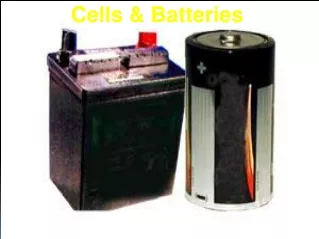
Secondary Cells & Batteries • a battery is a group of galvanic cells connected in series • the potentials of the individual cells add to give the total battery potential • secondary cells can be recharged by adding electricity
Figure 7 One of the Cells in a 12-V Lead Storage Battery (LSM 14.1C)
Fuel Cells . . . voltaic cells where the reactants are continuously supplied. 2H2(g) + O2(g) 2H2O(l) anode: 2H2 + 4OH 4H2O + 4e cathode: 4e + O2 + 2H2O 4OH
Figure 8 Schematic of the Hydrogen-Oxygen Fuel Cell (LSM 14.1C)
Homework Textbook p. 614 #1-5 Textbook p. 619 #10-15 LSM 14.1 B,C,D