Understanding Floating Point Representation and Computation in IEEE 754 Standard
This guide delves into the fundamentals of Floating Point Representation (FLP) using the IEEE 754 Standard. It explains the components of a floating point value, including mantissa, exponent, and normalization. The document details both single and double precision formats, including the construction of numbers in 32 and 64-bit representations. It also discusses the impact of biased exponents, precision limitations, and the computational methods for adding, multiplying, and dividing floating point values. Overflow, underflow, and precision considerations are also addressed.

Understanding Floating Point Representation and Computation in IEEE 754 Standard
E N D
Presentation Transcript
Floating Point (FLP) Representation A Floating Point value: f = m*r**e Where: m – mantissa or fractional r – base or radix, usually r = 2 e - exponent
Normalization • Normalized value: 0.1011 • Unnormalized value: 0.001011 • Normalization: 0.001011*(2**2)*(2**-2)= • =0.1011*2**-2 • Value of normalized mantissa: • 0.5<=m<1
FLP Format • sign exponent mantissa • sign: 0 + • 1 - • Biased exponent: assume exponent q bits • -2**(q-1)<=e<=2**(q-1)-1 add bias: • +2**(q-1) to all sides, get: • 0 <= eb <= 2**q -1 • e – true exponent; • eb – biased exponent
Example • f = -0.5078125*2**-2 • Assume a 32-bit format: • sign – 1 bit, exponent – 10 bits (q=10), • mantissa – 21 bits • q-1 = 9, b = bias = 2**9 = 512, • e = -2, eb = e + b = -2 + 512 = 510 • f representation: • 1 0111111110 10000010………0 • since 0.5=0.1, 0.0078125=2**-7
Range of representation • In fixed point, the largest number representable in 32 bits: • 2**31-1 approximately equal 10**9 • In the previous 32-bit format, the largest number representable: (1-2**-21)*2**511 • Approximately equal 10**153 • The smallest: 0.5*2**-512 • If a number falls above the largest, we have an overflow, if below the smallest, we have an underflow.
IEEE FLP Standard 754 1985 • Single precision: 32 bits • Double precision: 64 bits • Single Precision. • f = +- 1.M*2**(E’-127) where: • M – fractional, E’ – biased exponent, • bias = 127 • Format: sign: 1 bit, exponent – 8 bits, • fractional – 23 bits. • True exponent E = E’ – 127 • 0 < E’ < 255
Normalized single precision • Normalized: • 1.xxxxxx • The 1 before the binary point is not stored, but assumed to exist. • Example: convert 5.25 to single precision representation. • 5.25 = 101.01 not normalized. • Normalized: 1.0101*2**2 • True exponent E = 2, • Biased exponent E’ = E + 127 = 129, thus: • 0 10000001 01010…………0
Double precision • Value represented: • +- 1.M*2**(E’-1023) • Format: sign: 1 bit, exponent 11 bits, • fractional 52bits. • Bias = 1023 • Maximal number represented in single precision, approximately: 10**38 • In double precision: approximately 10**308
Precision • Increasing the exponent field, increases the range, but then, the fractional is decreased, decreasing the precision. • Suppose we want to receive a precision of n decimal digits. How many bits x we need in the fractional? • 2**x = 10**n, take decimal log on both sides: xlog2 = n; x=n/log2=n/0.301 • For n=7, need 7/0.301=23.3, 24 bits. • Achieved in single precision standard, since M has 23 bit and there is 1., not stored but existing.
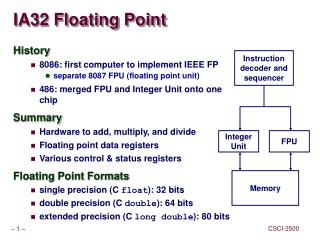
Extended Precision 80 bits • Not a part of IEEE standard. Used primarily in Intel processors. • Exponent 15 bits. • Fractional 64 bits. • This is why FLP registers in Intel processors are 80 and not 64 bits. • Its precision is 19 decimal digits.
FLP Computation • Given 2 FLP values: • X=Xm*2**Xe; Y=Ym*2**Ye; Xe<Ye • X+-Y = (Xm*2**(Xe-Ye)+-Ym)*2**Ye • X*Y = Xm*Ym*2**(Xe+Ye) • X/Y = (Xm/Ym)*2**(Xe-Ye)