Floating Point
210 likes | 336 Vues
This comprehensive guide explores the principles of IEEE floating point representation, focusing on the structure and properties of fractional binary numbers. It covers key concepts such as the definition and standards of floating point, the nuances of rounding, addition, and multiplication, and provides practical insights into floating point representation in the C programming language. Additionally, it clarifies how numbers like 0.75 and various fractions are represented in binary, alongside exploring denormalized values, NaN, and the limitations of floating point precision.


Floating Point
E N D
Presentation Transcript
Today: Floating Point • Background: Fractional binary numbers • IEEE floating point standard: Definition • Example and properties • Rounding, addition, multiplication • Floating point in C • Summary
Fractional binary numbers • How do we represent 0.75? • What is 1011.1012?
Fractional Binary Numbers • Representation • Bits to right of “binary point” represent fractional powers of 2 • Represents rational number: • • • • • •
Fractional Binary Numbers: Examples • Value Representation • 5 3/4 101.112 • 2 7/8 0? • 1 7/160? • Observations • Divide by 2 by shifting right • Multiply by 2 by shifting left • Numbers of form 0.111111…2 are just below 1.0 • 1/2 + 1/4 + 1/8 + … + 1/2i + … ➙ 1.0 • Use notation 1.0 – ε
Representable Numbers • Limitation • Can only exactly represent numbers of the form x/2k • Other rational numbers have repeating bit representations • Value Representation • 1/3 0.0101010101[01]…2 • 1/50.001100110011[0011]…2 • 1/100.0001100110011[0011]…2
Today: Floating Point • Background: Fractional binary numbers • IEEE floating point standard: Definition • Example and properties • Rounding, addition, multiplication • Floating point in C • Summary
IEEE Floating Point • IEEE Standard 754 • Established in 1985 as uniform standard for floating point arithmetic • Supported by all major CPUs • Driven by numerical concerns • Nice standards for rounding, overflow, underflow • Hard to make fast in hardware • Numerical analysts predominated over hardware designers in defining standard
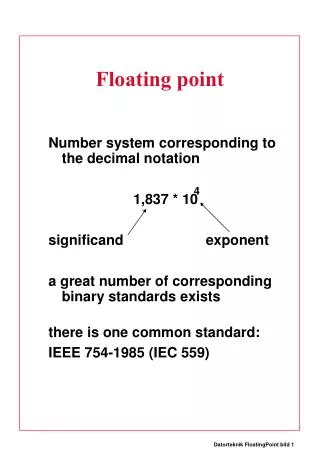
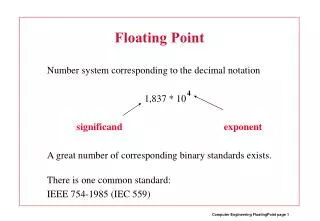
Floating Point Representation • Numerical Form: (–1)sM 2E • Sign bits determines whether number is negative or positive • SignificandM normally a fractional value in range [1.0,2.0). • ExponentE weights value by power of two • Encoding • MSB s is sign bit s • exp field encodes E (but is not equal to E) • frac field encodes M (but is not equal to M)
Precisions • Single precision: 32 bits • Double precision: 64 bits • Extended precision: 80 bits (Intel only)
Normalized Values • Condition: exp ≠ 000…0 and exp ≠ 111…1 • Exponent coded as biased value: E = Exp– Bias • Exp: unsigned value exp • Bias = 2k-1 - 1, where k is number of exponent bits • Single precision: Bias? (Exp: 1…254; E: ?) • Double precision: Bias? (Exp: 1…2046; E: ?) • Significand coded with implied leading 1: M = 1.xxx…x2 • xxx…x: bits of frac • Minimum when 000…0 (M = 1.0) • Maximum when 111…1 (M = 2.0 – ε) • Get extra leading bit for “free”
Normalized Encoding Example • Value: float F = 15213.0; • 1521310 = 111011011011012 = 1.11011011011012x 213 • Significand M = 1.11011011011012 frac = 110110110110100000000002 • Exponent E = 13 Bias = 127 Exp = 140 = 100011002 • Result:0 10001100 11011011011010000000000 s exp frac
Denormalized Values • Condition: exp = 000…0 • Exponent value: E = –Bias + 1 (instead of E = 0 – Bias) • Significand coded with implied leading 0: M = 0.xxx…x2 • xxx…x: bits of frac • Cases • exp = 000…0, frac = 000…0 • Represents zero value • Note distinct values: +0 and –0 • exp = 000…0, frac ≠ 000…0 • Numbers very close to 0.0 • Lose precision as get smaller • Equispaced
Special Values • Condition: exp = 111…1 • Case: exp = 111…1, frac = 000…0 • Represents value (infinity) • Operation that overflows • Both positive and negative • E.g., 1.0/0.0 = −1.0/−0.0 = +, 1.0/−0.0 = − • Case: exp = 111…1, frac ≠ 000…0 • Not-a-Number (NaN) • Represents case when no numeric value can be determined • E.g., sqrt(–1), − , 0
Visualization: Floating Point Encodings − + −Normalized +Denorm +Normalized −Denorm NaN NaN 0 +0
Today: Floating Point • Background: Fractional binary numbers • IEEE floating point standard: Definition • Example and properties • Rounding, addition, multiplication • Floating point in C • Summary
Tiny Floating Point Example • 8-bit Floating Point Representation • the sign bit is in the most significant bit • the next four bits are the exponent; Bias is ? • the last three bits are the frac • Same general form as IEEE Format • normalized, denormalized • representation of 0, NaN, infinity
Dynamic Range (Positive Only) s exp fracEValue 0 0000 000 -6 0 0 0000 001 -6 1/8*1/64 = 1/512 0 0000 010 -6 2/8*1/64 = 2/512 … 0 0000 110 -6 6/8*1/64 = 6/512 0 0000 111 -6 7/8*1/64 = 7/512 0 0001 000 -6 8/8*1/64 = 8/512 0 0001 001 -6 9/8*1/64 = 9/512 … 0 0110 110 -1 14/8*1/2 = 14/16 0 0110 111 -1 15/8*1/2 = 15/16 0 0111 000 0 8/8*1 = 1 0 0111 001 0 9/8*1 = 9/8 0 0111 010 0 10/8*1 = 10/8 … 0 1110 110 7 14/8*128 = 224 0 1110 111 7 15/8*128 = 240 0 1111 000 n/a inf closest to zero Denormalized numbers largest denorm smallest norm closest to 1 below Normalized numbers closest to 1 above largest norm
Distribution of Values • 6-bit IEEE-like format • Bias is ? • Range of E? • Notice how the distribution gets denser toward zero. 8 values Smallest pos. ? Smallest pos. normalized ? Largest pos. normalized Biggest ?
Distribution of Values (close-up view) • 6-bit IEEE-like format
Interesting Numbers {single,double} Description exp frac Numeric Value • Zero 00…00 00…00 0.0 • Smallest Pos. Denorm. 00…00 00…01 2– {23,52} x 2– {126,1022} • Single ≈ 1.4 x 10–45 • Double ≈ 4.9 x 10–324 • Largest Denormalized 00…00 11…11 (1.0 – ε) x 2– {126,1022} • Single ≈ 1.18 x 10–38 • Double ≈ 2.2 x 10–308 • Smallest Pos. Normalized 00…01 00…00 1.0 x 2– {126,1022} • One 01…11 00…00 1.0 • Largest Normalized 11…10 11…11 (2.0 – ε) x 2{127,1023} • Single ≈ 3.4 x 1038 • Double ≈ 1.8 x 10308