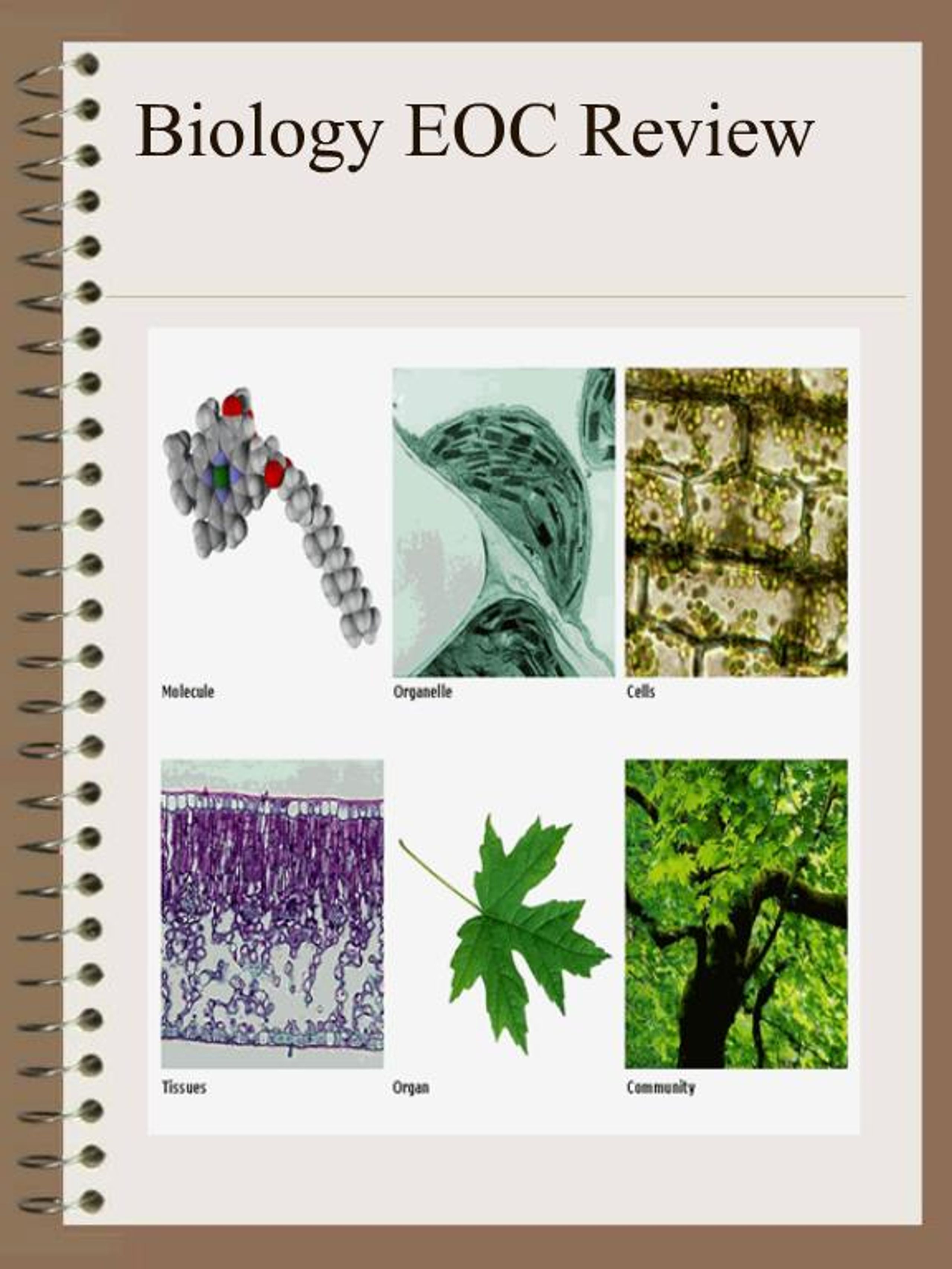
1. Biology EOC Review
2. Science Methods Steps used to solve a problem
Observation
Questioning and stating problems
Hypothesizing
Experimenting – including a control and experimental group IV – independent variable
DV – dependent variable
Tables and Graphs
IV on x-axis and DV on y-axis of a graph
Ex) Effects of pH on Tadpole Survival
IV – pH
DV-Number of Tadpoles
3. Characteristics of Life
4. Chemistry Organisms are composed of organic compounds – carbon containing compounds that can be very large macromolecules
Macromolecules are often built by dehydration synthesis and polymerization
Four main types
1) Carbohydrates – composed of monosaccharides primarily glucose
2) Lipids – composed of fatty acids joined to glycerol and sometimes phosphate groups, can also include the steroids
3) Proteins – composed of amino acids (20 different types) – do most of the work in organisms and are major structural components
4) Nucleic Acids – are composed of nucleotides – either DNA or RNA
Metabolism – is the chemistry of life – all metabolism is controlled by the action of enzymes
Enzymes are proteins that function to speed up chemical reactions in the cell. They have a specific shape and interact with a specific substrate which binds at the active site.
Enzymes are reusable and are not changed during a chemical reaction. They can be damaged at temperature and pH extremes.
5. Ecology Ecology – is the study of interactions between organisms and the environment
Levels of Organization
Biosphere?Biomes?Ecosystem ?Community?Population?Organism
We study an organisms habitat, niche, and trophic level
Populations – are members of the same species living in the same place at the same time with the potential to interbreed
Population growth – exponential (J-shape) and logistic (S-Shape)
* Limited by factors like disease and competition that are density-dependent or by density-independent factors like natural disaster.
* Carrying capacity is seen in logistic growth – the maximum number the environment can support
Community Interactions
* Competition – intraspecific (same species) or interspecific (diff sp)
* Symbiosis – parasitism, commensalism, and mutualism
* Succession – both primary (bare rock) and secondary (soil)
Ecosystem Level – food chains and webs and matter recycling
6. Cells Cell theory - 3 parts
1) cells are basic unit of life
2) cells come from existing cells
3) all organisms are composed of cells
Prokaryotic versus Eukaryotic
A) simple A) complex
B) has no nucleus B) has a MB nucleus
C) has no MB organelles C) has MB organelles
D) includes bacteria D) includes protists, fungi, plants, and animals
Organelles – compartments for carrying out specific jobs / chemical reactions
1) chloroplast – photosynthesis
2) mitochondria – cellular respiration
3) ribosomes – protein synthesis
4) vacuoles – storage
5) nucleus – contains DNA and
controls cell actions
6) nucleolus – site of ribosome formation
Plant versus Animal
A) has cell wall A) no cell wall
B) has chloroplasts/plastids B) has no plastids/chloroplasts
C) has large vacuole C) has small vacuoles
7. Cellular Transport Plasma membrane controls homeostasis (balance)
Structure – composed of a phospholipid bilayer with
embedded proteins “gates”
Function – acts as a selectively permeable boundary
around the cell
Types of Passive Transport – no energy required
1) Diffusion – moves substances from high to low concentrations down their concentration gradient
2) Osmosis – the diffusion of water from high to lower water concentrations down its concentration gradient
Ex) cell in salt water – shrivels Ex) cell in fresh water swells
3) Facilitated diffusion – movement of a substance down its concentration through a transport protein channel
Active Transport – requires energy – moves substances against the concentration gradient from low to high concentrations
8. Photosynthesis The process used by producers to convert sunlight to chemical energy in glucose
Overall equation: 6CO2 + 6H2O ? C6H12O6 + 6O2
Occurs in the palisade layer of leaves (yellow layer under the upper epidermis)
Large numbers of chloroplasts are found in these mesophyll cells.
Chloroplasts are the cellular site of photosynthesis. The light reaction of photosynthesis occurs on the inner membrane called the thylakoid. The dark reaction (aka Calvin Cycle) occurs in the stroma
Pigments absorb light energy
Chlorophyll / carotenoids
Input Output
Light Reaction light, water O2, ATP
NADPH
Dark Reaction ATP, CO2 GLUCOSE
NADPH
9. Cellular Respiration Cellular respiration is the process by which organisms break down food to release its energy. This energy is then stored in ATP (Adenosine triphosphate)
Three parts to ATP
1) adenine (Nbase)
2) ribose (5-C sugar)
3) 3 phosphates (high energy)
ATP/ADP cycle – when energy
is needed for cell work ATP
loses a phosphate to become ADP
Overall equation: C6H12O6 + 6O2 ? 6CO2 + 6H2O + 38 ATP
Respiration can be aerobic or anaerobic
Aerobic Anaerobic
O2 required no O2 required
most organisms are aerobes few anaerobes (yeast/bacteria)
38 ATP 2 ATP
3 steps – glycolysis, Krebs cycle, 2 steps – glycolysis and electron transport fermentation (alcoholic and
lactic acid)
Glycolysis is the first step of both
forms of respiration and occurs in
the cytoplasm
If no oxygen is present after glycolysis,
then fermentation occurs
If oxygen is present, then the Krebs cycle
and e-transport occur in the mitochondria
10. DNA, RNA, and Protein Synthesis DNA and RNA are composed of nucleotides
DNA RNA____________
Deoxyribose Ribose
A, C, G A, C, G
Thymine Uracil
Double helix Single helix
Codes for proteins/RNA Copy of DNA info
Replication – the process used by cells to copy DNA – enzyme unzips DNA and each side of the ladder acts as a template for the building of the new half. Use the N-base paring rules : A-T ; C-G
EX) TACGGAC (old strand)
ATGCCTG (new strand
Transcription – the process of making RNA from DNA
EX) TACGGAC (template DNA strand)
AUGCCUG (RNA built)
3 Types of RNA have a
role in protein synthesis
1) mRNA – messenger-blueprint
for how to build protein
2) tRNA – transfer - carries amino
acids to ribosome
3) rRNA – ribosomal – makes up
a ribosome
Translation – the process of
of building a protein by matching
Codons in mRNA to anticodons
of tRNA (use codon chart)
11. Reproduction Reproduction is a fundamental characteristic of life
Propagates your species
2 form: asexual and sexual
Asexual Sexual____________
-1 parent -2 parents (usually)
-No gametes -Fusion of gametes
-Offspring are genetically identical -Offspring genetically unique
to the parent (clones)
-Fast, efficient, less energy -Slower, less efficient, more energy
-No variation -Huge amounts of variation
-Stable Environment -Changing Environment
Asexual Strategies
1) binary fission
2) budding
3) fragmentation/fission
Sexual strategies
1) Internal fertilization
Copulation (vagina/penis) –
sperm meets egg in female
2) External fertilization
Spawning – eggs and sperm
released into the environment
usually aquatic
In humans fertilization occurs
in the fallopian tube.
12. Cell Division Haploid – having one set of chromosomes (n) – gametes – sperm/egg
Diploid – having two sets of chromosomes (2n) – body cells – one set is maternal and one is paternal
The cell cycle – Interphase – growth
- Mitosis – division
Mitosis creates diploid cells and is for
the purpose of tissue repair and growth
in animals
DNA coils to form chromosomes
during cell division
Stages of the cell cycle ( see diagram)
Interphase, Prophase, Metaphase,
Anaphase, Telophase, Cytokinesis
Meiosis – cell division that creates 4
haploid cells called gametes – aka –
reduction division
Meiosis involves 2 divisions – Meiosis I
and Meiosis II
Meiosis I has some special events:
In Prophase I homologous chromosomes
pair up and crossing over occurs. This
recombination increases genetic
variation for the species
Metaphase I – Pairs line up
Anaphase I – pairs are separated
Meiosis II is similar to mitosis
13. Simple Genetics Gregor Mendel worked with pea plants to learn the basic patterns of inheritance.
Phenotype – what the organism looks like
Genotype – the gene combination – either Homozygous (TT or tt)
or Heterozygous (Tt)
Monohybrid Cross – follows 1 trait through several generations
P(parental) TT x tt
T T T t
t geno- all Tt T geno – ¼ TT, ½ Tt, ¼ tt
t pheno – all tall t pheno – ¾ Tall; ¼ short
(3:1 ratio)
Other important monohybrid crosses
T t T t
T geno- ½ TT; ½ Tt t geno – ½ Tt; ½ tt
T pheno – all Tall t pheno– Tall; ½ short
Dihybrid cross – follows two traits
14. Complex Genetics Incomplete Dominance – intermediate/blended phenotype
Ex) snap dragons ? Red (RR) X White (R’R’) ? all Pink
R R R R’
R’ geno- all RR’ R’ geno- ¼ RR; ½ RR’; ¼ R’R’
R’ pheno-all pink R’ pheno- ¼red; ½ pink; ¼ white
Codominance – both parental phenotypes show up in offspring
Ex) Chickens ? Black x White ?Black and White feathers
Multiple Allelism – trait with 3+ alleles
ex) A, B, O blood types
Sex Linkage – genes carried on sex chromosomes
Ex) hemophilia, color blindness Cross shows a
carrier female and a normal male. For a female to
inherit the trait the father must have it and the
mother must at least be a carrier
Polygenic Inheritance – traits controlled
by many genes Ex) Height, hair color
Aneuploidy – condition caused by
having abnormal chromosome number.
Ex) Down’s Syndrome aka Trisomy 21
15. DNA Technology Today, DNA techniques include:
1) DNA Extraction – the opening of cells to separate/isolate DNA from other cell parts
2) Cutting DNA – large DNA molecules are cut into smaller fragments using restriction enzymes. These enzymes recognize and cut DNA at specific sequences. See Fig 13-5 p322.
3) Separating DNA – DNA fragments can be separated and analyzed using gel electrophoresis. This process allows scientists to compare genomes of different organisms, separate genes, and create DNA “fingerprints”
4) Sequencing DNA – this process allows scientists to determine the sequence of N-bases in DNA.
5) Recombinant DNA – scientists can cut DNA from two sources with the same restriction enzyme and combine them. This is used in genetic engineering. This process has been used to create human proteins used to treat disease, create pest-resistant crops, and for many other purposes.
6) Copying DNA – polymerase chain reaction (PCR) has been developed that makes many copies of a small amount of DNA. See Fig 13-8 p325.
16. Evolution Charles Darwin – proposed that organisms (species or populations) change over time
Occurs by Natural Selection – “survival of the fittest”
Lines of evidence
1) fossils (geologic time)
2) Homologous Structures –
same basic structure formed from
same embryonic tissue
3) Analogous Structures – same
basic functions due to same
environmental pressures
4) Vestigial Structures – structures
that have lost function ex) appendix
5) Embryology – embryos of various
species appear identical
6) Biochemistry – DNA and protein amino acid sequence comparisons
Adaptive radiation – an ancestral
species radiates or diverges into many
species. Ex) Galapagos Finches
Origin Ideas
Urey and Miller simulated Earth’s early environment and created organic compounds like amino acid
Endosymbiont theory – eukaryotic
cells formed when prokaryotic cells began
to live together permanently
17. Classification Carolus Linnaeus – developed 7 categories of classification
Also developed binomial nomenclature – naming using the genus and species names to refer to an organism
Classification tools include dichotomous keys – a series of paired statements that lead to the name of an organism
1a) Object has no sides . . . . . . . . . . . . . .Go to 2
1b) Object has sides . . . . . . . . . . . . . . . . . Go to 3
2a) Object is oblong . . . . . . . . . . . . . . . . . oval
2b) Object is symmetrical . . . . . . . . . . . circle
3a) Object has 3 sides . . . . . . . . . . . . . . . triangle
3b) Object has 4 sides . . . . . . . . . . . . . . . Go to 4
4a) Object has 4 equal sides . . . . . . . . . . square
4b) Object doesn’t have 4 equal sides . . rectangle
18. Kingdoms http://www.ric.edu/ptiskus/Six_Kingdoms/Index.htm
How are organism placed into their kingdoms?
1) Cell type, complex or simple
2) Their ability to make food
3) The number of cells in their body
Five Kingdom System
Monera – all prokaryotic includes the bacteria
Protista – most are unicellular, eukaryotic, and aquatic
Fungi – all eukaryotic heterotrophs that act as decomposers
Plantae – all eukaryotic autotrophs
Animalia – all eukaryotic heterotrophs that must eat other organisms for food
In Six Kingdom system the Kingdom Monera has been divided into the Archaebacteria and the Eubacteria
Archaebacteria – are extremists that live in hot, acidic, saline, or other harsh environments
Eubacteria are “true” bacteria that come in 3 shapes
1) round (coccus)
2) rod (bacillus)
3) spiral (spirillus)
19. Plants Plant cell structure – cell walls, large vacuole, chloroplasts
Photosynthesis
Classification – 4 groups
1) Nonvascular – no true roots/stems/leaves – ex) mosses (Bryophytes)
2) Seedless vascular plants – Ferns
3) Vascular with seeds in cones – Gymnosperms (pines, fir, spruce)
4) Vascular with seeds in fruits – Angiosperms – flowering plants
Types of Vascular Tissue
A) Xylem – transports water from roots to leaves
B) Phloem – transports sugars from leaves to roots
Reproductive Life Cycle – called Alternation of Generations
Tropisms – growth responses to stimuli – often controlled by hormones like auxins and gibberellins
Phototropism Gravitropism Thigmotropism
20. Animals Modes of reproduction
Animal cell structure – no cell wall, small vacuoles, no plastids, centrioles
Classification – 2 main groups
Vertebrates Invertebrates
Phylum Chordata 9 Phyla
3 classes of fish Arthropods – insects (6 legs)
Amphibians (exoskeleton) - arachnids (8 legs)
Reptiles - crustaceans
Aves (birds) Mollusks – have shell created by
Mammals structure called mantel
Human Anatomy – Look through the chapters in your book regarding anatomy.
* Neurons
* Heart
* Kidneys
Animal Behavior – responses that allow an organism to respond to stimuli
1) Innate Behavior – instincts, inherited, inborn behaviors
ex) circadian rhythms – daily patterns of activity – including feeding behaviors - nocturnal
ex) annual rhythms – yearly patterns of activity – including courtship, estivation, hibernation, migration
2) Learned Behavior – based on experience
ex) imprinting – recognition of parents
ex) Trial and error learning
ex) Conditioning (Pavlov’s dog) – learning by association
3) Social Behavior – division of labor as in a termite or ant colony
21. Biologists Robert Hooke – discovered and named the cell with crude microscope
Anton van Leeuwenhoek - saw “wee little beasties” living cells for the first time
Gregor Mendel – is the father of genetics – discovered the basic patterns of inheritance in pea plants
Charles Darwin – is the father of evolution theory – proposed that organisms that are most fit or best adapted to their environment are more likely to survive – called Natural Selection
James Watson and Francis Crick – discovered the double helix structure of DNA by examining an x-ray made by Rosalind Franklin and Maurice Wilkins
Charles Drew – associated with our understanding of the ABO blood groups and transfusion
Carolus Linnaeus – binomial nomenclature and classification of organisms
Rachel Carson – wrote “Silent Spring” bringing to public attention the dangers of pesticides particularly DDT – this toxin bioaccumulates in the bodies of top consumers
Jane Goodall – studied chimpanzee behavior
Louis Pasteur – helped disprove abiogenesis or spontaneous generation by creating a s-neck flask and showing that microorganisms spoil food