Understanding Photosynthesis: Mechanisms, Organisms, and Environmental Interactions
This chapter delves into the process of photosynthesis, a vital function of plants, algae, and some bacteria, which captures approximately 5% of the Sun’s energy. The focus is on chlorophyll pigments, the first organisms that utilized sunlight for energy, and the structure of chloroplasts. We explore the role of stomata in gas exchange and transpiration, the significance of cyanobacteria in evolution, and the impact of environmental conditions on photosynthetic efficiency. Understanding these elements is crucial for appreciating ecological dynamics and the basis of life on Earth.

Understanding Photosynthesis: Mechanisms, Organisms, and Environmental Interactions
E N D
Presentation Transcript
Chapter 3 PHOTOSYNTHESIS
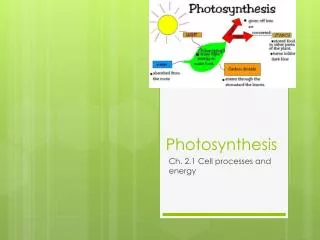
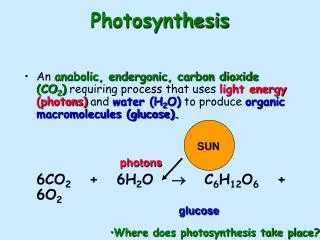
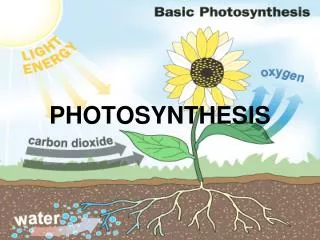
Plants, algae, some protists, some bacteria capture about 5% of Sun’s energy. Absorb CO2, water, and radiant energy chemical potential energy (glucose) Introduction
Plants, algae, some protists, and cyanpbacteria. • Contain green-coloured pigment called _____________________: absorbs light energy and begins the process of photosynthesis. • Chlorophyll a (blue-green) (contains –CH3) at position –R • Primary light-absorbing pigment • Chlorophyll b (yellow-green) (contains –COH at –R) Photosynthetic organisms
Contains a porphyrin ring attached to a long HC tail. • Porphyrin: contains a magnesium atom at center surrounded by a HC ring with – and = bonds. • Delocalized electrons in single-double bonds absorb light energy. • Different functional groups affect type of light energy molecules can absorb. Chlorophyll
“blue-green algae”: largest group of photosynthesizing prokaryotes. • Evolved between 2.5 and 3.4 billion y.a. • Probably the first organisms to use sunlight in the production of organic compounds. • Produced oxygen: paved way for heterotrophic life on Earth. • Unicellular, but may grow in visible colonies Prokaryotic autotrophs: cyanobacteria
Live in oceans, freshwater lakes and rivers, rocks, and soil... And polar bear fur. • Rocks? Cyanobacteria + fungi lichens • Cyanobacterial blooms: rapid-growing colonies in water rich in nitrates and phosphates (fertilizer, detergent runoff from homes, farms, industry) • May be toxic to fish, birds, humans, and other mammals. • Produce toxin called microcystin.
Endosymbiosis: ancestor of cyanobacteria engulfed by ancestor of today’s eukaryotic cells. • Mutually beneficial relationship. • Cyanobacteria protected from harsh environment • Eukaryotic host obtained food molecules from bacterium • Cyanobacteria lack membrane-bound organelles: have infoldings of cell membrane used as sites of photosynthesis and respiration. Eukaryotic autotrophs: algae, photosynthetic protists, and plants
Algae, some protists, plant cells: • Contain chlorophyll within chloroplasts. • Leaves, stems, unripened fruit: green! • Chloroplasts: possible ancestors of _______________.
Thin and broad, or thin and narrow • Structure and arrangement on stems and branches maximizes SA exposed to sunlight • Limits distance that gases need to travel to reach chloroplasts. Leaves: photosynthetic organs of plants
Cuticle: waxy water-resistant coating • Protection against excessive absorbtion of light and evaporation of water. • Epidermis: transparent • Mesophyll: abundant with chlorplasts • Guard cells: create microscopic openings called stomata • Regulate the exchange of CO2 and O2 with atmosphere • Allow water to escape by transpiration • Vascular bundles: ‘veins’ • Transport water and minerals from roots and leaves and carry carbs from leaves to roots. Structure of leaves
Stomata: responsible for more than 85% of water lost by plant. • Two ways transpiration assists in photosynthesis: • Creates ‘transpiration pull’ that helps move water, minerals, and other substances from roots leaves. • Prevents leaves from heating to temperatures that could inhibit or denature enzymes. • Stomata open and close depending on environmental conditions. • Closed:________________________________ • Open:_________________________________ Transpiration and photosynthesis
Guard cells control the size of a stoma by changing their shape in response to changes in environmental conditions. • Open: guard cells turgid (swollen) • Day-time: when photosynthesis can occur (light energy) need of CO2 (diffusion) and H2O (transpiration pull) • Closed: guard cells flaccid (limp) • Night-time: when photosynthesis cannot occur (limited light energy). Opening and closing of stomata
Photosynthetic factories of plants and algae. • Have own DNA and can replicate by fission. • Two-membranes • Stroma: protein-rich semiliquid material in the ‘middle’ • Thylakoids: membrane-bound sacs that form columns. • About 30-50 per... • Grana: column of thylakoids. • About 60 in each chloroplast • Lamallae: connection between thylakoids. • Thylakoid Lumen: inside of the thylakoid fluid-filled . chloroplasts
Pg. 145 #1,2,3,4,5,6,7 Seatwork/homework