Gas Laws
60 likes | 209 Vues
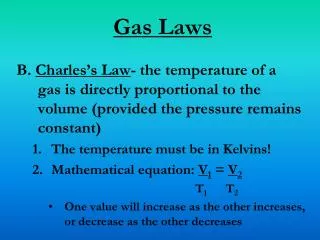
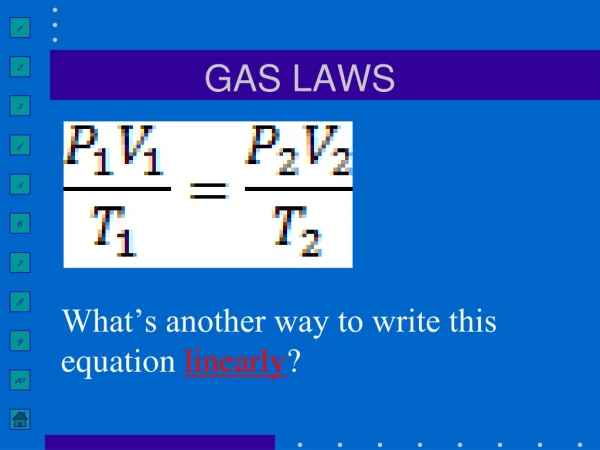
This guide provides an overview of fundamental gas laws: Boyle's Law, Charles's Law, and Guy-Lussac's Law. Boyle's Law explains the inverse relationship between pressure and volume at constant temperature, highlighting P1V1 = P2V2. Charles's Law describes the direct relationship between volume and temperature at constant pressure, with V1/T1 = V2/T2 (in Kelvin). Guy-Lussac's Law shows that at constant volume, an increase in temperature leads to an increase in pressure (P1/T1 = P2/T2). Lastly, the Combined Gas Law combines these principles for comprehensive problem-solving.


Gas Laws
E N D
Presentation Transcript
Boyles Law (BLT) At constant Temperature An increase in Pressure will decrease the volume Inverse relationship P1=V2 P2 V1 5. PV = K (constant)
Charle’s Law (CLP) 1. At constant Pressure 2. If you inc. T, you inc. V 3. temp is in degrees KELVIN 4. Direct relationship V1 = T1 V2 T2 0K = 0C + 273
Guy Lussac’s Law (GLV) 1. Volume is Constant 2. Inc in Temperature will Inc Pressure 3. Direct Relationship 4. T1 = P1 T2 P2
COMBINED GAS LAW 1. No Constants 2. Temperature in Kelvin
Can I make a suggestion? V1P1T2 = V2P2T1 Now, you are always just one step away from solving any gas law problem!