Download
1 / 11
110 likes | 254 Vues
This section explores the concepts of hydronium (H3O+) and hydroxide (OH-) ions, which are formed during the self-ionization of water. At 25°C, the concentrations of H3O+ and OH- are equal, maintaining the water equilibrium constant (Kw = 1.0 x 10^-14). In acidic solutions, H3O+ concentration increases while OH- concentration decreases, and vice versa for basic solutions. The relationship between pH and pOH is crucial for determining the acidity or basicity of a solution, providing essential insights for laboratory experiments.

E N D
Concept of ph Chapter 15 section 1
Hydronium and Hydroxide Ions • Hydronium ions (H3O+) is formed • Hydroxide ions (OH-) is formed • Pure water will self ionize between both • H2O + H2O
Ionization of Water • In pure water the concentration of H3O+ and OH- • In water at 25 *C there concentrations are equal to • H3O concentrations • OH concentrations
Ionization of water • When the two concentrations are added together they create • This constant is expressed by • Kw = • Kw =
Ionization of water • Kw = • [H3O] = • [OH] = • Kw = • Kw =
Acid & Base Solutions • In acidic solutions the H3O concentration increases & the OH • In basic solutions the OH concentrations increase and the H3O • There Kw value still equals • [H3O] = • 1.0 x 10-14 = • [OH] =
Practice pg 502 • A 1.0 x 10⁻⁴ M solution of HNO3 has been prepared for a laboratory experiment. • HNO3 = • [H3O] = • [OH] = • Kw =
Practice pg 502 • Kw = • 1.0 x 10-14= • 1.0 x 10-14 = • [OH] = • [OH] =
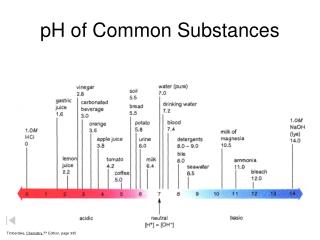
pH Scale • pH • Used to determine if a solution is • pH can be found by using a logarithm of the solutions • pH = • pOH = • pH + pOH =
Practice pg 505 • What is the pH of a 1.0 x 10⁻³ M NaOH solution? • NaOH = base = • [OH] = • pH = • [H3O] =
Practice pg 505 • Kw = • 1.0 x 10-14 = • [H3O] = • pH = • pH = • pH =