
Exploring the Chesapeake Bay's Ecosystem: A Historical and Contemporary Overview
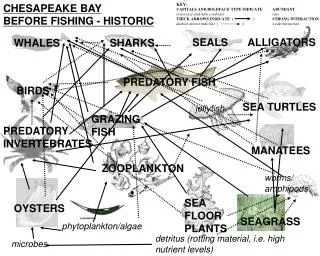
Discover the rich ecosystem of the Chesapeake Bay, examining its historical context and current state. This guide contrasts abundant species such as seals, whales, and predatory fish with rare ones represented in italics. It highlights interactions between various marine organisms, including jellyfish, sea turtles, and grazing fish, and the impact of human activities through fishing. Learn about the roles of seagrass, oysters, and detritus (rotting material) in maintaining the health of this vital estuarine environment.

Exploring the Chesapeake Bay's Ecosystem: A Historical and Contemporary Overview
E N D
Presentation Transcript
CHESAPEAKE BAY BEFORE FISHING - HISTORIC KEY: CAPITALS AND BOLDFACE TYPE INDICATE ABUNDANT lowercase and italics indicate rare THICK ARROWS INDICATE ( ) STRONG INTERACTION dashed arrows indictate ( ) weak interaction SEALS ALLIGATORS WHALES SHARKS PREDATORY FISH BIRDS SEA TURTLES jellyfish GRAZING FISH PREDATORY INVERTEBRATES MANATEES ZOOPLANKTON worms/ amphipods SEA FLOOR PLANTS OYSTERS SEAGRASS phytoplankton/algae detritus (rotting material, i.e. high nutrient levels) microbes
CHESAPEAKE BAY WITH FISHING - TODAY PEOPLE X sharks seals whales alligators predatory fish BIRDS JELLYFISH sea turtles grazing fish predatory invertebrates X manatees WORMS/ AMPHIPODS zooplankton oysters sea floor plants PHYTOPLANKTON/ ALGAE seagrass DETRITUS (rotting material, i.e. high nutrient levels) KEY: CAPITALS AND BOLDFACE INDICATE ABUNDANT lowercase and italics indicate rare THICK ARROWS INDICATE ( ) STRONG INTERACTION dashed arrows indictate ( ) weak interaction X indicates locally extinct MICROBES