Agile Development
Agile development is a broad term that encompasses various methodologies designed to enhance project flexibility and customer involvement. Rooted in the Agile Manifesto, established in 2001 by 17 visionaries, Agile emphasizes collaboration, working software, and adaptability over rigid processes. Key methods include Scrum, Extreme Programming (XP), and Crystal. The core principles focus on customer satisfaction through continuous delivery, welcoming changing requirements, frequent progress updates, and fostering teamwork. This approach leads to improved product quality and increased customer happiness.

Agile Development
E N D
Presentation Transcript
Agile Development By: Isuru Abeysekera
What is agile development? • Broad term used to describe several methods for a development process • Introduced in The Agile Manifesto (2001)
The manifesto • Put together by a group of 17 individuals • Kent Beck Mike Beedle • Arie van BennekumAlistair Cockburn • Ward Cunningham Martin Fowler • James Grenning Jim Highsmith • Andrew HuntRon Jeffries • Jon Kern Brian Marick • Robert C. Martin Steve Mellor • Ken SchwaberJeff Sutherland • Dave Thomas
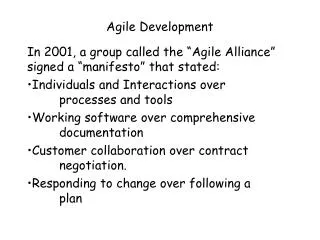
Core values • Individuals and interactions over processes and tools • Working software over comprehensive documentation • Customer collaboration over contract negotiation • Responding to change over following a plan
Most common methods • Extreme programming (XP) • Scrum • Crystal • Dynamic Systems Development Method (DSDM) • Etc…
The methods • The 12 principles of the Agile Software development made by the Agile Manifesto • Our highest priority is to satisfy the customer through early and continuous delivery of valuable software. • Welcome changing requirements, even late in development. Agile processes harness change for the customer's competitive advantage. • Deliver working software frequently, from a couple of weeks to a couple of months, with a preference to the shorter timescale. • Business people and developers must work together daily throughout the project. • Build projects around motivated individuals. Give them the environment and support they need, and trust them to get the job done. • The most efficient and effective method of conveying information to and within a development team is face-to-face conversation. • Working software is the primary measure of progress. • Agile processes promote sustainable development. The sponsors, developers, and users should be able to maintain a constant pace indefinitely. • Continuous attention to technical excellence and good design enhances agility. • Simplicity--the art of maximizing the amount of work not done--is essential. • The best architectures, requirements, and designs emerge from self-organizing teams. • At regular intervals, the team reflects on how to become more effective, then tunes and adjusts its behavior accordingly
Example • You’re a chair manufacturing company • I am you client and asked you to build me a chair
Shouldn’t Happen In Agile • Keep your client involved in the design process • What kind of chair? (office, lawn, dining table etc…)
Design the chair • Have your team work together (face to face)
Requirement Change • I decide I want arm rests on my chair • Builders and designers work together to implement it. • Does not require to restart entire process.
Testing • You find out wheel issues (too loud) • Find out solutions and check with customer
Mission Accomplished • Delivered product • I received exactly what I wanted. • I’m happy + your happy = good for business
Agile manifesto: http://agilemanifesto.org • Images: http://petemergencymelbourne.com.au/wp-content/uploads/2012/05/ConfusedDog.jpg http://pitstop.intro-techautomotive.com/GrandPrix.html http://www.cs.umd.edu/class/spring2003/cmsc838p/Process/waterfall.pdf