5.6 Quadratic Formula & Discriminant
80 likes | 255 Vues
Discover how the discriminant of a quadratic equation informs the number and types of solutions it has. This informative guide explores the key concepts behind the quadratic formula, detailing how to use it when factoring isn't feasible. Learn to compute the discriminant (b² - 4ac) and interpret its value: a positive result indicates two real solutions, a negative value means two imaginary solutions, and zero denotes a single real solution. Detailed examples illustrate the application of these principles in solving quadratic equations.


5.6 Quadratic Formula & Discriminant
E N D
Presentation Transcript
Discriminant: b2-4ac • The discriminant tells you how many solutions and what type you will have. • If the discrim: Is positive – 2 real solutions Is negative – 2 imaginary solutions Is zero – 1 real solution
Find the discriminant and give the number and type of solutions. 9x2+6x+1=0 a=9, b=6, c=1 b2-4ac=(6)2-4(9)(1) =36-36=0 1 real solution 9x2+6x-4=0 a=9, b=6, c=-4 b2-4ac=(6)2-4(9)(-4) =36+144=180 2 real solutions c. 9x2+6x+5=0 a=9, b=6, c=5 b2-4ac=(6)2-4(9)(5) =36-180=-144 2 imaginary solutions Examples
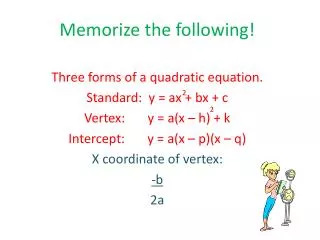
Quadratic Formula(Yes, it’s the one with the song!) If you take a quadratic equation in standard form (ax2+bx+c=0), and you complete the square, you will get the quadratic formula!
When to use the Quadratic Formula Use the quadratic formula when you can’t factor to solve a quadratic equation. (or when you’re stuck on how to factor the equation.)
Examples • 3x2+8x=35 3x2+8x-35=0 a=3, b=8, c= -35 OR
-2x2=-2x+3 -2x2+2x-3=0 a=-2, b=2, c= -3