Analyzing the Impact of Political Factors on Vote Share and Economic Indicators
This analysis explores the intricate connections between electoral outcomes, including vote shares in two-party systems, popular vote, and the Electoral College. It incorporates historical adjustments for significant factors like the 1948 Full Employment Act, growth rates, and inflation trends affecting real GDP. The study measures changes over the last 15 quarters, accounting for war influences and presidential term durations. Variations in party affiliations and term limits of the sitting president are also examined to understand their impact on political and economic landscapes.

Analyzing the Impact of Political Factors on Vote Share and Economic Indicators
E N D
Presentation Transcript
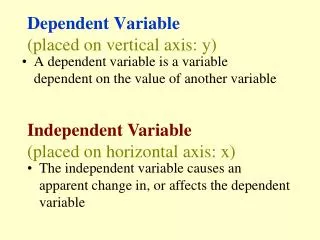
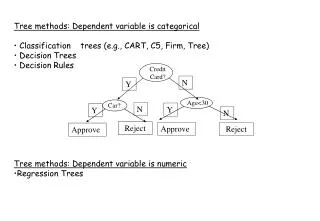
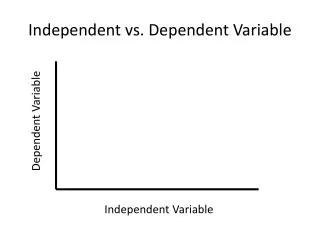
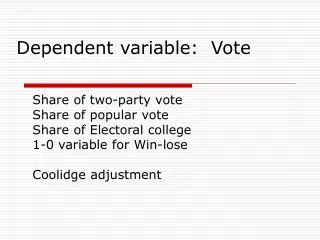
Dependent variable: Vote Share of two-party vote Share of popular vote Share of Electoral college 1-0 variable for Win-lose Coolidge adjustment
Data run • Most recent back to… • Smith • Fair – two versions • 1948 Full Employment Act
Growth rate • Three quarters prior • Per capita • Real GDP
Inflation • Average rate over 15 Q • % change in GDP deflator • Inflation-deflation symmetric • War adjustment
Good news • # of Qs in previous 15 with g > 3.2 • War adjustment
Duration • 1 term = 0 • 2 terms = 1 • 3 terms = 1.25 • 4 terms = 1.50 • 5 terms = 1.75
Person • 1 if sitting president running • Includes VP becoming President • Ford exception
Party • 1 = Democrat • -1 = Republican
![The Impact of [independent variable] On [dependent variable] Controlling for [control variable]](https://cdn0.slideserve.com/430545/the-impact-of-independent-variable-on-dependent-variable-controlling-for-control-variable-dt.jpg)