
SlideServe
Menu
Préférences
© SlideServe · v2026

Radio Frequency Identification (RFID)

emily avatar
15 diapositives · 532 Views · Jun 07, 2013

Radio Frequency Identification (RFID). Features and Functionality of RFID Including application specific ISO specifications. Presented by: Chris Lavin Sarah Clark Spencer Prows. What is RFID?.
Radio Frequency Identification (RFID) - slide 1
01 / 15Radio Frequency Identification (RFID)
1 / 17

Télécharger la présentation

Radio Frequency Identification (RFID)
Une image / un lien ci-dessous est fourni (tel quel) pour télécharger la présentation

Politique de téléchargement : le contenu du site vous est fourni TEL QUEL pour votre information et votre usage personnel ; il ne peut être vendu, concédé sous licence ni partagé sur d’autres sites sans l’accord de son auteur.Le contenu vous est fourni TEL QUEL, pour votre information et votre usage personnel uniquement. Téléchargez la présentation en cliquant sur ce lien. Lors du téléchargement, si vous ne parvenez pas à télécharger une présentation, l’éditeur a peut-être supprimé le fichier de son serveur.Pendant le téléchargement, si vous ne parvenez pas à obtenir une présentation, le fichier a peut-être été supprimé par l’éditeur.

F I N

Plus de contenu associé

Transcription de la présentation
  1. Radio Frequency Identification(RFID) Features and Functionality of RFID Including application specific ISO specifications Presented by: Chris Lavin Sarah Clark Spencer Prows

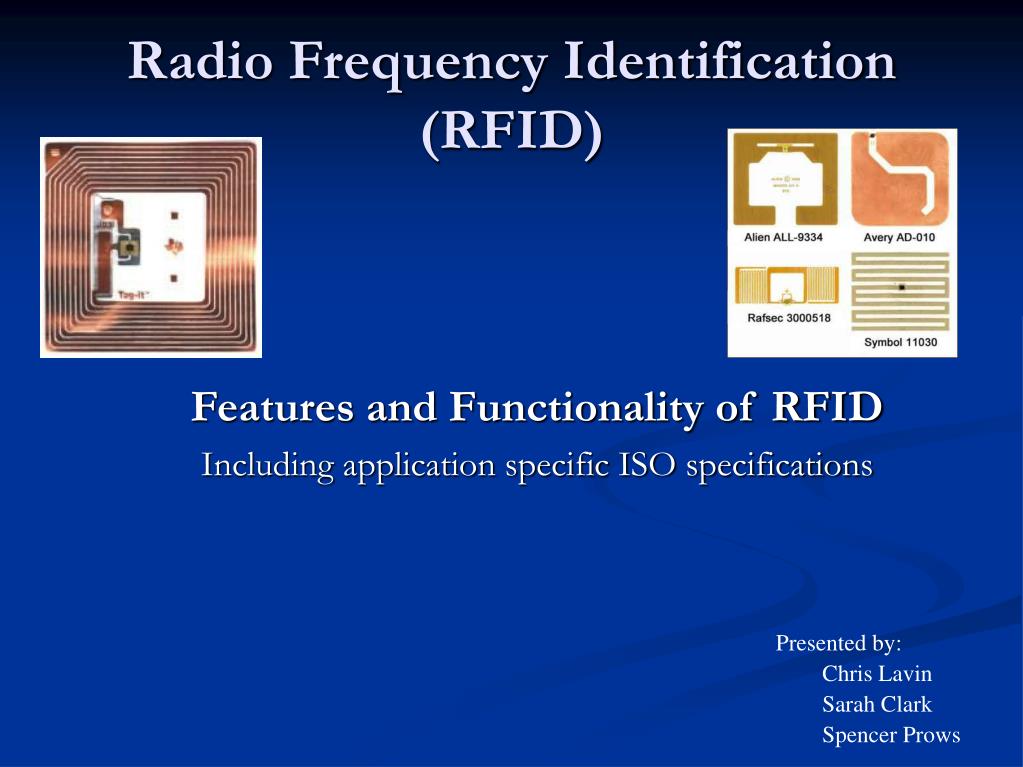
  2. What is RFID? RFID is a technology, whose origins are found in the WWII era, that incorporates electromagnetic or electrostatic coupling in the RF portion of the EM spectrum to uniquely identify an object, animal or person. It is also gaining increasing use in industry as an alternative to the bar code. Requires a transceiver, antenna, and transponder Can operate in Passive or Active Modes Source: http://searchmobilecomputing.techtarget.com/gDefinition/0,294236,sid40_gci805987,00.html

  3. What is RFID? RF signals transmitted by the transceiver activates the transponder, which transmits data back to the transceiver. Transponder is powered by EM waves emitted by the transceiver Various frequencies are used depending on the application Requires no line-of-sight (like bar-codes) Source: http://searchmobilecomputing.techtarget.com/gDefinition/0,294236,sid40_gci805987,00.html

  4. RFID Applications Tracking Books in Libraries Inventory Tracking Walmart required it of their top 100 vendors Authorized building access (Prox Cards) Passports (US passports recently) AmEx Blue credit card Prison inmates (embedded)

  5. RFID Applications For toll booths (or any “pay for entry” system) Airport Baggage ID Car keys, wireless entry and ignition Animals Hospital Patients Instant history tracking

  6. RFID Shortfalls Cost Transceiver ~ $1000 RFID Tags $0.20 each Not competitive with cost of barcode UHF signals problematic near metal and water Reader Collisions Can be overcome using TDMA Tag Collisions Required some engineering of tag transmit timing Security Concerns

  7. RFID Standards and Specifications Application specific ISO standards

  8. RFID Standards Tracking Animals ISO 11784 – Specifies the structure of the ID code ISO 11785 – Specifies how transponder is activated ISO 14223/1 – Specifies RF code for advanced transponders Credit Cards ISO 15693 – Specifies modulation and coding schemes Passports and proximity cards ISO 14443 – Specifies modulation and coding schemes General Frequency bands ISO 18000 series

  9. Standard RFID Operating Frequencies ISO 18000-2 <135 KHz ISO 18000-3 13.56 MHZ ISO 18000-4 2.45 GHz ISO 18000-6 860-960 MHz ISO 18000-7 433 MHZ (active)

  10. Standard RFID Operating Frequencies ISO 18000-2 ~ 135 kHz ISO 18000-6 ~ 800-960 MHz ISO 18000-3 ~ 13.56 MHz ISO 18000-4 ~ 2.45 GHz ISO 18000-7 ~ 433 MHz

  11. ISO 18000-2 Operates at >135 KHz Inductive Unaffected by presence of water Short range (a few centimeters) Fairly costly because of coil in transponder

  12. ISO 18000-3 Operates at 13.56 MHz Inductive Lower cost ~ 35 cents Thin flexible form factor ( smart label ) Read / write capable Unaffected by water (but has to be tuned to item) Mid range, 70 – 125 cms Two flavors: Mode 1 Standard ISO 15693 data rate (26 kb/s) Mode 2 High speed interface (848 kb/s)

  13. ISO 18000-4 Operates at 2.45 GHz Propagating Dual Mode Passive Backscatter Passive tag currently out of fashion Active High data rate Long range in active version (100 m+) Affected by water (signal absorbed…microwave) Read / write capable Moderate cost Small antenna

  14. ISO 18000-6 A/B Operates between 860 – 960 MHz Propagating Long range 2-5 meters Low cost High data rates “Frequency agile” Read / write capable Relatively large antenna The future for mass application RFID

  15. ISO 18000-7 Operates at 433 MHz Active Long range - many meters High cost High data rates Read / write capable Manifest tags- DoD