Download
1 / 26

E N D
1. Homeostasis Chapter 1
Mr. Knowles
Anatomy and Physiology
Liberty Senior High School
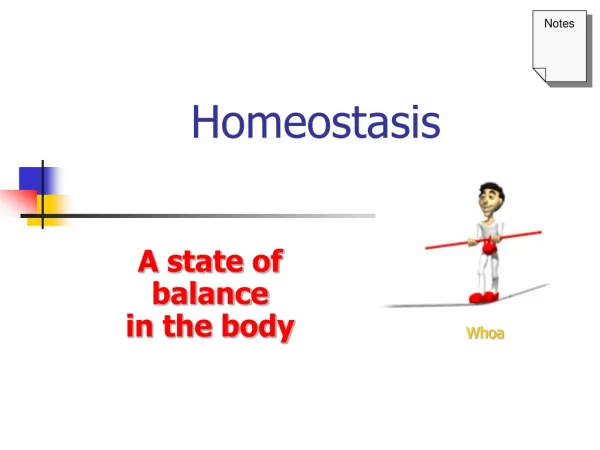
2. Homeostasis is a balancing act!
3. Homeostasis “Homeo”- same.
“-stasis”- standing or status.
To maintain a relatively constant internal environment.
External environment has many variables-temp., pH, amount of energy, etc.
4. What is a stimulus and a response? Stimulus- an environmental change that signals the body in some way.
Response- the change in cellular activity the body makes in order to maintain homeostasis.
5. Homeostasis is a Balancing Act! Chemical reactions within cells work most effectively within a certain range of conditions (temp., pH, salt, energy).
Organ systems work together to maintain this stable internal environment.
6. Homeostatic Regulation Two Mechanisms:
1. Autoregulation- activities of a cell, tissue or organ change automatically when faced with environmental variation.
Ex. Cells in a certain tissue need more O2. Cells?release chemicals?dilate (open) blood vessels nearby?local cells receive more O2 . Only localized changes.
7. Homeostatic Regulation Two Mechanisms:
2. Extrinsic Regulation-activities of several systems, such as the nervous and endocrine, work together to adjust or change the internal environment.
Ex. Touching a hot stove ?nervous system responds?processes information?muscle contraction .
Ex. Endocrine system? releases chemical messengers (hormones) ? affect many systems for a long period, last for hours, days.
8. Homeostasis Has Three Parts Receptor- a sensor that is sensitive to a particular environmental change or stimulus.
Control Center- receives and process the information supplied by the receptor.
Effector- a cell or organ that responds to the commands of the control center and whose activity opposes or enhances the original stimulus.
9. Homeostasis in Your House!
10. Two Types of Feedback 1. Negative Feedback- when the effector(s) activated by the control center oppose or eliminate stimulus. Most common feedback system; thermoregulation, salt, energy, pH, etc.
16. Another Perspective!
17. Negative Feedback-Ignores Minor Changes
18. Homeostasis and Negative Feedback It is range in which there is a set point.
The set point is not a fixed value.
The set point is dynamic and can change for the time of day or the individual.
19. Blood Sugar Regulation
20. Osmoregulation
21. The Second Kind of Feedback Positive Feedback- initial stimulus produces a response that exaggerates or enhances its effects. Less common.
Ex. Labor contractions, Blood clotting
22. Positive Feedback
23. A Physiological Example
24. When positive feedback doesn’t stop…
25. Prolapsed Uterus in a Horse
26. Homeostasis is a Balancing Act! Organ systems work together to keep within the range around the set point.
The systems are interdependent.
All are necessary for survival.
27. Show Me an Example of Homeostasis! The New Living Body-Homeostasis, 1995, VT 574.1 HOM