Efficient GPU-based Array Addition in C with CUDA
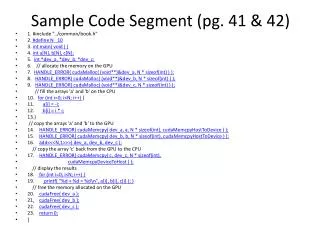
This code segment demonstrates the process of performing array addition on the GPU using CUDA C. It illustrates the allocation of device memory, array transfer between the CPU and GPU, and the execution of a kernel to perform element-wise addition. The program initializes two arrays on the CPU, copies them to the GPU, adds their corresponding elements, and then retrieves the results back to the CPU for output. Memory management is also showcased, emphasizing the need to free allocated device memory before program termination.

Efficient GPU-based Array Addition in C with CUDA
E N D
Presentation Transcript
Sample Code Segment (pg. 41 & 42) • 1. #include "../common/book.h" • 2. #define N 10 • 3. int main( void ) { • 4. int a[N], b[N], c[N]; • 5. int *dev_a, *dev_b, *dev_c; • 6. // allocate the memory on the GPU • 7. HANDLE_ERROR( cudaMalloc( (void**)&dev_a, N * sizeof(int) ) ); • 8. HANDLE_ERROR( cudaMalloc( (void**)&dev_b, N * sizeof(int) ) ); • 9. HANDLE_ERROR( cudaMalloc( (void**)&dev_c, N * sizeof(int) ) ); • // fill the arrays 'a' and 'b' on the CPU • 10. for (int i=0; i<N; i++) { • 11. a[i] = -i; • 12. b[i] = i * i; • 13.} • // copy the arrays 'a' and 'b' to the GPU • 14. HANDLE_ERROR( cudaMemcpy( dev_a, a, N * sizeof(int), cudaMemcpyHostToDevice ) ); • 15. HANDLE_ERROR( cudaMemcpy( dev_b, b, N * sizeof(int), cudaMemcpyHostToDevice ) ); • 16. add<<<N,1>>>( dev_a, dev_b, dev_c ); • // copy the array 'c' back from the GPU to the CPU • 17. HANDLE_ERROR( cudaMemcpy( c, dev_c, N * sizeof(int), • cudaMemcpyDeviceToHost ) ); • // display the results • 18. for (int i=0; i<N; i++) { • 19. printf( "%d + %d = %d\n", a[i], b[i], c[i] ); } • // free the memory allocated on the GPU • 20. cudaFree( dev_a ); • 21.cudaFree( dev_b ); • 22. cudaFree( dev_c ); • 23. return 0; • }
Sample Code Illustration – time t1 3. Int main (void) { 4. int a[N], b[N], c[N]; 5. int *dev_a, *dev_b, *dev_c; 2. define N 10 B C A Idle *dev_a *dev_c *dev_b
Sample Code Illustration – time t1 7. HANDLE_ERROR( cudaMalloc( (void**)&dev_a, N * sizeof(int) ) ); 8. HANDLE_ERROR( cudaMalloc( (void**)&dev_b, N * sizeof(int) ) ); 9. HANDLE_ERROR( cudaMalloc( (void**)&dev_c, N * sizeof(int) ) ); &dev_c &dev_a Idle &dev_b
Sample Code Illustration – time t2 • 14. HANDLE_ERROR( cudaMemcpy( dev_a, a, N * sizeof(int), cudaMemcpyHostToDevice ) ); • 15. HANDLE_ERROR( cudaMemcpy( dev_b, b, N * sizeof(int), cudaMemcpyHostToDevice ) ); 10. for (int i=0; i<N; i++) { 11. a[i] = -i; 12. b[i] = i * i; &dev_a i = 0 i = 1 i = 2 i = 3 i = N a[0] 0 a[1] -1 a[2] -2 a[3] -3 a[n] 9 … a[2] -2 a[1] -1 a[0] 0 b[0] 0 * 0 b[1] 1 * 1 b[2] 2* 2 b[3] 3* 3 b[n] 9 * 9 … … a[3] -3 a[9] -9 &dev_b c[0] c[1] c[2] c[3] c[9] … Array c, currently unused b[1] 1 * 1 b[0] 0 * 0 b[2] 2 * 2 … b[3] 3 * 3 b[9] 9 * 9
Sample Code Illustration – time t3 16. add<<<N,1>>>( dev_a, dev_b, dev_c ); &dev_a &dev_b &dev_a elements, added to &dev_b elements by each thread … … a[2] -2 a[1] -1 a[0] 0 a[3] -3 a[9] -9 -9+81 -1+1 -3+9 -2+4 0 + 0 … Idle a[9] + b[9] a[3] + b[3] a[0] + b[0] a[1] + b[1] a[2] + b[2] 10 total threads, one thread per operation &dev_c b[1] 1 * 1 b[0] 0 * 0 b[2] 2 * 2 c[2] 2 c[1] 0 c[0] 0 c[3] 6 c[9] 72 b[3] 3 * 3 b[9] 9 * 9 …
Sample Code Illustration – time t4 17. HANDLE_ERROR( cudaMemcpy( c, dev_c, N * sizeof(int), cudaMemcpyDeviceToHost ) ); dev_c c[0] c[1] c[2] c[3] c[9] … … c[0] 0 c[2] 2 c[1] 0 c[3] 6 c[9] 72
o Sample Code Illustration – time t5 18. for (inti=0; i<N; i++) { 19. printf( "%d + %d = %d\n", a[i], b[i], c[i] ); } For i, being 0 through 9, since it is n large, which is 10. a[i] Added with b[i] Equals c[i] a[0] 0 a[1] -1 a[2] -2 a[3] -3 a[n] -9 … a[n] a[3] a[2] a[1] a[0] b[1] 1 b[2] 4 b[3] 9 b[n] 81 b[0] 0 … b[n] b[3] b[2] b[1] b[0] c[3] 6 a[n] 72 c[1] 0 c[2] 2 c[0] 0 … c[n] c[3] c[2] c[1] c[0]
Sample Code Illustration – time t6 20. cudaFree( dev_a ); 21. cudaFree( dev_b ); 22. cudaFree( dev_c ); dev_b dev_a dev_c 23. return 0;
Diagram Key &dev_c &dev_a CPUGPU Triangle: Represents Array Transparent Oval: Empty Pointer Oval: Represents Pointer Solid Oval: Referenced Pointer Oval [red square]: Individual Array Elements Inverted Triangle: Filled Array Circle [red square]: Pointer Element Size in Bytes Triangle [red square]: Pointer Element Size in Bytes Red Square: One Block Color and Shading Transparent: Empty Blue Tint: Array Color Solid Color: Full Yellow: Dynamic Memory Allocation Parallel Arrays: Identical Colors Dashed Black Border: Pointer ---------------------------------------------------------------------------------------------------------------------------------------------- Red Arrows: Directionality of Memory Transfer Between CPU and GPU, or GPU and CPU Squiggle Arrow: Single Thread … a[2] -2 a[1] -1 a[0] 0 A a[3] -3 a[9] -9 -9+81