Database Design
This guide covers the importance of identifying key entities and relationships, determining attribute domains, and utilizing normalization techniques to create a robust E-R diagram and implement logical and physical designs. Learn how to avoid modification anomalies and ensure data integrity through functional dependence and normalization up to the Domain Key Normal Form (DKNF).

Database Design
E N D
Presentation Transcript
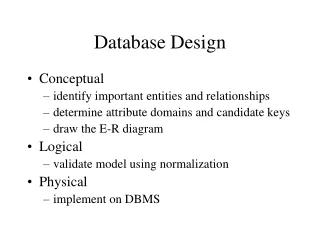
Database Design • Conceptual • identify important entities and relationships • determine attribute domains and candidate keys • draw the E-R diagram • Logical • validate model using normalization • Physical • implement on DBMS
Logical Design • Split data into multiple tables, such that • no information is lost • useful information can be easily reconstituted.
Modification Anomalies • Update • redundancies • Deletion • Insertion • violates entity integrity
Functional Dependence A column (attribute), B, is functionally dependent on another column, A (or possibly a collection of columns), if a value for A determines a single value for B at any one time.
Keys • All candidate keys are determinants • A group of attributes is a primary key if: 1) All attributes in the table are functionally dependent on the group 2) No subset of the group also meets the above condition
The Normalization Process • A set of steps that enables you to identify the existence of potential problems, called update anomalies, in the design of a relational database. • The goal of normal forms is to allow you to take a table or collection of tables and produce a new collection of tables that represents the same information but is free of problems.
Normalization • First normal form (1NF) • Second normal form (2NF) • Third normal form (3NF) • Boyce-Codd normal form (BCNF) • Fourth normal form (4NF) • Fifth normal form (5NF) • Domain key normal form (DKNF)
First normal form • A table that meets the definition of a relation • If there are repeating groups: • Place the repeating groups in a new table • Duplicate the primary key of the original table • Designate a new primary key for this table
Second Normal Form • A table (relation) is in second normal form (2NF) if it is in first normal form and no nonkey attribute is dependent on only a portion of the primary key. • If the primary key of a table contains only a single column, the table is automatically in second normal form.
Update Anomalies • Update • Inconsistent data • Additions • Deletions
Progressing to 2NF • If a table is not in second normal form • Move that data item and the part of the primary key on which it is functionally dependent to a new table. • Add any other data items are functionally dependent on the same part of the key • Make the partial primary key the primary key for the new table.
Third Normal Form • A table is in third normal form (3NF) if it is in second normal form and if the only determinants it contains are candidate keys. • Similar update anomalies: Updates, inconsistent data, additions, deletions.
Progressing to 3NF • Move all items involved in transitive dependencies to a new entity • Identify a primary key for the new entity • Place the primary key for the new entity as a foreign key on the original entity
Boyce-Codd Normal Form • A table is in BCNF if every determinant is a candidate for the primary key • Anomalies occur if : • The table has more than one candidate primary key. • The candidate keys are composite. • The candidate keys share a common data item.
Progressing to BCNF • Place the two candidate primary keys in separate entities. • Place each of the remaining data items in one of the resulting entities according to its dependency on the primary key
Multivalued Dependence In a table with columns A, B, and C, there is a multivalued dependence of column B on column A, if each value for A is associated with a specific collection of values for B and, furthermore, this collection is independent of any values for C. A table is in fourth normal form (4NF) if it is in 3NF and there are no multivalued dependencies.
Fourth Normal Form • A table is in fourth normal form (4NF) if it is in 3NF and there are no multi-valued dependencies • To remove multi-valued dependencies, create separate tables for the independent repeating groups