Understanding Prokaryotes: Kingdom Monera Overview
This chapter delves into prokaryotes, the unicellular organisms from Kingdom Monera characterized by the lack of membrane-bound organelles and nuclei. It outlines their classifications based on domain, nutritional types (autotrophs and heterotrophs), and oxygen reactivity (aerobes and anaerobes). The vital roles of prokaryotes include decomposition, pathogen behavior, nitrogen fixation, and their contribution to genetic engineering. The text also distinguishes between archaebacteria and eubacteria, highlighting their unique properties and significant subgroups.

Understanding Prokaryotes: Kingdom Monera Overview
E N D
Presentation Transcript
Prokaryotes Chapter 27
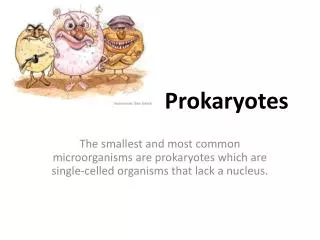
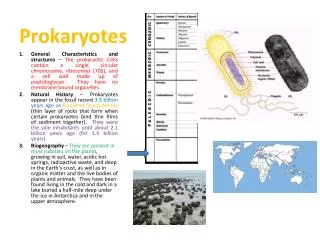
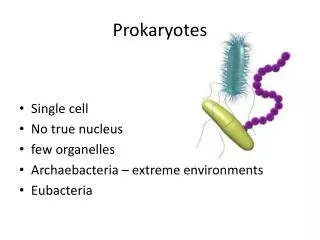
Kingdom Monera • Prokaryotes • Unicellular (Single-celled) organisms that lack membrane-bound organelles and nuclei • Divided by 1. Domain 2. Nutritional Classification 3. Reactivity with Oxygen
Nutritional Classification AUTOTROPHS • Photoautotrophs • Photosynthetic autotrophs – Like plants • Light energy Energy (ATP) • Carbon dioxide organic compounds (Glucose) • Chemoautotrophs • Inorganic substances Energy (ATP) • Carbon dioxide organic compounds (Glucose
Nutritional Class (Page 2) HETEROTROPHS • Photoheterotrophs • Light energy Energy (ATP) • Get carbon from consuming other organisms • Chemoheterotrophs • Get both carbon & energy from consuming other organisms
Reactivity with Oxygen • Whether they must react with O2, must be in absence of O2, or they can be in absence or not of O2 • Obligate aerobe – Require O2 for respiration • Obligate anaerobe – O2 is a poison to them • Facultative anaerobe – Prefer to use O2, but don’t need to use it to live
Questions • Which of the 3 classifications is appropriate for humans? • What would you call something that uses light for energy, but must obtain carbon in an organic form? • Aerobes would do what form of catabolism? • What about anaerobes?
Roles of Prokaryotes • Decomposers – recycle dead organic manner • Pathogens – organisms that cause disease • Nitrogen Fixation • Atmospheric N2 NH4 • ONLY way to fix nitrogen into organic systems • Play a vital role in genetic engineering • E. Coli is used to manufacture human insulin
Bacteria’s Roles (Page 2) • Symbionts in the gut – Manufacture vitamins • Digest cellulose • Digest Food • Bioremediation – remove pollutants • Used in production of cheese & yogurt
Symbiotic Roles • Symbiotic – relationships with other species • Mutualism – Both symbionts benefit • Pollinators & Flowering plants • Commensalism – One organism benefits other is unharmed • Fern growing in the shade of a tree • Parasitism – One benefits at the expense of another
Antibiotics • Chemicals that kill prokaryotes • Usually produced by fungi • NOT effective against viruses • Many plasmids confer resistance to different antibiotics • MDR-TB – Multi-Drug Resistant (resistant to multiple antibiotics) Tuberculosis bacteria • XDR-TB – eXtremely-Drug Resistant (resistant to almost every antibiotic) Tuberculosis bacteria
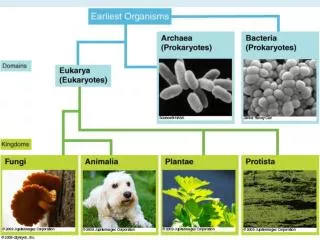
Archaebacteria • Unicellular • Prokaryotes • No Peptidoglycan in their cell walls • Able to live in extreme environments • Resemble the first cells on Earth • Extreme Halophiles– Salt lovers • Extreme Thermophiles – exist in extreme temperatures (high temperatures) • Methanogens – Use CO2 to oxidize H2 • Produce methane as a by product
Examples of Archaebacteria Hot Springs - Thermophiles Thermoacidophiles
Eubacteria • Broadly categorized as Gram-negative or Gram-positive • Due to whether the bacterium is able to take up Gram’s stain • Gram-positive – large amount of peptidoglycan in cell wall • Susceptible to antibiotics • Gram-negative – structurally more complex cell wall • Contains less peptidoglycan • Outer membrane contains lipopolysaccharides
5 Important Bacterial Subgroups • Proteobacteria • Chlamydias • Spirochetes • Gram-Positive Bacteria • Cyanobacteria
Proteobacteria • Includes photoautotrophs, chemoautotrophs, and heterotrohps • Some are aerobic, others are anaerobic • Nitrosomonas – Nitrogen fixing bacteria • Examples: • Escherichia coli (E coli) – benign & pathogenic • VibrioCholerae – Cholera • Rhizobium – live in roots of legumes
Chlamydias, Spirochets • Gram-negative like proteobacteria • Chlamydias • ALL are parasitic • Lack peptidoglycan • Chlamydia = most common STD or VD • Spirochetes • Helical shape • Move by rotating internal flagella-like filaments • Syphilis and Lyme disease • Others are free-living (not parasitic or pathogenic)
Gram-positive Bacteria • Diversity rivals proteobacteria • Streptomyces – source of many antibiotics • Bacillus anthracis • Clostridium botulinum • Mycoplasms – bacteria that lack cell walls (WTF?) • Synthetic organism?
Cyanobacteria • ONLY photoautotrophs • Plant-like photosynthesis • May have heterocytes – can fix nitrogen