Hydrogen-Production-Using-Electrolyzers
This presentation focuses on how electrolyzers produce hydrogen through the process of water electrolysis, where electricity is used to split water into hydrogen and oxygen. It highlights different types of electrolyzer technologies, their efficiency, and their role in generating clean, green hydrogen. The topic also touches on real-world applications and how this technology supports the shift toward sustainable and low-carbon energy systems.

Hydrogen-Production-Using-Electrolyzers
E N D
Presentation Transcript
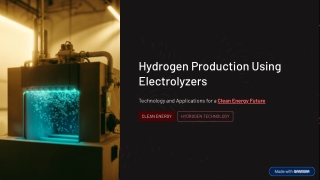
Hydrogen Production Using Electrolyzers Technology and Applications for a Clean Energy Future CLEAN ENERGY HYDROGEN TECHNOLOGY
What Is an Electrolyzer for Hydrogen Production? An electrolyzer for hydrogen production is an electrochemical device that splits water (H¢O) into hydrogen and oxygen using electricity. When powered by renewable energy sources 4 solar, wind, or hydro 4 it produces green hydrogen, a zero-emission fuel with transformative potential across industries. The core reaction: 2H¢O ³ 2H¢ + O¢ 4 clean, scalable, and carbon-free.
The Green Hydrogen Production Process Renewable Energy Input 1 Solar or wind power generates clean electricity Water Electrolysis 2 Electricity splits purified water in the electrolyzer stack Hydrogen Separation 3 H¢ is isolated, dried, and compressed for storage End-Use Application 4 Fuel cells, industrial processes, or grid balancing
Types of Green Hydrogen Technology Alkaline Electrolysis (AEL) PEM Electrolysis Solid Oxide (SOEC) Mature, cost-effective technology using liquid alkaline electrolyte. Ideal for large-scale, steady-state operations. Proton Exchange Membrane systems offer high efficiency and rapid response 4 perfect for intermittent renewables. High-temperature electrolysis achieves the highest efficiency, leveraging waste heat from industrial processes.
Building a Green Hydrogen System A complete green hydrogen system integrates multiple components beyond the electrolyzer stack itself. From renewable energy procurement and water treatment to compression, storage, and distribution 4 every element must be engineered for safety, efficiency, and scalability. Renewable energy integration & power conditioning Water purification and feed systems Hydrogen compression and storage infrastructure Safety controls, monitoring, and grid interface
Applications Across Industries Heavy Industry ? Decarbonizing steel, cement, and chemical manufacturing by replacing fossil-fuel-based processes with green hydrogen. Transport ? Fuel cell electric vehicles (FCEVs) for long-haul trucking, shipping, and aviation where batteries fall short. Energy Storage § Seasonal energy storage and grid balancing 4 converting surplus renewable electricity into storable hydrogen. Buildings & Heat ? Blending hydrogen into natural gas networks or using it directly in industrial heating applications.
Why Green Hydrogen Technology Is Accelerating Global Electrolyzer Capacity áMWâ A Market in Motion 2.5k Global electrolyzer capacity is growing exponentially, driven by national hydrogen strategies, falling renewable energy costs, and mounting climate commitments. The IEA projects over 8 GW of new capacity by 2025 4 a 10× increase from 2021 levels. 2k 1.5k 1k 500 EU Green Deal & REPowerEU targets US Inflation Reduction Act tax credits 0 2019 2020 2021 Year 2022 2023 Asia-Pacific national hydrogen roadmaps
Challenges on the Path to Scale Cost Competitiveness Infrastructure Gaps Efficiency & Water Use Green hydrogen currently costs $33$8/kg vs. $13$2/kg for grey hydrogen. Scaling electrolyzer manufacturing and reducing renewable energy costs are critical levers. Transport, storage, and refueling infrastructure for hydrogen remains underdeveloped. Significant capital investment is required to build a hydrogen economy backbone. Electrolysis requires purified water and has energy conversion losses. Co-locating systems with desalination and waste-heat recovery can improve overall system efficiency.
The Road Ahead: Innovation & Investment $300B Projected Investment Global hydrogen investment expected by 2030 50% Cost Reduction Target Electrolyzer cost reduction projected by 2030 24M Tonnes by 2030 IEA Net Zero scenario green hydrogen target 30+ National Strategies Countries with published hydrogen roadmaps
Key Takeaways Ready to Act? 1 2 Electrolyzers are the cornerstone Multiple pathways, one goal The hydrogen economy is not a distant vision 4 it is being built today. Early movers in electrolyzer deployment will define the competitive landscape for decades to come. The electrolyzer for hydrogen production is the enabling technology that converts renewable electricity into clean, storable hydrogen fuel. Alkaline, PEM, and SOEC technologies each serve different use cases 4 the right choice depends on scale, location, and energy source. Explore green hydrogen opportunities for your organization. 3 Scale is accelerating Falling costs, policy support, and industrial demand are converging to make green hydrogen systems commercially viable within this decade.