Lexicographic Search:Tries
70 likes | 239 Vues
This article explores the trie data structure, a versatile method for storing and searching keys as sequences of characters. Unlike traditional methods that compare entire keys, tries branch based on individual characters, allowing for faster searches. For alphabetic names, a 29-way branch is formed, while for numbers, a 10-way branch is used. The article provides examples of searching, inserting, and deleting keys within a trie. It examines the performance of tries compared to binary search trees, particularly advantageous when key character lengths are small relative to key quantity.


Lexicographic Search:Tries
E N D
Presentation Transcript
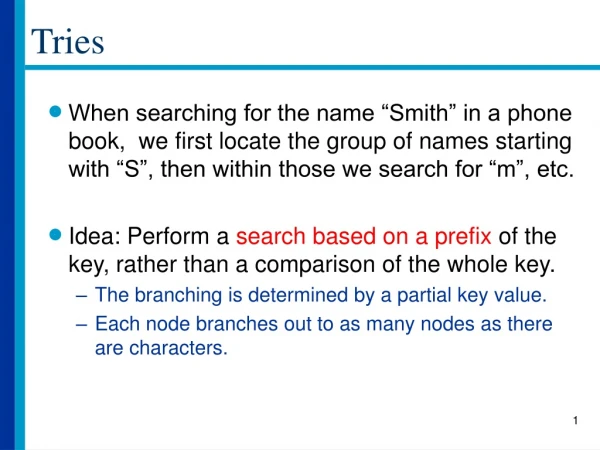
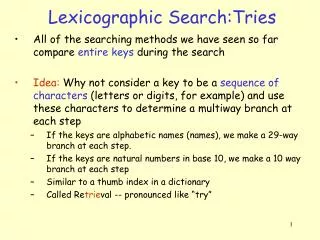
Lexicographic Search:Tries • All of the searching methods we have seen so far compare entire keys during the search • Idea: Why not consider a key to be a sequence of characters (letters or digits, for example) and use these characters to determine a multiway branch at each step • If the keys are alphabetic names (names), we make a 29-way branch at each step. • If the keys are natural numbers in base 10, we make a 10 way branch at each step • Similar to a thumb index in a dictionary • Called Retrieval -- pronounced like “try”
0 Tries - Example • Assume that we have the following keys in a trie: • 0, 10, 11, 100, 101, 110, 2, 21 • Notice that the rootdoes not store actual data 0 1 2 3 4 5 6 7 8 9 2 10 11 21 110 100 101
0 110 Tries - Search • Search 110: 0 1 2 3 4 5 6 7 8 9 2 10 11 21 110 100 101
0 2195 Tries - Insertion • Insert 2195 into the following trie: 0 1 2 3 4 5 6 7 8 9 2 10 11 21 110 100 101
0 2195 Tries - Deletion • Delete 10 from the following trie: 0 1 2 3 4 5 6 7 8 9 2 10 11 21 110 100 101
0 2195 Tries - Deletion • Delete 110 from the following trie: 0 1 2 3 4 5 6 7 8 9 2 21 110 100 101
Tries: Summary • # of steps requires to search a trie (or to insert into it) is proportional to the number of characters making up a key • E.g., if we have numbers in the range 0 – 999999, then we have at most 6 steps (comparisons) to reach a key • If the number of chars is small relative to the logarithm 2 of the number of keys, a trie may be superior to a binary search tree • E.g., if keys consist of all 999999 numbers in the range 0-999999, we have at most 6 steps to reach a key, whereas a binary search tree would take log2(999999) ~ 20 steps (key comparisons) • The best solution may be to combine the methods • A trie can be used in the fist few chars of the key, and then another method can be used for the remainder of the key