Progressivism Essay
>>> How to write an essay? Order on the website: HelpWriting.Net

Progressivism Essay
E N D
Presentation Transcript
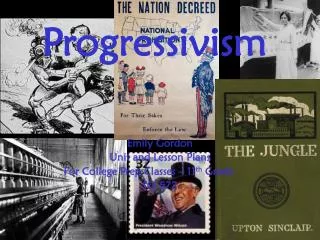
Progressivism Essay Progressivism The Progressive Movement in the late nineteenth century, early twentieth century presented quite a situation for historians to conquer. At the turn of the twentieth century political questioning was the norm. Practically every historian that writes about this time period has a different opinion of what made up "Progressive Movement," some even going so far to beg the question if it was actually a movement or if it was more of an "era." The two are interchanged so often that they have in many ways come to mean the same thing although according to some they are distinctly different. The four works, Richard Hofstadter's The Age of Reform, Peter Filene's "An Obituary for the Progressive Movement," Richard McCormick's "The...show more content... He discusses the agrarian myth in some depth and argues that the agrarian populism eventually evolves into part of the progressive movement. His book is one of the main sources that Peter Filene argues against in his article questioning the existence progressivism as a movement. Peter Filene's article presents the idea that Progressivism was not a movement at all but more of a jumbled mess of similar ideas that occurred around the same period in history. Filene "seeks to prove that 'the progressive movement' never existed." (Article 1, p. 20) He believed that there are too many discrepancies between the ideas of different historians and that if it were an actual movement that the definitions of the progressive movement/era would be consistent with each other. The only real agreement that Filene finds between the many differing opinions is the goals of the time period. He includes as the "standard list of progressive objectives... constraints on monopolies, trusts and big banking interests; regulation of railroad rates; lower tariffs; the direct primary; initiative, referendum and recall; direct election of U.S. Senators; women's suffrage; child– and female– labor laws; pure food and drug laws and conservation." (Article 1, p. 21) Filene explains the discrepancies between the many historians' views. He then asks the question, with so many different initiatives and so many different groups working towards similar goals how it can be considered ...Get more content on HelpWriting.Net...
John Dewey And Progressivism Progressivism, by definition, is the advocacy for societal improvement by reform. During the early twentieth century, education went through John Dewey was an American psychologist, philosopher, educator, social critic, and political activist who had a profound influence on education. In 1897, he published a groundbreaking document entitled "My Pedagogic Creed" that shaped progressive education for the twentieth century. It is broken down into five main articles in which he explains his philosophies about how students should learn, how teachers should teach, and how schools should operate. He believed that the educational process has two sides; psychological and sociological. Furthermore, he believed that the educational process should reflect those two sides and that each individual is unique. His philosophy emphasizes the active role of the student to build understanding and process information. He believed that students thrived in an environment in which they were encouraged to interact with the material and take part in their education. In his eyes, a school was not only a place to develop knowledge but also to develop life skills. Dewey's foundational document inspired many progressive–era educational activists and teachers and helped shape modern education. Dewey saw education and society as interconnected concepts. He believed that school should be a social institution because students learn best when school is an extension of a nurtured home life. This belief of ...Get more content on HelpWriting.Net...
Reflection On Progressivism After completing the survey in the Introduction to Teaching textbook, I learned that my philosophy of education closely correlates with the views of progressivism. My understanding of this philosophy highlights the child as a whole and the importance of active learning that readies students for the world ahead of them. Progressivists also believe that experiences are a large part of a students learning which is why active learning is so common allowing students to learn about themselves and learn how to problem solve. Rather than believing in strict common core curriculum, progressivist believe that the interest of students should be the main source of deciding curriculum and activities. John Dewey 'father of progressive education' was a...show more content... A student can be involved in their education and the progress they make rather than being a bystander with a lecture style classroom and are active participants in their learning and evaluations. Overall, the use of a progressive outlook in the classroom creates a student centered and directed environment that focuses on the student and their interests promoting growth and knowledge rather than testing and repetition. The INTASC that has always stuck out to me and would fit well into a progressive classroom was standard #2: Learning Differences. Council of Chief State School Officers define this strategy as "the teacher uses understanding of individual differences and diverse cultures and communities to ensure inclusive learning environments that enable each learner to meet high standards" (2011). With a progressive philosophy of education, the main goals are to give students an education that is personal and relates to their life. The focus of meaningful life and education can be explored and expressed in learning differences. To start the year off on a high note, I plan to meet with parents and students as an introductory meeting. These are sometimes held in group settings, but meeting face to face and allowing parents to voice their beliefs separate from peering eyes is a more personal approach. In these initial meetings, I will gather information about diversity ...Get more content on HelpWriting.Net...
Essay about Progressivism Progressivism implies a philosophy which welcomes innovations and reforms in the political, economic, and social order. The Progressive movement, 1901 to 1917, was ultimately the triumph of conservatism rather than a victory for liberalism. In a general sense, the conservative goals of this period justified the Liberal reforms enacted by Progressive leaders. Deviating from the "traditional" definition of conservatism (a resistance to change and a disposition of hostility to innovations in the political, social, and economic order), the Conservatist triumph was in the sense that there was an effort to maintain basic social and economic relations vital to a capitalist society. The Progressive leaders essentially wanted to perpetuate...show more content... In 1902, the United Mine Workers were willing to submit to arbitration, but the coal operators adamantly opposed any recognition of the union. Thus, the union members decided to strike over wages, safety conditions, and union recognition. The Anthracite Coal Strike of 1902 ended with the appointment by Roosevelt of an arbitration commission to rule on the issues. Business men did not regard politics (government regulation) as a necessary evil, but as an important part of their position in society. Roosevelt did not see big business as evil, but a permanent development that was necessary in a modern economy. Roosevelt couldn't rely on the courts to distinguish between "good" or "bad" trusts. The only solution was for the executive to assume that responsibility. Roosevelt's ingenious "square dealings" and "gentlemen's agreements" controlled many firms. In 1903, a new cabinet position was created to address the concerns of business and labor (Department of Commerce and Labor). Within the department, the Bureau of Corporations was empowered to investigate and report on illegal activities of corporations. The abuse of economic power by railroads proposed another problem for Roosevelt. However, in 1903, the Elkins Act empowered the ICC (Interstate Commerce Commission, first American federal regulatory agency) to act against ...Get more content on HelpWriting.Net...
Progressivism Reflection Upon self–evaluation and reflection of the chapter on philosophies of education, I have determined that I lean mostly towards progressivism and I will explore the role as a teacher, the students' cognitive development, curriculum development, and the ways people learn best, in the American history classroom scenario. Progressivism sees learning as student–centered, therefore, the teacher's role is the facilitator. As a progressive teacher, I believe that students should be problem–solvers in order to adapt to the ever–changing world. In a progressive classroom, a curriculum is not a collection of standards and facts, it is, instead, ongoing "hands–on investigations, projects, and design challenges that inspire greater interest, depth and understanding" ("Progressive Education", 2017, para. 2). Constructivism is the paradigm where students learn through experimenting and real–world problem solving to construct their own understanding of the world. As a subject, American history lends itself to becoming a microcosm of the ideals and practices of a democratic community with simulated, real–world problems in the historical setting. In my classroom I am the facilitator of my students learning. I began by training them in critical thinking skills, communication and collaboration, as well as, effectively using, managing, and evaluating information ("Progressive Education", 2017, para 5). Providing resources and activities for developing students' problem–solving abilities includes setting up multiple learning spaces with several resources for exploration that are both print and technology based. Student–centered classrooms require that the teacher acts as guide in helping children do what they want to do and learn. In the provided American History Teacher scenario, the teacher needs to scaffold the children from the traditional classroom expectations and habits to more independent, critical thinking skills. This will eliminate students' responses such as, "I didn't have my hand up" or "I don't know." C'mon, just tell us what you want us to know, "Why do we have to learn this stuff?" (Philosophy Essay, n.d., para. 2). The aim of progressive education is to nurture the student's curiosity about their world and ...Get more content on HelpWriting.Net...
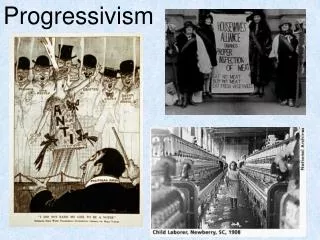
The Progressive Era The Progressive Era was a period of economic and social struggle which cause rapid industrialization in America. A Widespread of social activism and political reform across the United States. The Progressive Era was addressing the problems of economic and social problems. The progressivism started as a social movement and later grew into a political movement. The reformers of the Progressive Era were young, college educated, and in the middle–class. Although many laws were passed to regulate better working conditions, not many were by it, many companies still made their workers, work long hours. Not many had better working conditions as still many died from lack of better safety regulations. The Progressive Era did help the United States to improve many things, and if these things didn't occur many things such as working conditions would still be the biggest problem. There were laws passed to improve working conditions but didn't really do anything Working conditions: The laws that were passed were to include efforts to outlaw the sale of alcohol; regulate child labor. How was working conditions in the Progressive Era? Many companies in the Progressive Era didn't have better working conditions other places had little to no safety in the building of their workplace an example That didn't a good working place with safety is The Triangle Fire. The triangle fire occurred in March 25 in 1911, most of the victims died as a result of neglected safety features and locked doors within the factory building. There were no sprinklers that could've put out the fire in time, the doors were locked that not many were able to get out on time, many jumped to their deaths. There were teenage girls that didn't speak English, they worked everyday for 12 hours. Forty–nine workers had burned to death or being suffocated by smoke, 36 were dead in the elevator shaft and 58 died from jumping to the sidewalks. With two more dying later from their injuries, a total of 145 people were killed by the fire. What were the laws that were passed to improve situations in the Progressive Era. The Progressives wanted to take part of the government in passing laws, political reformers were protecting workers and also regulating big business. ...Get more content on HelpWriting.Net...