
SlideServe
Menu
Préférences
© SlideServe · v2026

Solid and Hazardous Waste

enoch avatar
18 diapositives · 368 Views · Sep 19, 2014

Solid and Hazardous Waste. G. Tyler Miller’s Living in the Environment 14 th Edition Chapter 24. Key Concepts. Types and amounts of wastes. Methods to reduce waste. Methods of dealing with wastes. Hazardous waste regulation in the US. US: 11 billion metric tons/year.
Solid and Hazardous Waste - slide 1
01 / 18Solid and Hazardous Waste
1 / 17

Télécharger la présentation

Solid and Hazardous Waste
Une image / un lien ci-dessous est fourni (tel quel) pour télécharger la présentation

Politique de téléchargement : le contenu du site vous est fourni TEL QUEL pour votre information et votre usage personnel ; il ne peut être vendu, concédé sous licence ni partagé sur d’autres sites sans l’accord de son auteur.Le contenu vous est fourni TEL QUEL, pour votre information et votre usage personnel uniquement. Téléchargez la présentation en cliquant sur ce lien. Lors du téléchargement, si vous ne parvenez pas à télécharger une présentation, l’éditeur a peut-être supprimé le fichier de son serveur.Pendant le téléchargement, si vous ne parvenez pas à obtenir une présentation, le fichier a peut-être été supprimé par l’éditeur.

F I N

Plus de contenu associé

Transcription de la présentation
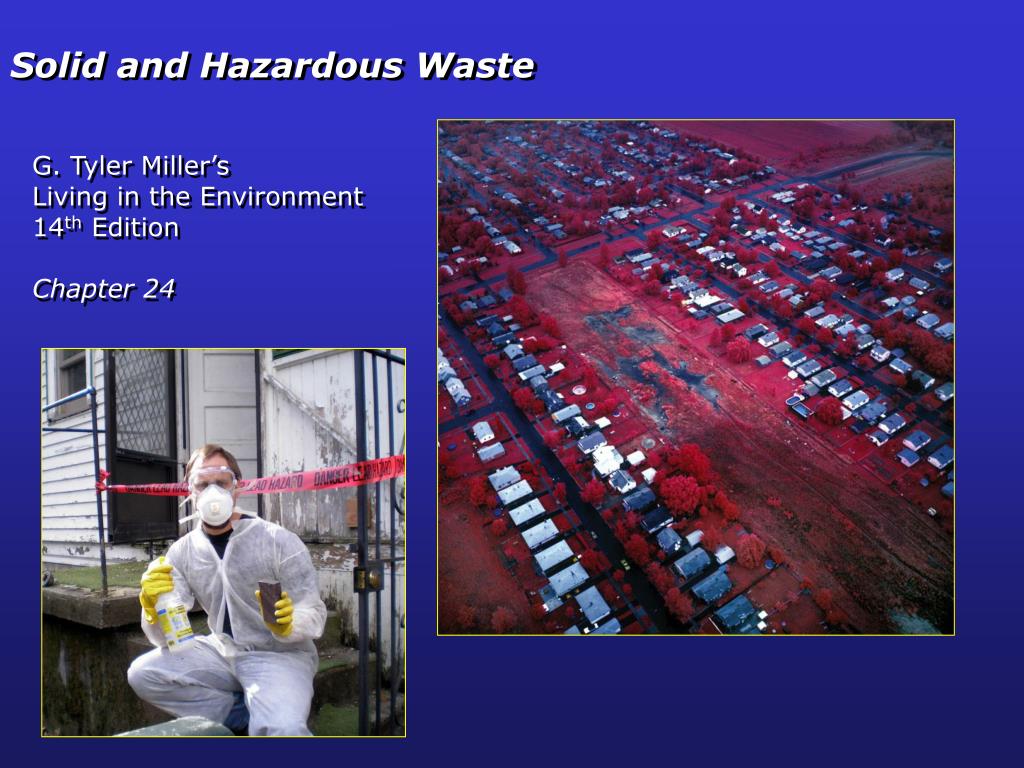
  1. Solid and Hazardous Waste G. Tyler Miller’s Living in the Environment 14th Edition Chapter 24

  2. Key Concepts • Types and amounts of wastes • Methods to reduce waste • Methods of dealing with wastes • Hazardous waste regulation in the US US: 11 billion metric tons/year

  3. Producing Less Waste and Pollution Sustainability Six • Waste prevention (low waste approach) • Consume less. • Use less materials and energy by redesigning manufacturing processes and products. • Produce less waste and pollution by redesigning manufacturing processes. • Develop products that are easily repaired, reused, remanufactured, composted, or recycled. • Design products with long lives. • Eliminate or reduce unnecessary packaging. Reduce, reuse, recycle • Waste management (high waste approach) Burying, burning, shipping Integrated Waste Management – Japan 1990’s

  4. Solutions: Cleaner Production Reuse • Ecoindustrial revolution • Extends resource supplies • Resource exchange webs • Saves energy and money • Biomimicry- (for example, 3M Company’s Pollution Prevention Pays (3P)). • Reduces pollution • Create jobs • Reusable products • Service-flow economy Solutions: Selling Services Instead of Things • Service-flow economy • Uses a minimum amount of material • Products last longer • Products are easier to maintain, repair, and recycle • Eco-leasing - Xerox Corporation’s document services and Ray Anderson’s INTERFACE company). See Individuals Matter p. 538

  5. Recycling • Primary (closed-loop) -when new products of the same type are created from the waste: new newspaper from old newspaper. • Secondary (open loop) –downcycling converts waste materials into different products. • Preconsumer waste / internal waste is generated from a manufacturing process that is recycled. • Postconsumer wasteexternal waste is generated by consumer use of products. Characteristics of Recyclable Materials • Easily isolated from other waste • Available in large quantities • Valuable

  6. Benefits of Recycling Fig. 24-8 p. 541 Recycling Methods • Centralized recycling of mixed waste (Materials-Recovery Facilities, MRFs) * • Source separation • Pay-as-you-throw (PAUT)

  7. Case Studies: Wastepaper and Plastics Paper • 49% of wastepaper recycled in US • Chlorine-based compound in paper production Plastics • 10% or less of plastic recycled in US Paper Recycling • Plastics can be very difficult to recycle • Plastic recycling is not feasible because of these problems: • Plastics are difficult to isolate in different materials. • Not much individual plastic resin is recoverable per product. • Recycled resin is much more expensive than virgin plastic resin. • Some success with plastics –building materials

  8. Burning Wastes Burying Wastes • Open dumps • Mass burn incineration • Air pollution • Sanitary landfills • Leachate collection • Monitoring wells • Emit greenhouse gases (CO2 and methane) that can be collected • Waste to energy Japan’s Incineration program Waste-to-Energy

  9. Burying Wastes Fresh kills: before and after

  10. Hazardous Wastes: Types • Contains at least one toxic compound • Catches fire easily • Reactive or explosive • Corrodes metal containers Not Hazardous Wastes under Resource Conservation and Recovery Act (RCRA) • Household wastes • Radioactive wastes • Mining wastes • Oil and gas drilling wastes • Cement kiln dust • Liquids containing organic hydrocarbons • <100 kg (220 lb) per month

  11. Detoxifying and Removing Wastes • Physical methods • Bioremediation * • Phytoremediation • Chemical methods • Plasma incineration *

  12. Deep-well Disposal Surface Impoundments: Hazardous Waste Landfill Examples: Love Canal Times Beach Netherlands’ Successful Hazardous Waste Program & Hazardous Waste Reduction Clean up vs. Prevention

  13. Case Studies: Lead • Lead poisoning major problem in children Primary Sources of Lead • Leaded gasoline (phased out by 1986) • Lead paint (banned in 1970) • Lead in plumbing • Progress is being made in reducing lead

  14. Case Studies: Mercury • Vaporized elemental Mercury • Natural inputs • Fish contaminated with methylmercury Minamata Bay • Emission control Minamata Bay • Prevention of contamination Bioaccumulation and Biomagnification

  15. Case Studies: Dioxins Sources of Dioxins • Waste incineration • Fireplaces • Coal-fired power plants • Paper production • Sewage sludge Examples: Love Canal Times Beach

  16. Hazardous Waste Regulation in the United States • Resource Conservation and Recovery Act (RCRA) regulates about 5% of the U.S. hazardous waste. • Comprehensive Environmental Response, Compensation, and Liability Act (CERCLA - Superfund) was passed in 1980. • The law identifies hazardous waste sites. • The law provides for cleanup of these sites on a priority basis. • The worst sites go on a National Priorities List (NPL) and are scheduled for total cleanup. • There are, also, laws that provide for cleaning up brownfields and abandoned sites contaminated with hazardous wastes like factories, gas stations, junkyards, etc. • National Priority List • Polluter-pays principle

  17. Solutions: Achieving a Low-Waste Society Local grassroots action The NIMBY (Not In My Backyard) philosophy has been replaced by most of citizens with the NOPE principle—Not On Planet Earth or ‘not in anyone’s backyard.’ There are four principles for transitioning to a low-waste society. Everything is connected. There is no place to send wastes “away.” Diluting waste is not the solution to pollution. The best solution is to prevent waste and pollution and, then, reuse/recycle the materials that we use. It is necessary to detoxify the U.S. economy. International ban on 12 persistent organic pollutants (the dirty dozen) In 2000, a global treaty to control twelve persistent organic pollutants (POPs) was developed. To be made effective, fifty countries must ratify the treaty. (1)POPs are toxic chemicals stored in the fatty tissue of humans and other organisms. (2)Twelve chemicals, the dirty dozen, need to be phased out, detoxified, and/or isolated. Precautionary Principle