SlideServe
Menu
Préférences
© SlideServe · v2026

Interdependence in Biological Diversity

eobryant avatar
33 diapositives · 592 Views · Jan 07, 2020

Explore the concept of niches and interdependencies among species in ecosystems, including symbiosis types like commensalism, mutualism, and parasitism. Learn how species coexist through resource partitioning and competition.
Interdependence in Biological Diversity - slide 1
01 / 33Interdependence in Biological Diversity
1 / 17

Télécharger la présentation

Interdependence in Biological Diversity
Une image / un lien ci-dessous est fourni (tel quel) pour télécharger la présentation

Politique de téléchargement : le contenu du site vous est fourni TEL QUEL pour votre information et votre usage personnel ; il ne peut être vendu, concédé sous licence ni partagé sur d’autres sites sans l’accord de son auteur.Le contenu vous est fourni TEL QUEL, pour votre information et votre usage personnel uniquement. Téléchargez la présentation en cliquant sur ce lien. Lors du téléchargement, si vous ne parvenez pas à télécharger une présentation, l’éditeur a peut-être supprimé le fichier de son serveur.Pendant le téléchargement, si vous ne parvenez pas à obtenir une présentation, le fichier a peut-être été supprimé par l’éditeur.

F I N

Plus de contenu associé

Transcription de la présentation
  1. Interdependence Biological Diversity, Unit A

  2. No species can survive by itself!

  3. Interdependence Learner Outcomes • I can investigate and interpret dependencies among species that link the survival of one species to the survival of others • I can identify examples of niches, and describe the role of variation in enabling closely related living things to survive in the same ecosystem

  4. What are Niches? • Niche is the role of an organism within a particular ecosystem.

  5. It includes… 1. What it eats. 2. Its habitat. 3. Nesting site, range and habits. 4. What effect it has on the other populations. 5. What effect it has on the environment. Describe your niche to someone beside you.

  6. If you were to describe your own niche… • 1. Where you live. • 2. What school you attend. • 3. Jobs you work at? • 4. Food you consume. • 5. Temperature you feel comfortable in. • 6. Influences you have on your community.

  7. Describe the different types of interdependencies between and among species. • Interdependence – ongoing relationship between organisms -

  8. SYMBIOSIS • “sym” means together & “bios” means life. • Symbiosis is an association between members of different species. • There are several types of symbiosis.

  9. Difference? • Does an organism benefit from the relationship, or is it harmed.

  10. Commensalism • One benefits, other does not benefit or is harmed.

  11. Mutualism • Both benefit.

  12. Parasitism • One benefits, other is harmed.

  13. Interspecies Competition • Two or more species need the same resource. • What are some examples that include humans?

  14. If 2 species compete… • For the same resource (e.g. food), there is less of it for each species. • Within each population, each member has access to a smaller share. • Which leads to more deaths due to starvation.

  15. Interspecies competition… • Limits the size of the populations of competing species. • How can so many species exist together in the same location? The answer lies in the niches they occupy.

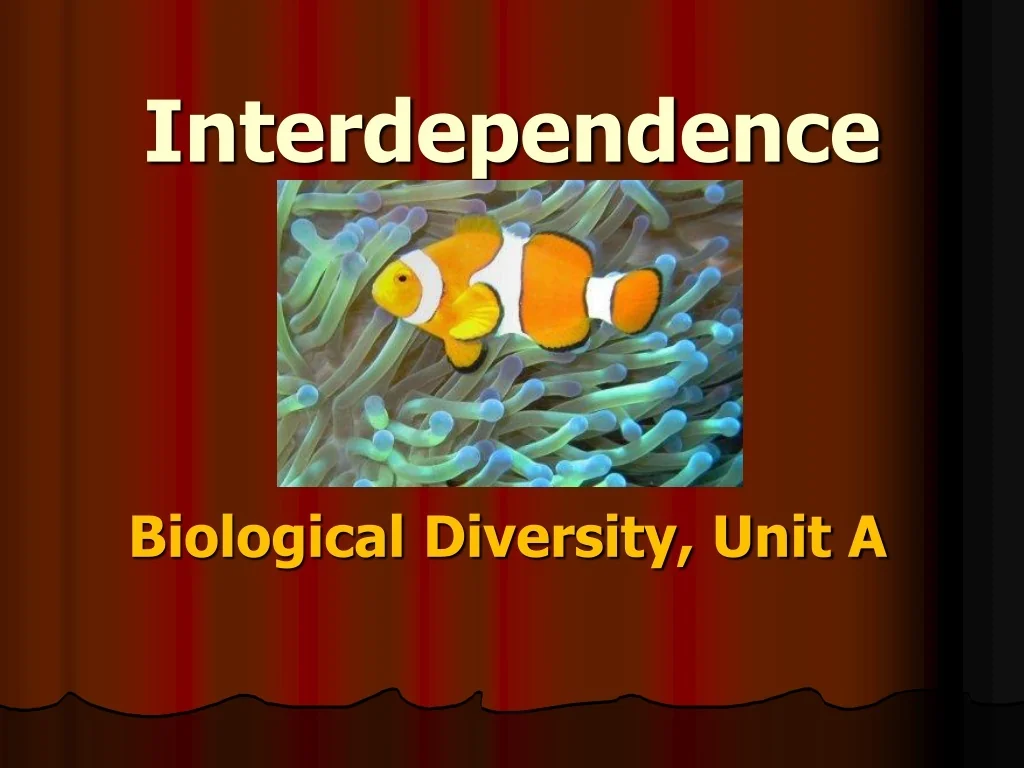
  16. Commensalism Some examples • Barnacles adhering to the skin of a whale or shell of a mollusk • Sea anemone and clownfish • Cattle Egrets and Cows

  17. Mutualism Some examples • Hummingbirds and flowers • Bull Horn Acacia and ants • Lichen on a mangrove tree

  18. Parasitism Some examples • Head louse on human • Mosquito on animal • Tapeworms

  19. What is Co-Habitation • Species that live within a common place and use the same resources. Mutual benefit.

  20. Resource Partitioning • … is the action which enables competing species to share the resources by accessing these resources in different ways, involving less direct competition. Three species of Warbler species feed on spruce bud worms in different parts of a tree.

  21. Sample Multiple Choice Question This type of arrangement described above is called • Natural selection • Artificial selection • Resource partitioning • Specialization Q1

  22. Sample Multiple Choice Question The association of an orchid and a mesophytic plant is an example of • Mutualism • Commensalism • Parasitism • Saprophytism Q2

  23. Sample Multiple Choice Question The adaptive value of the monarch’s colour pattern is necessary in order to • Warn predators so they do not try to eat the monarchs • Help the monarch find a mate • Help the monarchs to organize themselves into flocks • Camouflage the monarch amongst colorful flowers. Through the viceroy butterfly has no poison in its wings, the colour pattern on its wings is similar to that of the monarch’s. Such and adaptation is known as Specialization Selective breeding Mutualism Mimicry Q3 Q4

  24. Sample Multiple Choice Question The association of a a bee and a clusia is an example of • Parasitism • Commensalism • Mutualism • Heterotrophism Q5

  25. Answers to Sample Multiple Choice Questions • C • B • A • D • C

  26. Did you ... ... investigate and interpret dependencies among species that link the survival of one species to the survival of others? ... identify examples of niches, and describe the role of variation in enabling closely related living things to survive in the same ecosystem?

  27. Check & Reflect • Page 19, 1-5 • Due, Monday, September 26!