Enhancing Student Engagement Through Effective Questioning Techniques
This guide explores strategies to foster student dialogue, including "phone a friend" pair discussions and scaffolding techniques for younger learners. It emphasizes the importance of preemptive questioning, follow-up inquiries, and the use of Socratic questioning to deepen understanding. By incorporating methods like snowballing and encouraging metacognition, educators can nurture a classroom environment where students feel safe to take risks, explore ideas, and develop their own answers. The aim is to enhance student engagement and comprehension through dynamic questioning practices.

Enhancing Student Engagement Through Effective Questioning Techniques
E N D
Presentation Transcript
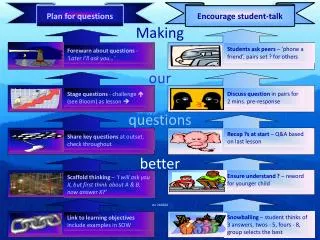
Plan for questions Encourage student-talk Making Students ask peers – ‘phone a friend’, pairs set ? for others Forewarn about questions - ‘Later I’ll ask you…’ our Stage questions - challenge (see Bloom) as lesson Discuss question in pairs for 2 mins. pre-response questions Recap ?s at start – Q&A based on last lesson Share key questions at outset, check throughout better Ensure understand ? – reword for younger child Scaffold thinking – ‘I will ask you X, but first think about A & B, now answer X?’ ctc 241004 Snowballing – student thinks of 3 answers, twos - 5, fours - 8, group selects the best Link to learning objectives Include examples in SOW
Support the ‘questionee’ Use open questions Making Support students in search for own answers Play Devil’s Advocate – challenge, extend, clarify our Provide wait, think, response time ( 15 secs.) Think answers - avoid thinking of a single answer questions Nurture classroom ethos of risk taking and tentativeness Follow-up questions – Why? Explain, Tell me more… better Credit effort Use enquiry questions - stimulate further enquiry ctc 241004 Use Socratic questions – open minds, probe understanding and reason Encourage metacognition – ‘What made you think that?’