Understanding Homeostasis: Passive and Active Transport Mechanisms in Cells
This lesson explores the fundamental concepts of homeostasis and the mechanisms that cells use to maintain equilibrium. Discover how diffusion and osmosis work, differentiating passive transport (which requires no energy) from active transport (which requires energy). Learn about the roles of cellular membranes in regulating molecular movement and the significance of various concentration gradients. Additionally, delve into processes such as facilitated diffusion, endocytosis, and exocytosis, along with key examples, including sodium-potassium pumps and the effects of osmosis on cells.

Understanding Homeostasis: Passive and Active Transport Mechanisms in Cells
E N D
Presentation Transcript
Maintaining Homeostasis Passive and Active Transport
Lesson Objectives • Understand how equilibrium is established as a result of diffusion. • Distinguish between diffusion and osmosis.
Cellular Membrane • Membrane: function is to control what enters and exits the cell • Selectively permeable
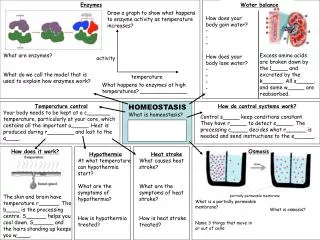
Homeostasis • All living cells exists in a liquid environment • Internal conditions need to remain constant • Homeostasis • Equilibrium=everything is balanced • Maintain homeostasis by regulating movement of molecules across the membrane • Passive Transport (no energy required) • Active Transport (energy required)
Passive Transport: Diffusion • Movement of materials across the cell membrane without using energy • Diffusion: • Movement of material/molecules from an area of high concentration to an area of low concentration • Concentration Gradient
Passive Transport: Osmosis • When water diffuses across the cell membrane • http://highered.mcgraw-hill.com/sites/0072495855/student_view0/chapter2/animation__how_osmosis_works.html
Effects of Osmosis on Cells Hypotonic: • Lower solute concentration outside of the cell • Water moves into the cell • Cell swells Hypertonic: • Higher solute concentration outside of the cell • Water moves out of the cell • Cell Shrinks Isotonic: • Concentration is the same inside and out • Water moves in and out
Osmosis In Nature • Cytolysis: in a hypotonic solution red blood cells will continue to swell until they burst • Penicillin killing bacteria • Contractile Vacuole: organelle in protist cells that pumps excess water out • http://www.youtube.com/watch?v=pahUt0RCKYc&feature=related • Turgor Pressure: water pressure placed on the cell wall to give plant cell its shape • Plants wilting if solution is hypertonic • Don’t drink salt water • Diarrhea • Something in stools that is drawing out the water
Facilitated Diffusion • Movement of particles from higher concentration to lower concentration • Large molecules may require “help”, they use carrier proteins • Nervous system uses Na and Ca pumps
Lesson Objectives • Distinguish between passive and active transport. • Explain how sodium-potassium pumps operate. • Compare and contrast endocytosis and exocytosis.
Active Transport Active Transport Passive Transport: down concentration gradient
Active Transport Passive Active
Active Transport • Requires energy to move molecules up their concentration gradient • Low concentration to high concentration • Sodium-Potassium Pump • Exocytosis • Endocytosis
Cell Membrane Pumps • Requires a carrier protein • 3 Na-2 K • Requires energy • http://highered.mcgraw-hill.com/sites/0072495855/student_view0/chapter2/animation__how_the_sodium_potassium_pump_works.html
Endocytosis • Phagocytosis • Pinocytosis