Decimals and Decimal Computations
This educational resource explores the relationships between decimals and fractions through visual aids, computational strategies, and practical examples. Students will learn how to represent parts of a whole using squares and fractions, convert familiar fractions to decimals, and apply estimation techniques. The material covers basic operations including addition, subtraction, multiplication, and division involving decimals. Concepts such as benchmark estimation and comparing decimals and fractions are also included, making this a comprehensive guide for mastering decimal computations.

Decimals and Decimal Computations
E N D
Presentation Transcript
10 x 10 Model • Square is seen as a whole. • How many squares make up the whole? • How many squares are in a half? • How many squares are in a quarter?
Fraction -Decimal Connection • Cover up 35/100 of the square • What is another way to record this part of the whole? • What is another way to write 1.68?
Familiar Fractions • 1/4 = what as a decimal? • 1/5 = What as a decimal? • 1/20 = what as a decimal? • 1/8 = what as a decimal? • What strategy do we use to solve?
Not so Familiar? • 1/3 = what as a decimal? • 1/6 = what as a decimal? • What strategy do we use now?
Estimation = Benchmarking • Which Fraction would be the approximate of .52 • 1/50 • 1/5 • 1/4 • 1/2
Fraction - Decimal Match • 2.804, 2.41, 2.6271, 2.211 • 11/5, 2 7/8, 2 5/8, 2 1/3
Comparing Decimals/Fractions • Estimate using a number line with benchmarks 0 , 1/2 , and 1 • 3/8, 2.567, 5/3, 1 4/5, 1.8765
Computations With Decimals • What comes to mind when you see these computations? • 4.907 + 123.01 + 56.1234 • 459.8 + 12.345 • 24.67 + 1.84 • 514.67 / 3.59
Estimation First • 73.46 + 6.2 + 0.582 • Estimate first • What is the answer? • How can you add and subtract decimal numbers that will work every time?
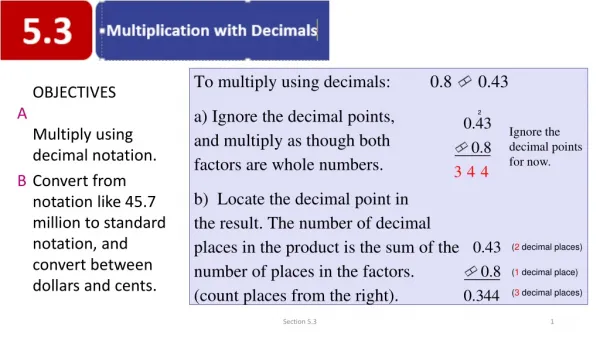
Multiplication • What is 24 x 63 • So what is • .24 x 6.3 • 24 x .63 • 2.4 x 63
Division • 146 / 7 = 20857 (without the decimal point) • So what is the answer: • 146 / 0.7 • 1.46 / 7 • 14.6 / 0.7