
Chapter Menu
E N D
Presentation Transcript
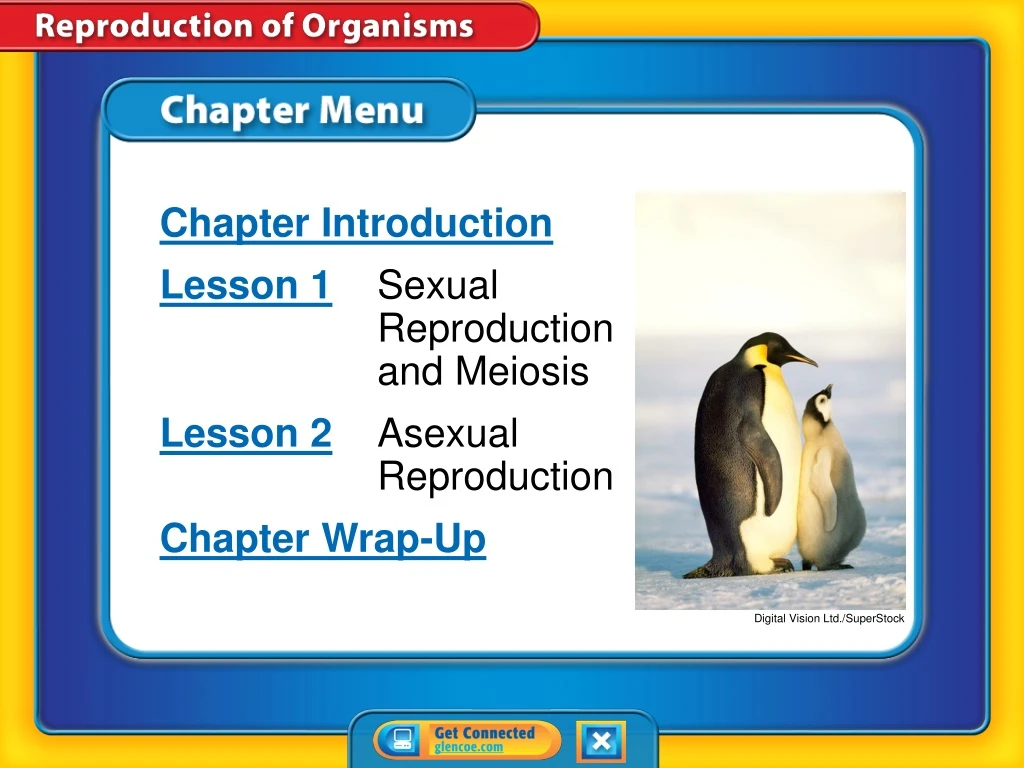
Chapter Introduction Lesson 1 Sexual Reproduction and Meiosis Lesson 2 Asexual Reproduction Chapter Wrap-Up Digital Vision Ltd./SuperStock Chapter Menu
Why do living things reproduce? Chapter Introduction
Sexual Reproduction and Meiosis • What is sexual reproduction, and why is it beneficial? • What is the order of the phases of meiosis, and what happens during each phase? • Why is meiosis important? Lesson 1 Reading Guide
Sexual Reproduction and Meiosis • sexual reproduction • egg • sperm • fertilization • zygote • diploid • homologous chromosomes • haploid • meiosis Lesson 1 Reading Guide - Vocab
What is sexual reproduction? • Sexual reproductionis atype of reproduction in which the genetic materials from two different cells combine, producing an offspring. • The female sex cell, an egg, forms in an ovary. • The male sex cell, a sperm, forms in the testis. Lesson 1
What is sexual reproduction? (cont.) During a process called fertilization, an egg cell and a sperm cell join together to create a zygote. Lesson 1
Diploid Cells • Organisms that reproduce sexually form body cells and sex cells. • In body cells of most organisms, similar chromosomes occur in pairs. • Diploidcells are cells that have pairs of chromosomes. Lesson 1
Diploid Cells (cont.) • Pairs of chromosomes that have genes for the same traits arranged in the same order are called homologous chromosomes. • Because one chromosome is inherited from each parent, the chromosomes are not identical. • Different organisms have different numbers of chromosomes. Lesson 1
Haploid Cells Haploidcells are cells that have only one chromosome from each pair of chromosomes. haploid from Greek haploeides, means “single” Lesson 1
Haploid Cells (cont.) • In meiosis, one diploid cell divides and makes four haploid sex cells. • Meiosis occurs only during the formation of sex cells. • Meiosis involves two divisions of the nucleus, meiosis I and meiosis II. • A reproductive cell goes through interphase before beginning meiosis I. Lesson 1
Why is meiosis important? • Meiosis forms sex cells with the correct haploid number of chromosomes. • Meiosis also creates genetic variation by producing haploid cells. • When haploid sex cells join together during fertilization, they make a diploid zygote, or fertilized egg. Lesson 1
Why is meiosis important? (cont.) The fertilized egg, formed when sex cells join together, divides by mitosis to create a diploid organism. Lesson 1
Why is meiosis important? (cont.) Why is meiosis important? Lesson 1
How do mitosis and meiosis differ? • During mitosis and cell division, a body cell and its nucleus divide once and produce two identical cells. • The two daughter cells produced by mitosis and cell division have the same genetic information. Lesson 1
How do mitosis and meiosis differ? (cont.) • During meiosis, a reproductive cell and its nucleus divide twice and produce four cells—two pairs of identical haploid cells. • Meiosis forms sex cells used for sexual reproduction. Lesson 1
Advantages of Sexual Reproduction • Genetic variation occurs in all organisms that reproduce sexually. • Due to genetic variation, individuals within a population have slight differences. Lesson 1
Advantages of Sexual Reproduction (cont.) Genetic variation may enable one plant to be more disease-resistant than another within the same species. Lesson 1
Advantages of Sexual Reproduction (cont.) Selective breeding has been used to develop many types of plants and animals with desirable traits. Ingram Publishing/SuperStock Stockbyte/Getty Images Medioimages/PunchStock image100/SuperStock Wally Eberhart/Visuals Unlimited/Getty Images Lesson 1
Advantages of Sexual Reproduction (cont.) Why is sexual reproduction beneficial? Lesson 1
Disadvantages of Sexual Reproduction • Organisms have to grow and develop until they are mature enough to produce sex cells. • Organisms must form sex cells—either eggs or sperm. Lesson 1
Fertilization occurs when an egg cell and a sperm cell join together. Lesson 1
Sexual reproduction results in genetic variation among individuals. Digital Vision Ltd./SuperStock Lesson 1
Cells that have pairs of chromosomes are called ____. A. chromosomes B. body cells C. diploid cells D. sex cells Lesson 1
During which process does one diploid cell divide and make four haploid sex cells? A. osmosis B. fertilization C. reproduction D. meiosis Lesson 1
1. Humans produce two types of cells: body cells and sex cells. 2. Environmental factors can cause variation among individuals. 3. Two parents always produce the best offspring. Do you agree or disagree? Lesson 1