Enhancing Expert Finding Through Organizational Hierarchies at Microsoft Research
210 likes | 342 Vues
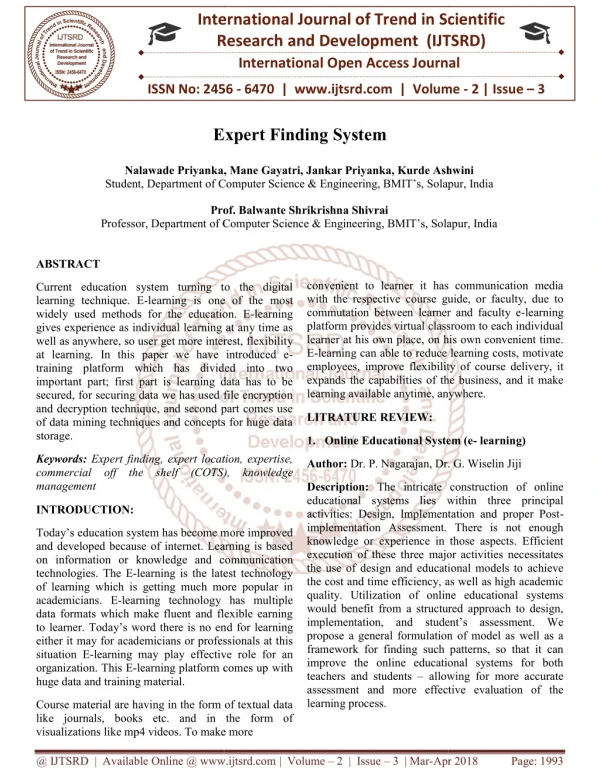
This presentation explores innovative methods to improve expert finding within organizations using hierarchical structures. Authored by Maryam Karimzadehgan and colleagues from Microsoft Research, the study emphasizes challenges in identifying experts and the inefficiencies of traditional approaches such as web searches. By leveraging organizational hierarchies and the relationships among employees, the authors propose an algorithm that effectively predicts expertise based on proximity and peer relationships. Through empirical studies, they demonstrate the utility of this method in large organizations like Microsoft, where extensive data gaps exist.


Enhancing Expert Finding Through Organizational Hierarchies at Microsoft Research
E N D
Presentation Transcript
Enhancing Expert Finding Using Organizational Hierarchies Maryam Karimzadehgan (U. Illinois Urbana-Champaign)*, Ryen White (MSR), Matthew Richardson (MSR)Presented by Ryen WhiteMicrosoft Research * MSR Intern, Summer 08
Motivation for expert finding • Some questions cannot be answered using a Web search engine • Involve tacit / procedural knowledge, internal org topics • Some solutions: • Social connections (ask people, follow referrals) • Time-consuming in large organizations • Post to forum or mail distribution list • May be unanswered, interrupt many, high latency • Find one or more candidate experts and present the question to them • Finding these experts is the challenge of expert finding...
Overview • Task in expert finding is to find people in an organization with expertise on query topic • Profiles typically constructed for each member from sources such as email / shared documents • What if we don’t have a profile for everyone? • Can we use organizational hierarchy to help us find experts without profiles and refine others’ profiles? • Propose and evaluate algorithm that considers org. member and the expertise of his or her neighbors
Organizational hierarchy • Depicts managerial relationships between organizational members • Nodes represent members (people) • Links represent reporting and peer relationships • Peers are members with the same direct manager • Can we use the hierarchy to improve expert finding by sharing expertise around the hierarchy? Reporting relationship Peer relationship
Does proximity shared expertise? • Before we can use neighbors as a proxy for a member’s expertise we must know if their expertise is comparable • People who work in the same group may have similar interests and expertise because: • They work on the same product • Their role is probably similar (dev, test, HR, legal, sales) • Neighbors may be good proxies for those with no profile • But we should check to be sure…
Does proximity shared expertise? • We conducted a study with Microsoft Corporation • MS employs over 150,000 people, inc. temps/vendors • By crawling internal email distribution lists we created profiles for 24% of employees via their sent mail • Demonstrates the challenge (76% had no profile) • Selected random question from internal “idunno” list: Subject: Standard clip art catalog or library Body: Do we have a corporate standard collection of clip art to use in presentations, specs, etc.? • Found candidates, asked them to rate own expertise
Does proximity shared expertise? • Asked for self-evaluation 0/1/2 = couldn’t answer / some knowledge / could answer • Emailed immediate neighbors same self-evaluation • A organizational member’s expertise correlates strongly neighbor expertise (caveat: for this particular question) • Neighbors’ expertise may be a good proxy for missing profiles or useful to refine existing profiles
Baseline • Language-modeling approach • Build profile based on email associated with person • Compute probability that this model generates query Number of times word w occurs in ej Estimated from all expertise docs, E Text representation of expertise for jth expert Total number of words in ej Dirichlet prior – set empirically
Hierarchy-based algorithm • Baseline only effective if we have email for all members • Since this is unlikely, we propose to use org. hierarchy • All members scored w/ Baseline (many get zero score) • Then, their scores are smoothed with neighbors weights member versus neighbors Initial scores using Baseline Number of neighbors of j
Smoothing Candidate expert • Multi-level • One, two, or three 1 2 3 = member w/ query-relevant profile
Expert profiling • Profiles were constructed for organizational members • Emails sent to internal discussion lists within MS • Stemmed text, only used text they wrote (not question) • “idunno” list was excluded from this crawl • Average number of emails per employee = 29 • Median number of emails per employee = 6 • We have outgoing emails for only approximately 36,000employees (there are ~153,000 employees) • We have information for only 24% of all employees
Expert-rating data • Compare the baseline and hierarchy-based algorithms • Expert rating data used as ground truth • Devise and distribute survey with 20 randomly-selected questions from internal “idunno” discussion list • Examples of questions from the list: Where can I get technical support for MS SQL Server? Who is the MS representative for college recruiting at UT Austin? • Survey was distributed to the 1832 member of the discussion list, 189 respondents rated their expertise as 0/1/2 for each of the 20 questions • 0/1/2 = couldn’t answer / some knowledge / could answer
Methodology • Baseline is sub-part of hierarchy-based algorithm • Allowed us to determine the effect of using hierarchy • Set Dirichlet prior, , to 100 and the hierarchy smoothing parameter, , to 0.9 - both determined empirically via parameter sweeps • Used subjects of 20 selected questions as test queries • Expert rating of 2 = relevant, 0/1 = non-relevant • Generated a ranked list of employees using each alg. • Computed precision-recall and avg. over all queries
Precision-recall • Ranked all employees for each question • Kept only those for whom we had ratings (189 total) • Interpolated-averaged 11-point PR curve
Precision-recall - ranking • Prior findings could be explained by hierarchy-based algorithm returning more employees • We used each algorithm to rank all employees • We kept only those for which we had expert ratings, maintaining their relative rank order. • We did not ignore rated employees that were not retrieved, but we appended them to the end of the result list in random order • Computed precision-recall curves for each algorithm, where each point was averaged across 100 runs
Precision-recall - ranking • Interpolated precision at zero for all alg. is approx. 0.58 • Hierarchy-based algorithm also better at ranking
Further opportunities • We investigated propagating keywords around the hierarchy rather than scores • Keyword performance was significantly worse • Perhaps because of low keyword quality or a shortage of information about each employee (only a few emails each) • Weighting edges between organizational members based on their relationship • Peer-to-peer manager-to-subordinate • Experiment with other sources • Whitepapers, websites, communication patterns
Summary • Expertise representation: • Use org. hierarchy to address data sparseness challenge when we lack information for all org. members • Expertise modeling: • Hierarchy-based algorithm to share expertise info. • Evaluation: • Org. hierarchy and human-evaluated data from Microsoft • Outcome: • Org. hierarchy improves expert finding – useful on its own or perhaps as a feature in machine learning (future work)