Download
1 / 21
210 likes | 339 Vues
There is a substantial body of evidence supporting the hypothesis that human activities contribute to climate change, evidenced by direct observations and computer simulations. The international consensus among climate scientists highlights key indicators such as rising temperatures, increasing greenhouse gas levels, melting glaciers, and rising sea levels. Arctic sea ice plays a critical role in moderating global climate, reflecting sunlight and maintaining polar coolness. This collection of evidence underpins the urgency of addressing climate change and understanding its potential impact on global weather patterns and ecosystems.

E N D
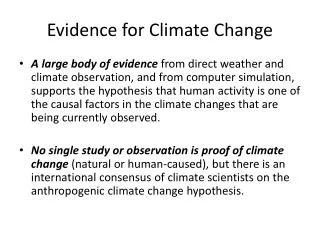
Evidence for Climate Change • A large body of evidence from direct weather and climate observation, and from computer simulation, supports the hypothesis that human activity is one of the causal factors in the climate changes that are being currently observed. • No single study or observation is proof of climate change (natural or human-caused), but there is an international consensus of climate scientists on the anthropogenic climate change hypothesis.
Evidence for Climate change • Rising Temperatures • Carbon dioxide (and other GHGs) level increases from direct measurement and glacier ice cores • Melting Glaciers, Ice sheets and Sea ice • Rising Sea Level • Changes in Severe weather • Changes in Precipitation Patterns • Tree ring evidence (compared to known climate records)
Rising Temperatures • Earth’s average temperature has generally increased from 1880-2006.
Melting Glaciers • Over the last few decades, the average size of glaciers all over the world have decreased. • Melting could cause serious water shortages.
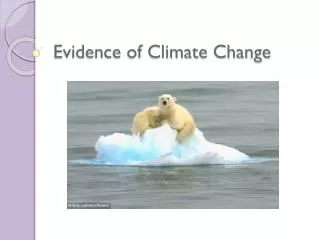
Why is Arctic sea ice important? • Arctic sea ice keeps the polar regions cool and helps moderate global climate. Sea ice has a bright surface; 80 percent of the sunlight that strikes it is reflected back into space.
http://svs.gsfc.nasa.gov/vis/a000000/a003800/a003802/SSMIgraph2010labeled.m4vhttp://svs.gsfc.nasa.gov/vis/a000000/a003800/a003802/SSMIgraph2010labeled.m4v
Tour of the cryosphere video • http://svs.gsfc.nasa.gov/vis/a000000/a003600/a003619/
http://svs.gsfc.nasa.gov/vis/a000000/a003800/a003802/SSMIgraph2010labeled.m4vhttp://svs.gsfc.nasa.gov/vis/a000000/a003800/a003802/SSMIgraph2010labeled.m4v • http://www.teachersdomain.org/resource/ess05.sci.ess.earthsys.esglaciers/
Larsen ice shelf collapse In 2002, a 3,250-square-kilometer (1,255-square-mile) section of the Larsen Ice Shelf rapidly collapsed http://earthobservatory.nasa.gov/IOTD/view.php?id=2288
Rising Sea Level • Global sea level has risen significantly over the past 120 years. • Even small increases can result in devastating floods. • Glacier and sea ice melt can cause sea levels to rise. • May explain why sea level rise is accelerating. • Thermal expansion is also an issue (warm water takes up more volume than cold water)
Albedo effect • http://svs.gsfc.nasa.gov/vis/a010000/a010000/a010020/albeldoCU.mpg
If the ice melts interactive • http://www.teachersdomain.org/resource/ess05.sci.ess.watcyc.icemelt/
Studying Climate Change • Ice Cores • Ice in polar regions contain trapped air bubbles. • Bubbles can be analyzed for various GHG • Ratios of heavy to light oxygen content can determine temperatures. • Dust layers in ice can also give information on precipitation and volcanic eruptions.
Ice cores • http://www.youtube.com/watch?v=RaENQj77iPA&feature=related
Tree Rings Tree Rings • Warm years produce thick rings and cold years produce thin rings. • Scientists assemble clues from living and dead trees to collect records of climate going back 10,000 years.