The Water Cycle
Explore the water cycle, a constant process of recycling water between the Earth's surface and its atmosphere. This guide explains the four main steps: evaporation, condensation, precipitation, and collection. Dive into practical questions like "Why does it rain?" and "Why does a puddle disappear?" Learn about the movement of water through examples found in Ohio, such as the Ohio River and Little Miami River. Engage in activities to reinforce your understanding and apply your knowledge through group challenges centered on each water cycle step.

The Water Cycle
E N D
Presentation Transcript
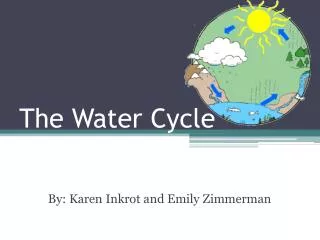
The Water Cycle By: Karen Inkrot and Emily Zimmerman
Think About This! • Why does it rain? • Why does a puddle disappear? • Why does your cold drink sometimes appear to sweat?
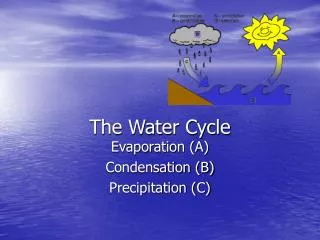
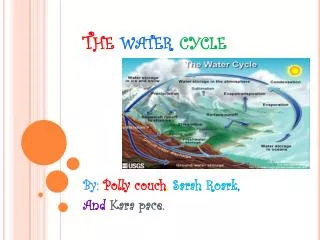
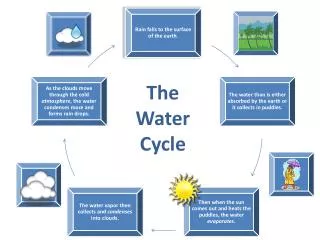
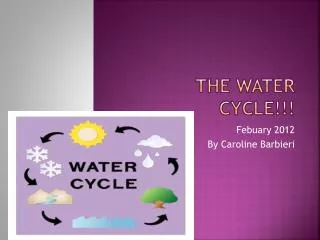
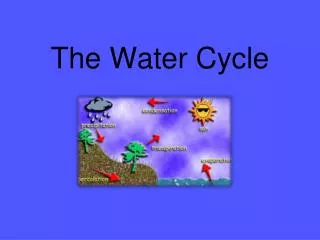
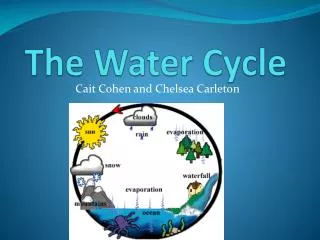
What is the Water Cycle? • Constant process of recycling water • Movement of water between the earth’s surface and atmosphere • Steps 1. evaporation 2. condensation 3. precipitation 4. collection • Examples of water cycle in Ohio? • Ohio River, Little Miami River, Maumee River
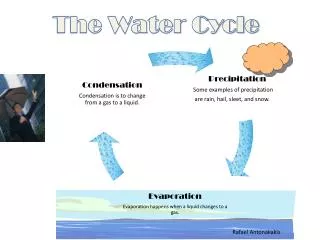
Step One: Evaporation • Definition • Changing of liquid to gas • Process • What? • Water from: plants, rivers, streams, puddles, lakes, oceans, surfaces • How? • Water takes in heat energy from the sun and changes into a gas • Water vapor leaves and goes into the air
Step Two: Condensation • Definition • Changing of a gas to liquid • Process • What? • Water vapor • How? • Water vapor in the air cools • Water vapor changes back to liquid in the form of tiny water droplets • Water droplets then make clouds
Step Three: Precipitation • Definition • Water that falls to the earth from the atmosphere • Process • What? • Rain, snow, hail, sleet • How? • So much water has condensed—the air cannot hold anymore • Clouds become heavy and water falls back to the earth as rain, snow, sleet, or hail • Very cold air causes snow, sleet, or hail
Step Four: Collection • Definition • Water that collects/soaks into the ground or other water sources • Process • When? • Water falls to earth as precipitation • Where does it go? • Oceans, lakes, rivers OR • Land as groundwater
Apply What You Have Learned • Activities • EVAPORATION • CONDENSATION, PRECIPITATION, COLLECTION
What Have You Learned? • Get into groups of 2-3 • CHALLENGE: • Think of a way to act out each step of the water cycle. *Each group will present their skit* • Write down an example of the water cycle that occurs in your house, and explain each step and how it relates.
References Bernstein, Leonard, et al. Concepts and Challenges in Earth Science. Upper Saddle River, NJ: Globe Fearon, 1998. 184-85. The Water Cycle. 2009. DLTK. 13 Apr. 2009 <http://www.kidzone.ws/water/.>