Download
1 / 5
50 likes | 152 Vues
Humans belong to the mammal category, characterized by the ability to produce milk for their young. With internal fertilization and development, the embryo relies on a placenta and umbilical cord for nutrients during gestation, which lasts approximately nine months. Human development is a continuous process that occurs throughout life, with significant changes during the early years and puberty. Puberty marks the onset of sexual maturity, driven by hormones regulating fertility and secondary sex characteristics, influencing growth and aging over time.

E N D
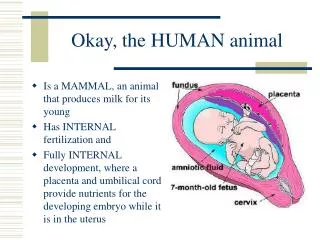
Okay, the HUMAN animal • Is a MAMMAL, an animal that produces milk for its young • Has INTERNAL fertilization and • Fully INTERNAL development, where a placenta and umbilical cord provide nutrients for the developing embryo while it is in the uterus
After 9 months- • -of internal development, called GESTATION, the placenta is not efficient enough for the embryo’s needs, so he or she has gotta get outta there!
Development • Continues throughout the human’s lifetime, most dramatically during the first few years • Growth continues until adulthood • Aging occurs from birth till death
PUBERTY • Puberty is the time when humans begin to get sexually mature • It generally occurs in the early teens when females’ eggs start to mature and males begin producing sperm
HORMONES • Control onset of puberty, • Control production of sperm or egg • Are responsible for secondary sex characteristics • Control growth, development, aging