Download
1 / 9
90 likes | 214 Vues
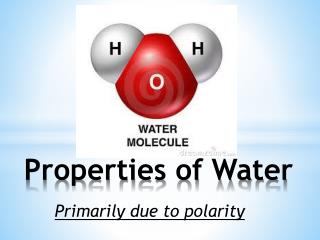
Water is a polar molecule with electrically charged areas, showcasing unique properties like cohesion, adhesion, surface tension, capillary action, solution formation, and suspension characteristics. Explore how water, as a universal solvent, interacts with different substances, creating various phenomena in the natural world.

E N D
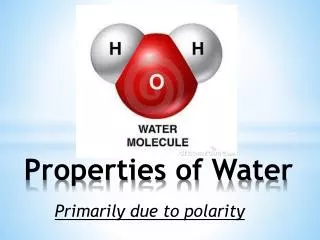
Polar Molecule • A molecule that has electrically charged areas • Water is polar • Oil is not • Polar and non polar molecules will not mix H+ H+ O-
COHESION • An attraction between substances of the same kind • This is how droplets form • Penny station
ADHESION • An attraction between different substances • examples: • Water on the glass slide, wax paper • Water sticking to you when you get out of the shower • Dew drops on a leaf
Surface Tension • The tension of the surface of a liquid • EXAMPLES: • Water skeeters on a pond
Capillary Action • The tendency of a liquid to move through a narrow tube • Examples • Celery and food coloring • Trees get water to their leaves • Blood flowing through veins
Solution • A mixture in which one or more substance is evenly distributed in another substance • Example: • Kool-Aid I’m a solution. OH, YEAAH!
SUSPENSION • A mixture that contains particles that settle out if left undisturbed • EXAMPLE: • Salad dressing • Dirt • Rivers and streams (Run off)
Universal Solvent • Able to dissolve most substances • EXAMPLE: • Well plate with water and alcohol • Likes dissolves likes • Most things will dissolve in water • Pollution