Download
1 / 7
80 likes | 218 Vues
Water exhibits remarkable properties due to its molecular structure. Its polarity results in molecules with a positive (hydrogen) and negative (oxygen) side, enabling hydrogen bonding. Cohesion refers to the attraction between water molecules, leading to phenomena like raindrop shapes and surface tension, allowing insects like water striders to walk on water. Adhesion allows water to stick to surfaces, evident in graduated cylinders. Capillarity combines adhesion and cohesion, facilitating water movement from roots to leaves in plants.

E N D
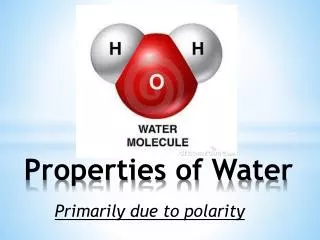
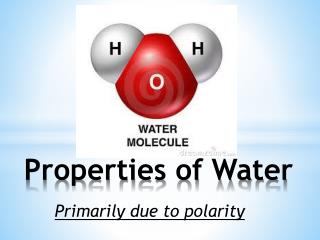
1. Polarity - Polar molecules have a positive (+) and a negative (-) side. In water, the Hydrogen is positive and the Oxygen is negative.
2. Cohesion - The positive hydrogens are attracted to the negative oxygen of a neighboring water molecule. The molecules are held together by these Hydrogen bonds.
Examples of Cohesion: • The shape of raindrops • Water beading up on a newly polished car • The convex surface of water when a container is filled to nearly overflowing • Surface tension – an organism can walk on water if it doesn’t break the hydrogen bonds holding the water molecules together. (water strider, basilisk)
3. Adhesion - Because water molecules are polar they stick to other substances. Ex:water sticks to the side of the graduated cylinder forming a meniscus
4. Capillarity - Water moves up narrow tubes by a combination of adhesion and cohesion. This is how water gets from the roots to the leaves.