
Diffusion Rates of Gases X and Y: Comparing Effusion Speeds
This problem explores the effusion rates of two gases, Gas X and Gas Y, with molar masses of 72 g/mol and 2 g/mol, respectively. At the same temperature, the question is how much faster Gas Y diffuses from a small opening compared to Gas X. Utilizing Graham's Law of Effusion, students are guided through the reasoning, justification, and mathematical calculations needed to solve the problem. The learning target focuses on understanding gas behavior and diffusion concepts. Detailed steps, vocabulary, and logic will be crucial in reaching a conclusion.

Diffusion Rates of Gases X and Y: Comparing Effusion Speeds
E N D
Presentation Transcript
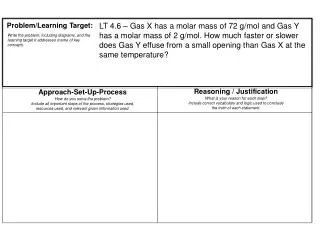
Problem/Learning Target: LT 4.6 – Gas X has a molar mass of 72 g/mol and Gas Y has a molar mass of 2 g/mol. How much faster or slower does Gas Y effuse from a small opening than Gas X at the same temperature? Write the problem, including diagrams, and the learning target it addresses (name of key concept). Reasoning / Justification Approach-Set-Up-Process What is your reason for each step? Include correct vocabulary and logic used to conclude the truth of each statement. How do you solve the problem? Include all important steps of the process, strategies used, resources used, and relevant given information used.
Problem/Learning Target: LT 4.7 – Calculate the pressure of 2 moles of real gas that has a volume of 50.2 L at a temperature of 25 oC. This gas has a value of a that is 6.29 L2/mol2 and a value of b that is 0.0562 L/mol Write the problem, including diagrams, and the learning target it addresses (name of key concept). Reasoning / Justification Approach-Set-Up-Process What is your reason for each step? Include correct vocabulary and logic used to conclude the truth of each statement. How do you solve the problem? Include all important steps of the process, strategies used, resources used, and relevant given information used.