Exploring Diction and Connotation in Narratives
This lesson focuses on analyzing diction for connotation within texts. Students will explore how narrators function by examining their language choices. Through independent reading and responses, learners will consider the main character's use of language, whether it's slang or standard English, and justify the author's choices. Activities include rewriting sentences for parallel structure, defining key terms (odd, strange, peculiar), and listing words with varied meanings. The session culminates with cultural connotations in contemporary language.

Exploring Diction and Connotation in Narratives
E N D
Presentation Transcript
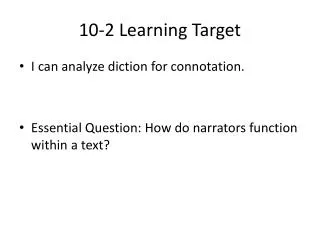
10-2 Learning Target • I can analyze diction for connotation. • Essential Question: How do narrators function within a text?
DOL • Rewrite the following sentences into one sentence that uses parallel structure. • The horse and rider approached the low wall. • The horse began its leap. • It caught its left foreleg on the wall.
Independent Reading • As you read, think about the kind of the language that the main character uses. • Reader Response: What kind of language does your main character use? Slang? Standard English? Give an example from the book and explain why you think the author made this choice.
Mini-Lesson • Which would you rather be called? Write it down in your folder and explain why you chose that word. • Odd • Strange • Peculiar
Definitions • Odd • Strange • Peculiar • What’s the big difference?
Write these down in your folder! • Denotation: the dictionary definition of a word; literal meaning • Connotation: your personal definition or a cultural definition; these are usually different from the denotations of words • Diction: word choice
Read Aloud • “The Color Purple” p. 13 • “Speak” p. 17
Work Period—2nd and 4th • In your folder, make a list of 10 words—find a mixture of denotative meanings and connotative meanings. • For each word, tell what the narrator means by the word and whether it is denotative or connotative.
Work Period • Read “Heathering” on p. 22. • As you read, complete the diction worksheet. Why did the author choose these wordings?
Closing Response • Write three words that our culture uses connotatively—we aren’t just using the denotative meaning. List the words and what the connotative meanings are. • EX: Neck—tricked you (no, you cannot use this as one of your examples)