Download
1 / 26
260 likes | 392 Vues
Dive into the fundamental concepts of light, the Bohr model, quantum models, and electron configurations. This review covers the essential principles, including the nature of light as energy, waves, and particles, as well as key vocabulary like orbitals and energy levels. Engage with questions about the behavior of electrons, energy release in atoms, and the elements in the periodic table. Test your knowledge with interactive scoring and wagering options to deepen your understanding of atomic and quantum mechanics.

E N D
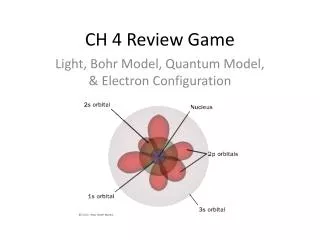
CH 4 Review Game Light, Bohr Model, Quantum Model, & Electron Configuration
tooth brush : teeth :: comb : • nails • hair • ears • eyes Response Grid
Which of these does not describe light? • It is energy. • It is a wave. • It is a particle. • It is electromagnetic radiation. • None of the above Response Grid
As wavelength decreases, frequency _________. • Decreases • Increases • Stays the same • Cannot be determined Response Grid
As frequency decreases, energy __________. • Decreases • Increases • Stays the same • Cannot be determined Response Grid
The photoelectric effect gave evidence for the _________. • Photon • Electron • Orbital • X-ray Response Grid
What percentage of your current points would you like to wager on the next question? • 0% 25% 50% 75% 100% Response Grid
In which period is this element – [Kr]5s24d10 ? • 1 • 2 • 3 • 4 • 5 • 10 Response Grid
How many orientations does an ‘f’ orbital have? • 1 • 3 • 5 • 7 • 14 Response Grid
How many electrons can the 3rd energy level hold? • 2 • 6 • 8 • 10 • 18 • 32 Response Grid
What orbitals does the 4th energy level hold? • S • P • D • F • S & P • S, P, & D • S, P, D, & F Response Grid
What percentage of your current points would you like to wager on the next question? • 0% 25% 50% 75% 100% Response Grid
To what group does this element belong – [He]2s22p6 ? • 2 • 6 • 8 • 18 • None of the above Response Grid
Elements in Group 14 have _____ valence electrons. • 2 • 4 • 6 • 8 • 10 • 14 Response Grid
A ‘p’ orbital is shaped like a ______. • Sphere • Cylinder • Cube • Dumbbell Response Grid
Electrons follow fixed paths in the atom. • True • False • Depends on the element Response Grid
What percentage of your current points would you like to wager on the next question? • 0% 25% 50% 75% 100% Response Grid
Bohr’s model explained ________. • Hydrogen’s line emission spectrum • Standing waves • Electron diffraction • Orbital shapes Response Grid
Who said electrons can act as waves? • Bohr • Schrodinger • De Broglie • Heisenberg • Aufbau • Pauli • Hund Response Grid
What percentage of your current points would you like to wager on the next question? • 0% 25% 50% 75% 100% Response Grid
An e- falls down a level and releases 4.4 x 10⁻¹⁹ J of energy. What color is seen? • Red • Orange • Yellow • Green • Blue • Violet Response Grid