Projectile Motion
This overview explores the principles of projectile motion, particularly focusing on objects kicked off a cliff and those projected from the ground. It delves into horizontal and vertical motion, detailing the key variables like velocity, acceleration, and displacement in both X and Y directions. Examples such as footballs and bullets illustrate real-world applications. The section emphasizes the importance of resolving initial velocities into their components to analyze projectiles launched at angles. With foundational concepts clarified, learners are equipped to tackle related problems effectively.

Projectile Motion
E N D
Presentation Transcript
Projectile Motion From the ground From a cliff
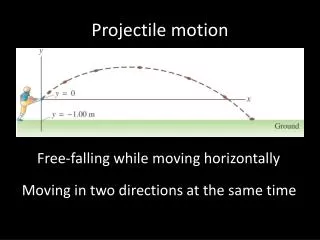
Kicked off a cliff • Review: • Objects Kicked off a cliff have: X-dirY-dir v= const. vi=0 m/s a= 0 m/s2 a = -9.8 m/s Δx= positive Δy= negative vf= negative
Kicked off a cliff • This is a combination of basic Horizontal Motion & Vertical Motion
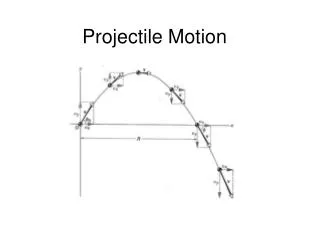
Projectile Motion- Level Ground • Examples: Footballs, golf balls, bullets, catapults. There is no displacement in the Δy direction between the beginning “sea level” and the ending “sea level”
Projectile Motion- Level Ground • This is a combination of Vertical Motion & Horizontal Motion
Projectile Motion- Level Ground • What do we know about: X-directionY-direction
Projectile Motion- Level Ground • What do we know about: X-directionY-direction Δxright= + Δy= 0 v=constant vi= + a= 0m/s2vf = - a= -9.8m/s2
Projectile Motion- Level Ground • Attacking the problem: Initial velocities will be given in vectors: 25 m/s @ an angle of 30˚. 30˚
Projectile Motion- Level Ground • Resolve the vector into components to determine Initial Velocity in the X and Y directions. 25 m/s 30˚
Projectile Motion- Level Ground • Resolve the vector into components to determine Initial Velocity in the X and Y directions. X-dirY-dir 25 m/s vy 30˚ vx
Projectile Motion- Level Ground • What do we know about: X-directionY-direction Δxright= +vxΔy= 0 v=constant vi= +vy a= 0m/s2vf = -vy a= -9.8m/s2 Now you are ready to solve the problem…