Exploring Value: Economic, Socio-Cultural, and Ecological Metrics in Resource Valuation
This text discusses the complex interplay between various forms of value—economic, socio-cultural, ecological, biological, and biophysical. It questions the feasibility of dollar valuation for ecosystem services lacking established metrics and examines the steps for valuation, including the identification of expected changes and their relative importance. The authors argue against the traditional neoclassical economic approach, highlighting its inadequacy for addressing the intrinsic value of ecological processes, while emphasizing the necessity of rethinking resource allocation and biosphere preservation.

Exploring Value: Economic, Socio-Cultural, and Ecological Metrics in Resource Valuation
E N D
Presentation Transcript
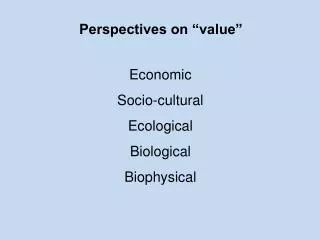
Perspectives on “value” Economic Socio-cultural Ecological Biological Biophysical
Are there metrics that can be used to reflect importance? How feasible and appropriate is dollar valuation? How do you address ecosystem services for which metrics don’t exist?
Valuation steps Identifying expected changes in the quantity or quality; 2. Weighing the relative importance of that change.
“We are not suggesting that humans are unimportant, [only] that neoclassical economics (and its reliance on human utility values) has no place in policy debates surrounding resource allocation and preservation of the biosphere.” From: Brown, M.T. and S. Ulgiati. 1999. Emergy evaluation of the biosphere and natural capital. Ambio 28(6).
“No amount of tinkering with the present economic paradigm can alter the logic trap of willingness-to-pay.” Human preferences cannot value ecological processes or environmental resources since these are outside the so called economic sphere.” From: Brown, M.T. and S. Ulgiati. 1999. Emergy evaluation of the biosphere and natural capital. Ambio 28(6).
“Welcome to Earth, home of the great women and men. We are animals that have ideas. Maybe cats and ravens have ideas too, but they keep them to themselves.” From: Hitchcock, R. 2004. Welcome to earth. From the album: Television. Yep Roc Records, Hillsborough, NC.