Download
1 / 16
160 likes | 277 Vues
This presentation by Dmitry Belyavsky at the TCI ENOG 6/RIPE NCC meeting in Kiev (October 2013) delves into public key infrastructure (PKI), emphasizing its role in digital security. It covers essential components of PKI, minor incidents like the DigiNotar case, and significant threats such as NSA interference. The talk includes practical advice for end-users to enhance their security and an overview of certificate transparency, certificate pinning, and the importance of managing human factors in security.

E N D
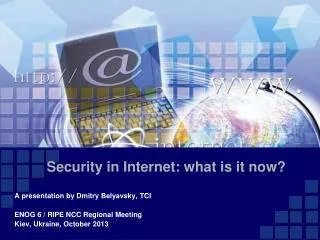
Security in Internet: what is it now? A presentation by Dmitry Belyavsky, TCI ENOG 6 / RIPE NCC Regional Meeting Kiev, Ukraine, October 2013
About PKI *) *)PKI (public-key infrastructure) is a set of hardware, software, people, policies, and procedures needed to create, manage, distribute, use, store, and revoke digital certificates
More about “DigiNotar case” OCSP requests for the fake *.google.com certificate Source: FOX-IT, Interim Report, http://cryptome.org/0005/diginotar-insec.pdf
NSA interference in security • 2013 Source:http://xkcd.com/538/
RSA key exchange Private key Public key So it can be decrypted when the attacker gets the server private key Premaster secret in encrypted on server public key and sent to server
Perfect Forward Secrecy ALICE + = + = Common Paint Secret Colours Secret Colours Common Secret Public Transport = + + = BOB SSL Best Practices https://www.ssllabs.com/projects/best-practices/
If you are an end-user… • Five pieces of advice: • Hide in the network • Encrypt your communications • Assume that while your computer can be compromised, it would take work and risk on the part of the NSA – so it probably isn't • Be suspicious of commercial encryption software, especially from large vendors • Try to use public-domain encryption that has to be compatible with other implementations Bruce Schneier: “I understand that most of this is impossible for the typical internet user”
PKI: extra trust DANE (RFC 6698) Limited browsers support Certificate pinning: Mozilla Certificate Patrol, Chrome cache for Google certificates Certificate transparency (RFC 6962)
Certificate Transparency: how it works & Two other options Source: http://www.certificate-transparency.org
Certificate Transparency Deployment Inspired by Google (Support in Chrome announced) One of the authors - Ben Laurie (OpenSSL Founder) CA support – Comodo
Summary For today the cryptographic mechanism https is not a guarantee of safety The weakest element in the system of safety provision is HUMAN FACTOR!
Q&A • Questions? • Drop ‘em at: • beldmit@tcinet.ru