Finding Balance in Career and Life: Insights from a Prof
Learn how Dr. Chandra Krintz juggles advising, research, teaching, outreach, and managing stress in academia. Explore tips on managing goals, insecurities, and time effectively.

Finding Balance in Career and Life: Insights from a Prof
E N D
Presentation Transcript
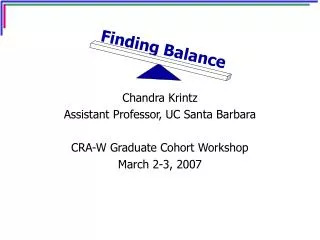
Having a Career and a Life Finding Balance Kristin Yvonne Rozier NASA Langley Research Center & Rice Univ. Chandra Krintz Associate Professor, Univ. of California Santa Barbara CRA-W Cohort Workshop March 13-14, 2008 Thanks to Kathleen Fisher for helping to improve these slides
A bit about Chandra… / outreach
Some of the things I do • Advise a group of 5-10 BS, MS, and PhD students • Research: Full system performance adaptation • Teach 1 course per quarter (3 courses per year) • Write many, many grant proposals • Committees in department • Lead on CS undergraduate curriculum revamp • Committees in community (conferences) • SIGPLAN Executive Committee Vice Chair! • Outreach, mentoring (CRA-W Cohort!) High-End Systems Low-End Systems
Some of the things I do • Outreach to Girls Inc. (thanks to tenure!!) • Teaching 6-10 year olds how to program using a game controller • Microsoft Research Boku (XBox game that runs on a PC) • And helping non-profits in my community w/ computers • Getting students involved -- feel good about themselves and gain perspective on what their degree (in CS or CE) means
Stress Similarities: Grad Students • Different each year • Y1: getting comfortable, class/tests, TAing • Topic search, advisor search • Y2-4: In the thick of it • Y5+: last mile • Paper deadlines • Identifying letter writers • Writing the thesis • Applying for jobs • Finding an advisor • Comprehensive exams • Paper deadlines • Encountering rejection • Going to conferences • Internships • Finding a thesis topic • Figuring out what comes next
Stress Similarities - Post-PhD, Academic • Different each year • Y1: getting comfortable, teaching real classes • Y2-3: attracting students, seeking funding • Every year • Paper/proposal deadlines + acceptances/rejections • Departmental and research community service • Identifying viable research projects • Attracting / working with students • Travel • Improving teaching quality • Multi-tasking / effective context switching • Y5: last mile before tenure • Identifying letter writers, giving talks
Stress Similarities - Post-PhD, Research Lab • Different each year • Y1: getting comfortable, finding a research project • Y2-3: figuring out how to do good research and positively impact the sponsoring company • Every year • Paper deadlines + acceptances/rejections • Organizational and research community service • Identifying viable new research projects • Attracting / working with students and colleagues • Travel • Y3+: advancing in company/lab • Coping with company downturns: layoffs, equipment shortages, lack of travel funds, etc.
Observations • Demands come in waves • Too many at once cause stress • Size and number matters • Many of us are very goal-oriented • We all have insecurities • We humans cannot maintain an insane pace continuously (time management) • Not sustainable • Leads to burnout / poor productivity • Will wear you out • There is always moreto do • Family obligations and relationships
Managing Waves of Demands • A continuous, incremental process • You must work at it; there is no free lunch! • Make changes incrementally • Riding the waves • Prioritize demands • Work hard during high-demand periods • Take a break, re-energize during low-demand • Recognize/work on the transition between the two
Managing Goals and Expectations • Set by yourself or others • Note when they are self-inflicted! • Understand completely what is required given a goal • Know why you want to achieve it • Evaluate your progress • Talk about it with your mentor(s) and others • Learn how to enjoy the process • Focus on the present • Appreciate your achievements before moving on • Work to ensure that goals are achievable
Managing Insecurities • Being insecure contributes to being out of balance • Seek out a good mentor (may/may not be your advisor) • Don't set yourself up to fail • Be proud of and celebrate your accomplishments • Don’t belittle achievements -- just because it was you who achieved them • Keep a “good file” of positive feedback • Realize that we all (you, me, him, her, us, them) have insecurities • Think them through, talk them over with those you trust
Chandra’s Insecurities • I am an imposter! • How did I get here? I know nothing. I’ll never have another research idea. • Manifestation: OK, just work more/harder... • I care deeply about what others think of me • I have panic attacks before entering areas where lots of people are (for fear I’m going to mess up in some way) • I take things very personally • Rejection, not being included, the success of others • Manifestation: OK, just work more/harder...
Time ManagementDid you see Janie's session yesterday? • There's always more to do • Learn how to estimate accurately the time required • Don't take on too much or feel pressured to say yes • Worse to take on something and only contribute minimally or do an average/poor/late job at it than to say no • Renegotiate unmanageable commitments • Be honest with those you are working with • Identify a solution that works for all • Taking on a new task can be an opportunity to let go of an old one. • Work with people who are good at getting things done. • Identify your guiding principles
Chandra’s Guiding Principles • Time for Rich and Zoe, larger family (sister, brother) • Do great research and share it with others • Through publication and communication • Through service in my community • For the support ($$), success, and options for my students • Work on interesting and high impact research problems • Programming language implementations • Make a difference in students’ lives • At any level, age • Let them know that what they are doing (working on their education) is exceptional • Teaching/Curriculum • Have time to be healthy
Be Organized • Keep a calendar that you always have with you • Electronic (back it up) or paper • Keep it up to date • Meetings as well as work things (email, paper reading, writing, coding, seminars, etc) • Schedule in both work and play • Block out time for only research • Know when you work efficiently: Don’t squander that time! • Avoid churn: pick a task and do it. • When “on a roll”, keep the momentum. Conversely, if something is a grind, don’t push too hard. • Handle email efficiently. • Keep a research/idea book or wiki.
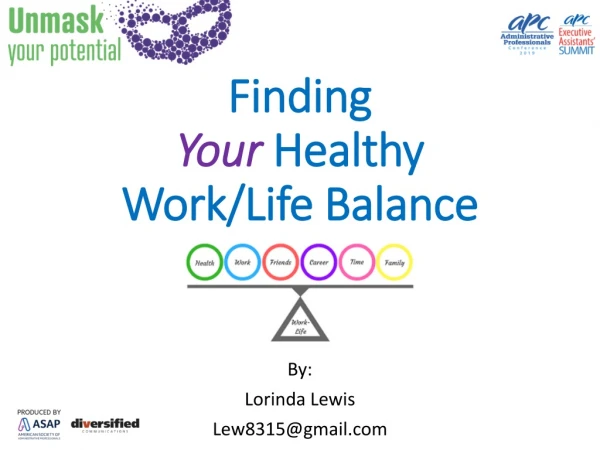
Finding Balance • Most importantly -- take care of you! • Figure out what makes you happy/unhappy • Look up every once in a while to take stock • Apply money to the problem if possible • Exercise! • Eat well • Sleep enough • Identify your optimal number of hours • Help and receive help from others • Don't isolate yourself • Seek out family, friends, others • Have a life as well as work • Set realistic goals to achieving balance
Finding Balance (non-work): Chandra • Sleep (8+hrs, yes, 8) • Exercise • Seeking out colleagues and making time to be social • Just going for coffee or lunch • Outreach to the community • Girls Inc., local high schools, DAWG, soup kitchens • Help with technology (simple things), sharing how fun computer science can be!, walking dogs • Listening to music (from my past) • Driving my car / going on roadtrips • Golf • Zoe
Something I found recently… Cookie Bjorn Cole Bjorn • How to find balance: Work Like A DOG! from Martha Beck's article in Oprah Magazine Mar08
Something I found recently… • How to find balance: Work Like A DOG! from Martha Beck's article in Oprah Magazine Mar08
Ideas for Questions • Balance as a graduate student • Balance and the tenure process or high-tech industry • Dual-career couple • Working at it • Finding jobs that are equally satisfying • Managing relationships • Having children • Deciding on your future and considering balance • Other time management questions